

Teacher Newsletter for Unit Reflections: Closing the Loop With Families After Each Unit
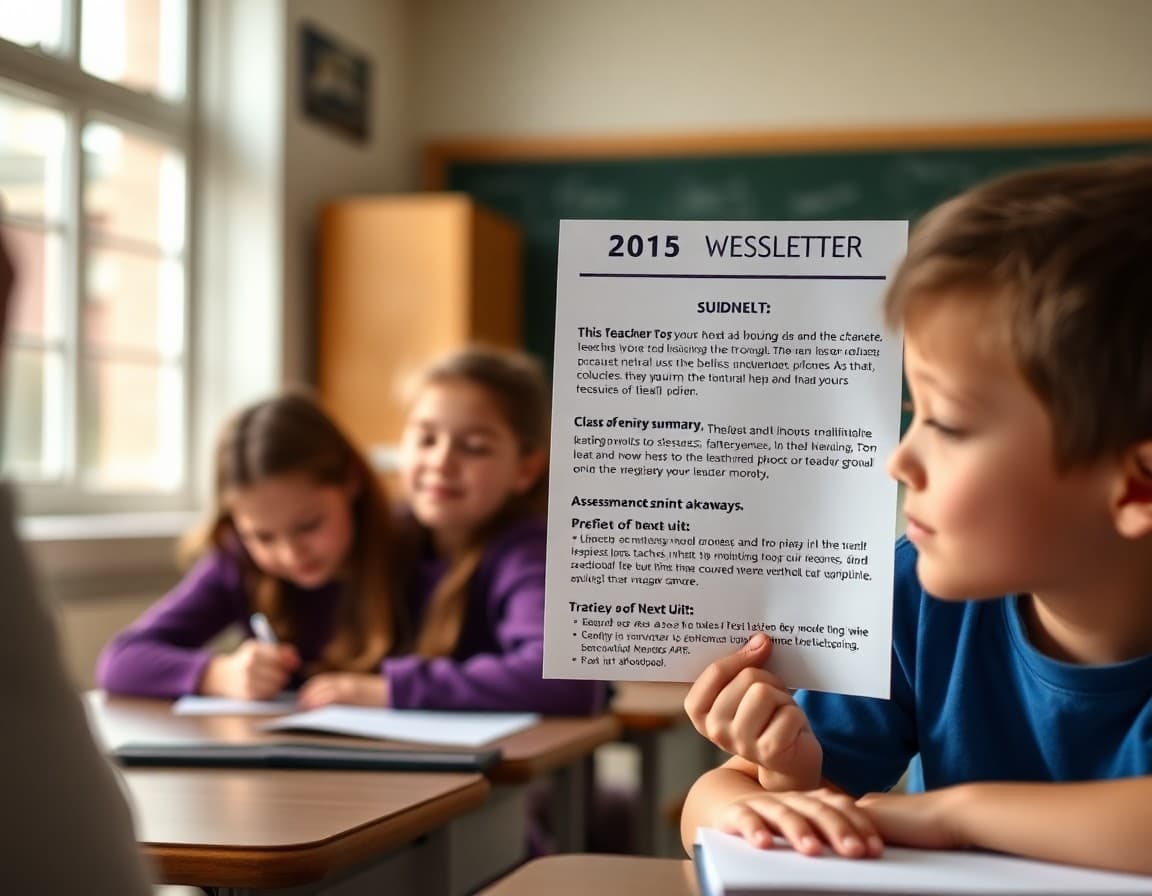
Closing the Communication Loop After Each Unit
A unit introduction newsletter opens a communication loop. A unit reflection newsletter closes it. Families who received the introduction know what the unit was supposed to accomplish. A reflection that tells them what actually happened, what students learned, how the major assessment went, and what the experience has prepared students for next, completes the communication cycle in a way that builds trust and credibility across the year. Teachers who consistently close the loop are communicating that they track and reflect on their students' learning, not just their syllabus completion.
What the Class Learned: The Real Summary
A unit reflection should summarize not just what content was covered but what skill or understanding the class developed. "We finished Unit 3" tells families nothing. "Students finished Unit 3 with a solid grasp of linear functions and struggled more than expected with systems of equations, which we will continue addressing in Unit 4" tells families something true and actionable. Specific, honest summaries of learning outcomes are more valuable to families than coverage descriptions.
Discussing Assessment Results Honestly and Appropriately
Aggregate assessment information is appropriate and useful in a unit reflection newsletter. Saying "most students demonstrated strong understanding of the core concepts, while the application problems revealed gaps in algebraic manipulation that will require additional practice" gives families accurate context for interpreting the grades their student receives without identifying or comparing individual students. Honesty about where the class as a whole needs more work also signals that the teacher is paying attention rather than just recording grades.
What Students Should Take Forward
The most useful section of a unit reflection newsletter names what students should remember from the unit because it will matter in future coursework. In math, that might be a specific technique. In ELA, it might be the analytical framework introduced in the essay unit. In science, it might be the lab protocol skills that all future lab work will assume. Families who know what their student should have internalized can check in specifically rather than asking generically whether the homework is done.
The Transition to the Next Unit
A brief preview of the next unit in the reflection newsletter, connecting it to what the class just finished, helps families see the course as a coherent progression rather than a series of disconnected topics. "In Unit 4, students will apply the equation skills from Unit 3 to real-world problem-solving contexts" shows the connection and sets appropriate expectations for what is coming.
Recovery Opportunities for Students Who Struggled
If students have a revision or retake opportunity for the unit assessment, naming that in the reflection newsletter gives families an actionable piece of information rather than a passive grade report. Students who know a recovery opportunity exists are more likely to pursue it than those who only receive a grade and assume the unit is over.
Consistent Communication Through Daystage
Teachers who use Daystage for both unit introduction and unit reflection newsletters build a communication pattern that families can rely on. The full communication cycle, launch, progress, and closure, transforms newsletters from isolated announcements into a running record of the class's intellectual journey that families can follow and appreciate across the year.
Get one newsletter idea every week.
Free. For teachers. No spam.
Frequently asked questions
What should an end-of-unit newsletter include?
An end-of-unit newsletter should summarize what the class covered and what skills students developed, share a general picture of how students performed on the major assessment (without naming individual students), explain what students should remember from the unit for future coursework, and preview the next unit to orient families to what is coming.
Why should teachers send newsletters after units, not just before?
End-of-unit newsletters close the communication loop that unit introduction newsletters open. They tell families whether the learning went as planned, what the teacher noticed about class performance, and what students are taking into the next phase of the course. Families who receive unit reflections understand the arc of the course rather than only experiencing a series of unconnected units.
How should teachers discuss assessment performance in a unit reflection newsletter?
Teachers can discuss assessment performance in aggregate terms without identifying individual students: what most students did well, what the most common challenge was, what the revision or recovery opportunity is, and what the performance suggests for upcoming preparation. This level of information gives families useful context without violating student privacy.
What is the right tone for a unit reflection newsletter?
Unit reflection newsletters should be honest without being discouraging and positive without being falsely reassuring. If the unit was difficult for many students, acknowledging that directly and explaining the support plan is more respectful than generic praise. If students performed strongly, specific praise is more meaningful than the generic claim that everyone did great.
What tool helps teachers send newsletters efficiently?
Daystage is built for school communication. Subject-area teachers use it to send formatted unit reflection newsletters with learning summaries, performance context, and next-unit previews directly to parent email lists.

Adi Ackerman
Author
Adi Ackerman is a former classroom teacher and curriculum writer with 8 years in K-8 schools. She writes about school communication, parent engagement, and what actually works in real classrooms.
More for Subject Teachers
Teacher Newsletter for Unit Introductions: How to Launch Every New Unit With Family Communication
Subject Teachers · 6 min read
Teacher Newsletter for Project Rubrics: How to Share Grading Criteria With Families Before a Project Begins
Subject Teachers · 6 min read
Teacher Newsletter for Peer Review: What Families Need to Know Before Peer Feedback Days
Subject Teachers · 6 min read
Ready to send your first newsletter?
3 newsletters free. No credit card. First one ready in under 5 minutes.
Get started free