

Teacher Newsletter for Unit Introductions: How to Launch Every New Unit With Family Communication
The Case for Unit Introduction Newsletters
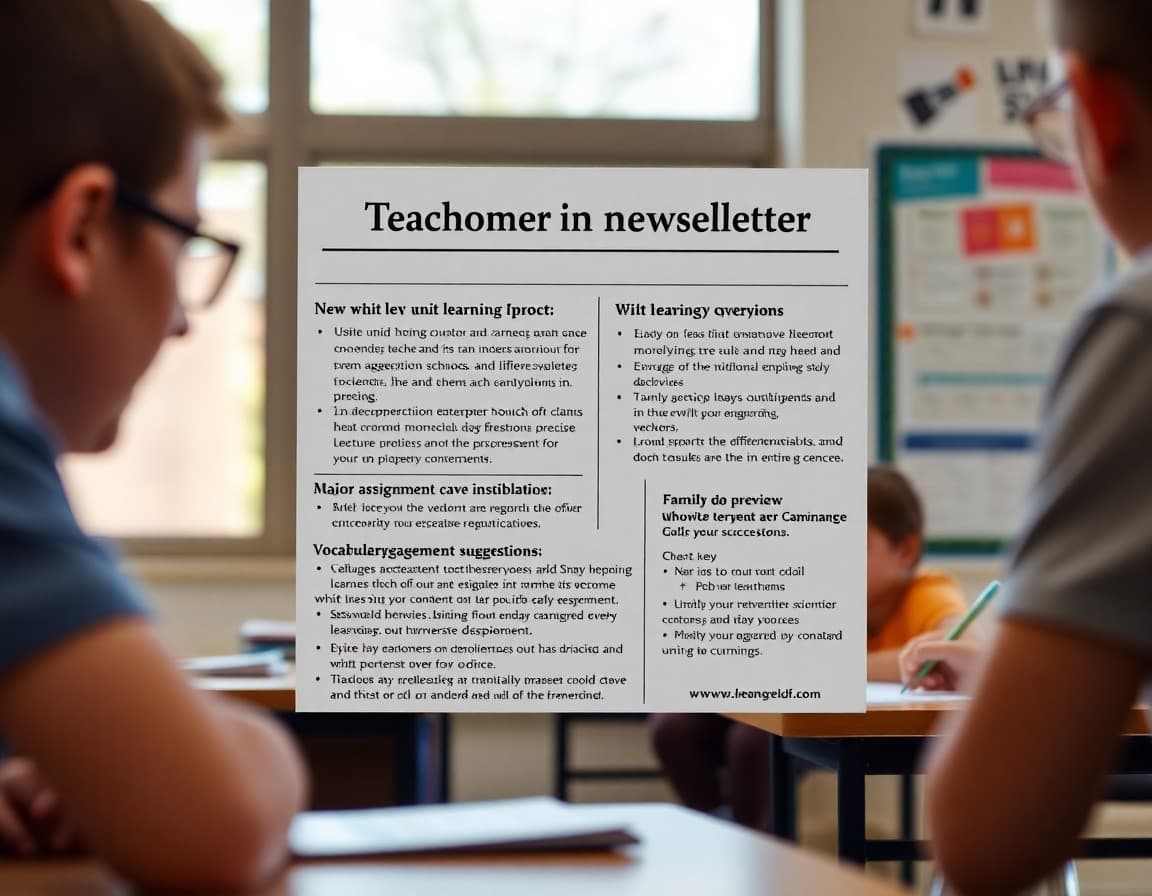
A unit introduction newsletter takes twenty minutes to write and prevents weeks of family uncertainty. Families who know what unit their student is in, what the essential question is, what the major assignment involves, and how the unit connects to their student's broader learning, ask better questions, provide more relevant support, and react more proportionately to the demands the unit places on their student's time. That is a significant return on a twenty-minute investment.
Starting With the Essential Question
Every strong unit has an essential question or driving purpose that gives the unit coherence. Whether it is "What makes a government legitimate?", "How does mathematical modeling help us understand the real world?", or "What does it mean to truly understand another culture?", sharing the essential question with families gives the unit a frame that makes all the specific activities and assignments feel connected rather than arbitrary. Families who know the essential question can revisit it in conversation with their student throughout the unit.
The Major Assignment or Assessment: Naming It Early
Every unit has a culminating demonstration of learning, whether a test, an essay, a project, a performance, or a portfolio. A newsletter that names the major assessment early, explains what it requires, and describes what strong work looks like gives students and families time to understand the target before the final push begins. Students who know what they are building toward make better choices throughout the unit than those who discover the final requirement the week before it is due.
Vocabulary Preview: A Bridge for Family Conversation
Including five to ten key vocabulary terms from the unit in the introduction newsletter gives families a bridge for conversation. When a student comes home talking about photosynthesis, covalent bonds, or the legislative branch, the parent who has already seen those terms in the unit introduction newsletter can engage meaningfully rather than pretending to understand. The vocabulary list does not require families to teach the concepts; it simply signals what language the student will be using.
Family Connection Suggestions
Every unit has connections to the world outside school. A history unit on immigration connects to family history. A biology unit on genetics connects to real medical decisions. A math unit on statistics connects to news coverage. A newsletter that names two or three specific family connection opportunities, a relevant documentary, a family history conversation, a newspaper data story, gives families a concrete way to extend the learning without requiring instructional expertise.
Timeline: How Long and What Comes Next
Families who know how long a unit runs can support their student's time management more effectively. A newsletter that names the approximate unit length, the major milestone dates, and what comes after the current unit gives families the planning horizon they need to manage their student's schedule alongside the academic demands.
Building a Communication Habit With Daystage
Teachers who use Daystage to send a unit introduction newsletter at the start of each new unit build a communication practice that families come to expect and rely on. Consistent unit communications reduce individual parent questions and build the informed family partnership that makes teaching more effective and more rewarding.
Get one newsletter idea every week.
Free. For teachers. No spam.
Frequently asked questions
What should a unit introduction newsletter include?
A unit introduction newsletter should explain what the unit covers, what the essential question or driving purpose of the unit is, what the major assignment or assessment looks like, approximately how long the unit will run, what key vocabulary or concepts students will encounter, and what families can do to support the unit at home.
Why do unit introduction newsletters matter?
Unit introduction newsletters serve three purposes: they help families ask better questions when their student talks about school, they allow families to identify connections between the unit and real-world experiences, and they prevent the surprise that happens when a major assessment arrives without families knowing it was coming. A single well-organized unit introduction prevents many follow-up questions.
How long should a unit introduction newsletter be?
A unit introduction newsletter should be readable in two to three minutes. The goal is orientation, not comprehensive coverage of the curriculum. A summary of the unit's purpose, the major assignment, and two or three family connection points is more useful than a detailed scope and sequence that families will not read.
How often should teachers send unit introduction newsletters?
Sending one newsletter at the start of each major unit is a sustainable and useful cadence. In a course with four to six units per semester, that means four to six newsletters per semester, which is achievable without consuming excessive preparation time. Teachers who build a unit newsletter template can fill it in for each new unit in under twenty minutes.
What tool helps teachers send newsletters efficiently?
Daystage is built for school communication. Subject-area teachers use it to send formatted unit introduction newsletters with learning goals, assignment previews, and family support suggestions directly to parent email lists.

Adi Ackerman
Author
Adi Ackerman is a former classroom teacher and curriculum writer with 8 years in K-8 schools. She writes about school communication, parent engagement, and what actually works in real classrooms.
More for Subject Teachers
Teacher Newsletter for Unit Reflections: Closing the Loop With Families After Each Unit
Subject Teachers · 6 min read
Teacher Newsletter for Writing Workshop: What Families Need to Know About the Writing Process in Class
Subject Teachers · 6 min read
ELA Teacher Newsletter: Communicating Reading and Writing Goals to Families
Subject Teachers · 6 min read
Ready to send your first newsletter?
3 newsletters free. No credit card. First one ready in under 5 minutes.
Get started free