

Teacher Newsletter for Vocabulary Building: How to Communicate Vocabulary Instruction to Families
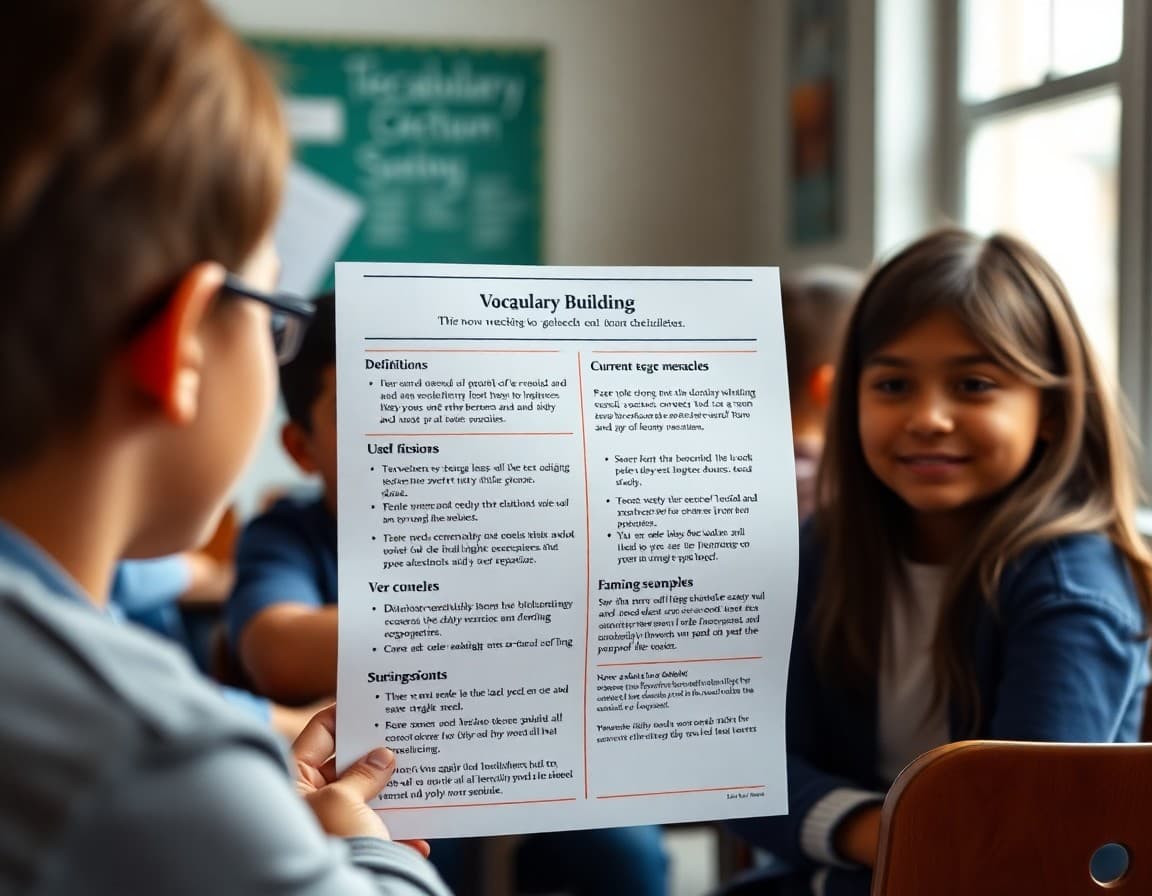
Why Vocabulary Communication Improves Test Scores
Students who study vocabulary at home in addition to in class retain the words more durably than those who only encounter them during instruction. A newsletter that sends the word list home with family study suggestions activates one more repetition cycle than would otherwise happen. Research on vocabulary acquisition consistently shows that multiple meaningful encounters with a word across different contexts produce retention far better than a single instructional pass. A family member who uses the word in dinner conversation is providing exactly that kind of additional encounter.
Words in Context: More Useful Than Definitions
A vocabulary newsletter that lists words alongside their definitions gives families something to use. A newsletter that lists words alongside their definitions and shows each word in a sentence that reflects the unit context gives families something far more useful. The sentence turns an abstract definition into a model of the word in use, which is what students need to produce on assessments that ask them to use words in context rather than match them to definitions.
Organizing Words by Concept Cluster
Subject-area vocabulary is almost never random. Science words cluster around systems, processes, and structures. History words cluster around events, causes, and political concepts. Literature words cluster around elements of craft and theme. A newsletter that groups the words by their natural relationships helps students build a conceptual framework around the vocabulary rather than memorizing a list. Students who understand that several words relate to the same concept can use those words to talk about the concept, which improves both retention and application.
Specific Study Strategies That Work
Families who receive a list and no guidance default to the least effective strategy: reading the list repeatedly. A newsletter that names two or three specific study methods gives families and students something concrete. The Frayer model, where students write the definition, a characteristic, an example, and a non-example for each word, produces deeper learning than flashcards alone. Asking a family member to give a definition and having the student guess the word tests recall rather than just recognition. Practice sentences that use the word in a sentence unrelated to the unit context test transfer.
The Connection Between Vocabulary and Reading Comprehension
Students who know the technical vocabulary of a subject read subject-area texts faster and with greater comprehension than those who must pause at every unfamiliar term. A newsletter that makes this connection explicit helps families understand that vocabulary study is not just about passing a word quiz. It is preparation for being able to read and understand everything else in the unit: the textbook, the articles, the test questions themselves. Families who see vocabulary as reading preparation take the study more seriously than those who see it as a separate assignment.
Assessment Preparation: What Students Will Be Asked to Do
Different vocabulary assessments require different preparation. A matching test rewards recognition. A fill-in-the-blank test rewards recall. A usage-in-context test rewards understanding. A newsletter that describes the assessment format lets families target preparation toward the right skill. Students who know they will be asked to use words in context need to practice usage more than students who will be given a matching test.
Sending Vocabulary Updates Through Daystage
Teachers who use Daystage for vocabulary newsletters send home word lists, study tips, and assessment information in one formatted message that families can reference throughout the study week. Consistent vocabulary communication builds the home practice habits that cumulative vocabulary growth depends on over a full school year.
Get one newsletter idea every week.
Free. For teachers. No spam.
Frequently asked questions
What should a vocabulary building newsletter include?
A vocabulary building newsletter should include the current word list, a brief explanation of why these words are important for the unit, examples of the words used in context, and specific suggestions for how families can help students learn the words at home. Including the assessment date and format gives families practical planning information.
How many vocabulary words should a newsletter include?
A vocabulary newsletter works best when it names all the words students are responsible for learning and groups them in a way that makes the relationships between words visible. If the list is long, organizing words by theme, root, or concept cluster helps families and students see patterns rather than a random list. A newsletter that says "this group of words all describe types of government" helps students learn the words as a network rather than as isolated items.
What is the most effective way for students to study vocabulary at home?
The most effective vocabulary study combines multiple retrieval strategies rather than rereading definitions. Flashcard practice with immediate self-scoring, writing sentences that use the word meaningfully rather than just inserting it, explaining the word to a family member in plain language, and connecting the word to something already known all produce better retention than looking at a definition list. A newsletter that recommends specific study methods gives families concrete guidance.
How can families help with vocabulary without knowing the subject content?
Families can support vocabulary learning by asking students to explain a word in their own words and then use it in a sentence about something from their own life, by posting a few target words somewhere visible in the home during the study week, and by asking quiz questions from a list rather than just asking if the student studied. None of these require subject-matter expertise.
What tool helps teachers send vocabulary newsletters efficiently?
Daystage is built for school communication. Subject-area teachers use it to send formatted vocabulary newsletters with word lists, study tips, and assessment information directly to parent email lists.

Adi Ackerman
Author
Adi Ackerman is a former classroom teacher and curriculum writer with 8 years in K-8 schools. She writes about school communication, parent engagement, and what actually works in real classrooms.
More for Subject Teachers
Teacher Newsletter for Grammar Focus: Communicating Grammar Instruction to Families
Subject Teachers · 6 min read
Teacher Newsletter for Reading Comprehension Strategies: What Families Need to Know
Subject Teachers · 6 min read
Teacher Newsletter for Unit Introductions: How to Launch Every New Unit With Family Communication
Subject Teachers · 6 min read
Ready to send your first newsletter?
3 newsletters free. No credit card. First one ready in under 5 minutes.
Get started free