
Teacher Newsletter for Earth Science Units: Bringing Geoscience Home to Families
Earth Science Is the Study of the World We Actually Live On
While chemistry and physics sometimes feel remote from daily life, earth science is literally underfoot and overhead. The weather each morning is a meteorology lesson. The hill formation visible from the highway is a geology observation. The moon phase at night is an astronomy data point. A newsletter that opens each earth science unit by pointing to the observable evidence of the current topic in the local environment makes the subject feel immediate rather than abstract, which transforms family conversations about school into genuine science observation sessions.
What This Earth Science Unit Covers
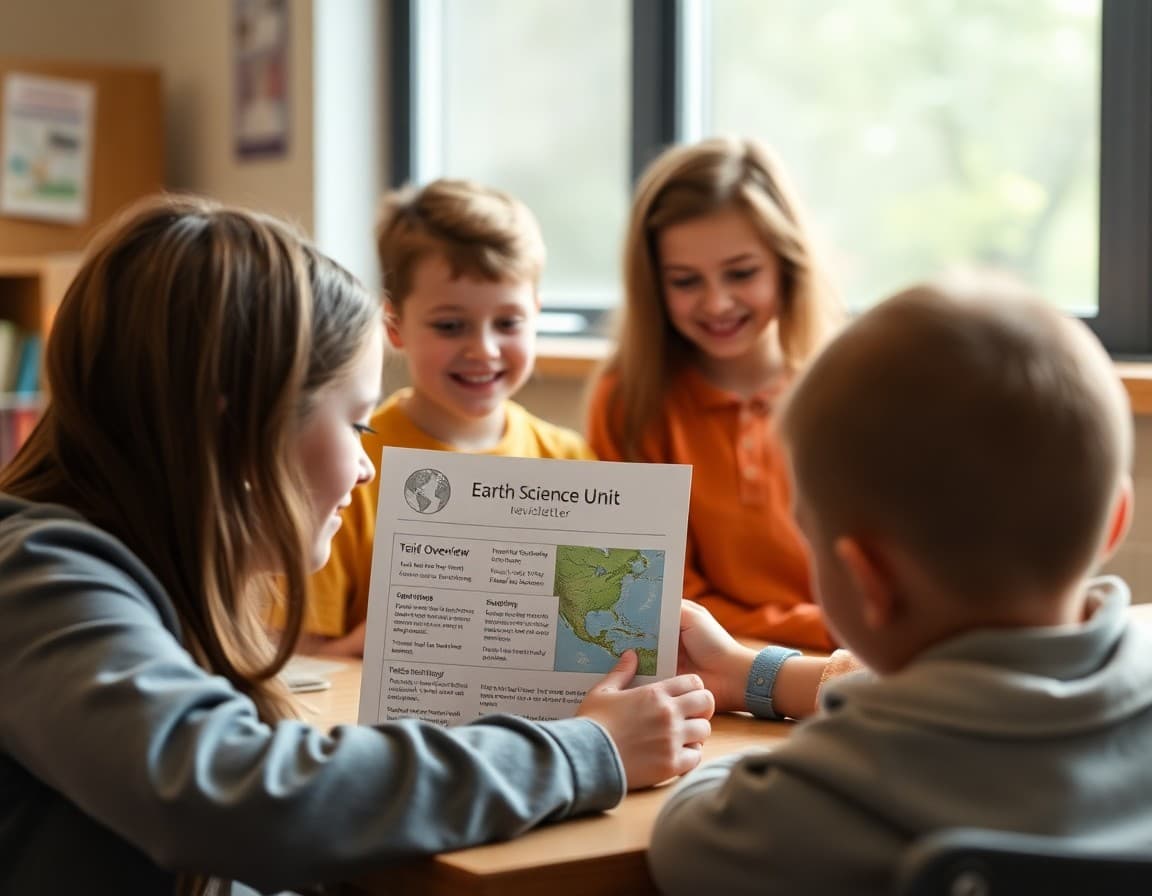
Earth science units vary enormously in subject matter. A plate tectonics unit covers the movement of crustal plates and the landforms, earthquakes, and volcanoes that result. A weather unit covers atmospheric processes, fronts, pressure systems, and precipitation. A rock cycle unit covers how rocks form, change, and are recycled over geological time. An astronomy unit covers Earth's place in the solar system and the scale of the universe. A newsletter that names the specific unit topic and frames it as a question, "why do earthquakes happen in some places and not others?", gives students and families a central question to hold as the unit unfolds.
Geological Time: The Most Challenging Concept in Earth Science
Geological time scales are one of the most conceptually challenging aspects of earth science because they exceed human intuition. A billion years, a hundred million years, and ten million years all feel equally incomprehensible to a person whose experience runs to decades. Teachers use analogies, scale models, and timeline activities to help students develop a sense of deep time. A newsletter that explains geological time as a concept and names the analogy or activity the class is using to make it concrete helps families reinforce the idea in conversation.
Field Observation as Learning
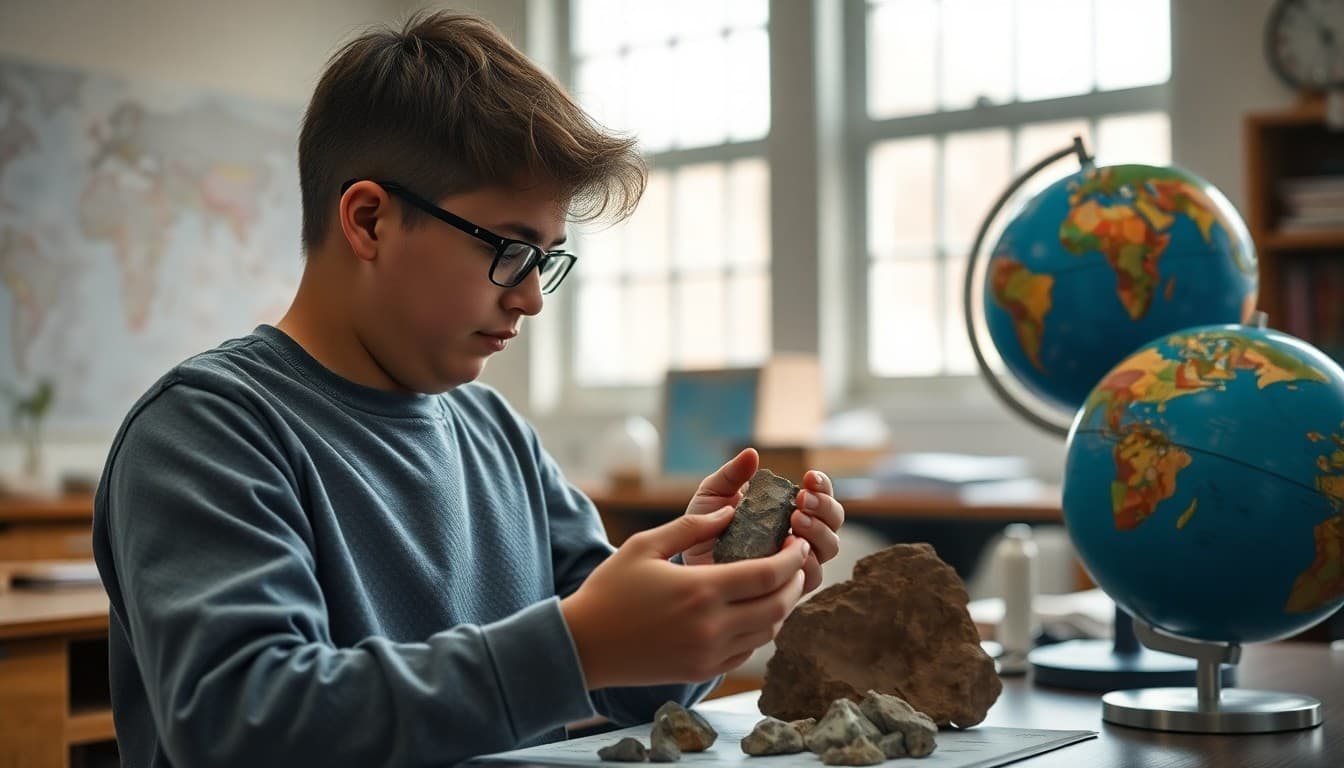
Earth science has an outdoor learning dimension that other sciences do not. Rock samples from local exposures, weather data from the school's weather station, and sky observation for moon phases and planetary positions are all legitimate earth science data collection. A newsletter that names any outdoor observation component of the current unit and suggests that families extend it at home, "track the moon phase every night for two weeks and predict when it will be full," creates genuine scientific observation habits that last beyond the classroom.
Reading and Interpreting Earth Science Data
Earth science involves many types of data: seismograph readings, weather maps, geologic maps, topographic maps, and astronomical charts all communicate information that requires specific reading skills. Students who learn to extract information from these representations rather than only from written descriptions develop a form of scientific literacy that is not duplicated in other courses. A newsletter that explains the specific data representation the current unit introduces helps families understand why their student is spending time on map reading or chart interpretation.
Connecting Earth Science to Environmental and Social Issues
Earth science connects directly to some of the most significant issues families and students care about: climate change, earthquake preparedness, freshwater availability, and energy resources. A unit on atmospheric science leads directly into climate system understanding. A unit on rocks and minerals leads into resource extraction and sustainability. A newsletter that makes these connections for the current unit helps students see the relevance of what they are learning to the world they will inherit.
Earth Science Unit Communication Through Daystage
Earth science teachers who use Daystage for unit newsletters give families the observation prompts, vocabulary, and conversation starters to make the outdoor world a continuous extension of the classroom. Earth science is one of the few subjects that can be practiced by looking out the window, and a well-timed newsletter is what makes families aware of what to look for.
Get one newsletter idea every week.
Free. For teachers. No spam.
Frequently asked questions
What should an earth science unit newsletter include?
An earth science unit newsletter should describe the specific branch of earth science the unit covers (geology, meteorology, oceanography, or astronomy), explain the central concepts and questions the unit addresses, name any field or outdoor observation components, connect the unit to observable features of the local environment, and give families specific real-world observation prompts that reinforce classroom learning.
How can families reinforce earth science without leaving home?
Earth science is unusually well-suited to home observation. Weather units connect to the daily forecast, cloud identification, and temperature tracking. Geology units connect to rocks and minerals in the local environment, construction sites, and road cuts. Astronomy units connect to moon phase observation, stargazing, and news about space exploration. A newsletter that names the specific observation opportunity for the current unit gives families a concrete outdoor activity that reinforces the academic material.
What are the main branches of earth science students study?
Earth science typically covers geology (the structure, composition, and history of Earth), meteorology (weather and atmospheric processes), oceanography (Earth's oceans and water systems), environmental science (human impact on natural systems), and astronomy (Earth's place in the solar system and universe). Each unit usually focuses on one of these branches, and a newsletter that identifies the current branch helps families understand the scope of what their student is studying.
Why do earth science units often include map reading skills?
Maps are one of the primary tools of earth science. Topographic maps, geologic maps, weather maps, and star charts all require specific reading skills that are not intuitive. Students who learn to read contour lines on a topographic map, interpret rock layer symbols on a geologic map, or trace isobars on a weather map develop spatial reasoning skills that are valuable beyond earth science. A newsletter that explains why map reading is part of earth science helps families see it as a fundamental tool rather than an unrelated skill.
What tool helps earth science teachers send unit newsletters efficiently?
Daystage is built for school communication. Earth science teachers use it to send formatted unit newsletters with concept overviews, observation activities, and real-world connection ideas directly to parent email lists.

Adi Ackerman
Author
Adi Ackerman is a former classroom teacher and curriculum writer with 8 years in K-8 schools. She writes about school communication, parent engagement, and what actually works in real classrooms.
More for Subject Teachers
Teacher Newsletter About Science Homework: Helping Families Support Effective Study
Subject Teachers · 6 min read
Teacher Newsletter for Environmental Science: Connecting Families to Sustainability Learning
Subject Teachers · 6 min read
Teacher Newsletter for Biology Units: Connecting Families to Life Science Learning
Subject Teachers · 6 min read
Ready to send your first newsletter?
3 newsletters free. No credit card. First one ready in under 5 minutes.
Get started free