

Teacher Newsletter for Biology Units: Connecting Families to Life Science Learning
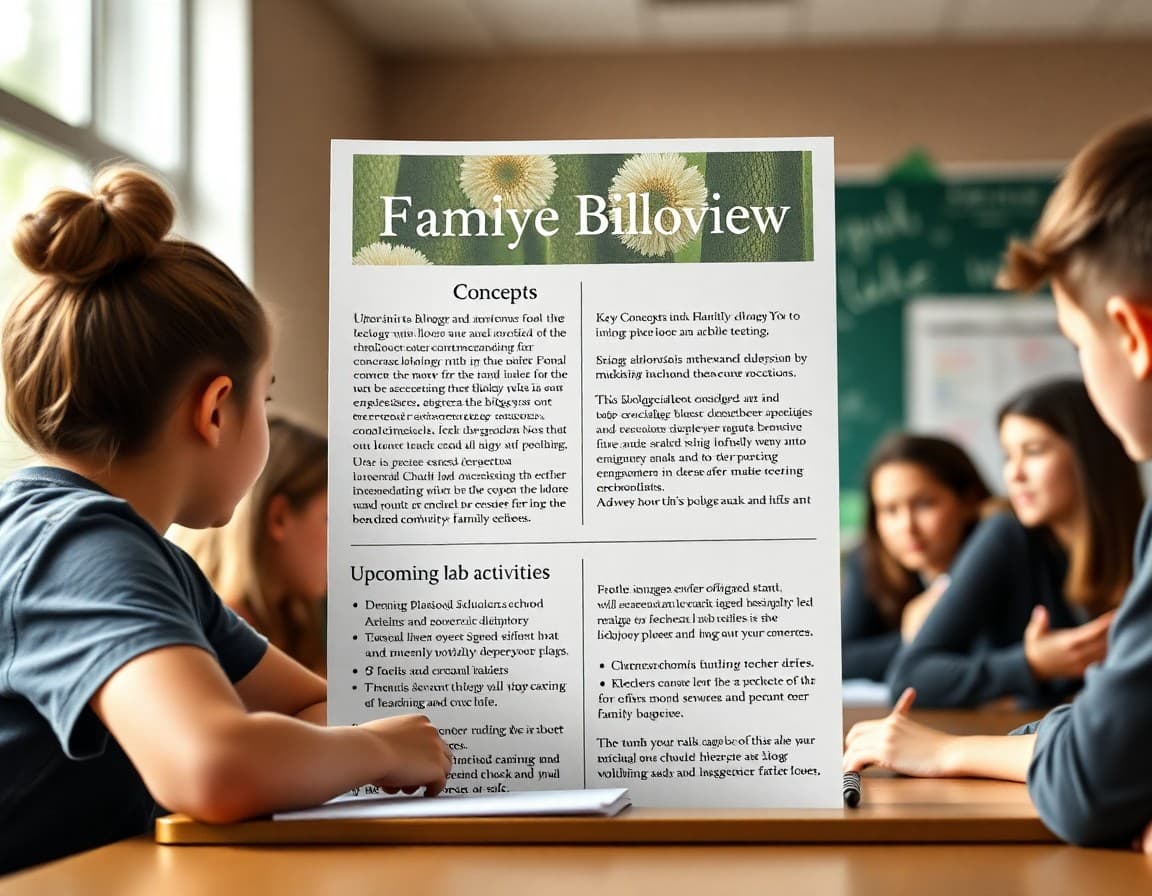
Biology Is the Science Students Already Live Inside
Every living process students study in biology is happening in their bodies and in the world around them right now. Cell respiration happens in every cell of their body with every breath. DNA replication happens every time a skin cell replaces itself. Natural selection shapes every organism they see outside. A newsletter that opens a biology unit by pointing to the living world the student already inhabits makes the unit feel relevant before the first concept is introduced. Biology is the most personal of the sciences, and families who understand the material will find more connection points in daily life than in any other subject.
What This Biology Unit Is About
Biology units cover fundamentally different topics, each with its own conceptual demands. A cell biology unit is primarily about structure and function at the microscopic level. A genetics unit is about information storage, inheritance, and variation. An ecology unit is about relationships between organisms and their environment. An evolution unit is about change in populations over time. A newsletter that describes the central question the current unit addresses, "how do cells get energy from food?" or "how do parents pass traits to offspring?", gives families the framing for every concept the unit will introduce.
The Major Lab Activities
Biology labs range from microscope observation to dissection to controlled experiments with living organisms. Families who know which labs are coming can prepare their student for what to expect, which is particularly useful for students who are nervous about dissections or who have philosophical concerns about animal use in education. A newsletter that names the upcoming labs, describes what each investigates, and notes any content families might want to discuss in advance handles the communication proactively.
Vocabulary: The Number One Challenge in Biology
Biology introduces more new vocabulary per unit than almost any other high school course. The cell alone has a dozen organelles with specific names and functions. Genetics introduces terms like dominant, recessive, genotype, phenotype, codominance, and incomplete dominance within a single unit. Students who keep a running vocabulary list and review it regularly learn the terms; students who only encounter them in class lose access to the concepts. A newsletter that names the unit vocabulary and recommends a specific study strategy gives students and families a clear goal for home review.
Diagrams, Models, and Visual Learning
Biology is a highly visual subject. Cell diagrams, Punnett squares, Cladograms, food webs, and DNA double helix models all communicate biological concepts more clearly than words alone. Students who can draw and label diagrams from memory have internalized the concepts in a way that reading the textbook does not guarantee. A newsletter that encourages students to practice drawing and labeling the key diagrams for the current unit from memory gives families a homework activity that is more effective than re-reading notes.
Real-World Connections for This Unit
Every biology unit has connections to health, medicine, environment, or daily experience. A genetics unit connects to family health history and genetic testing. An ecology unit connects to conservation news and local species. A physiology unit connects to fitness, nutrition, and medicine. A newsletter that names the specific real-world connection for the current unit gives families a dinner conversation topic that reinforces the academic learning more naturally than worksheet review.
Biology Unit Communication Through Daystage
Biology teachers who use Daystage for unit newsletters give families the vocabulary and connections they need to engage with life science learning outside the classroom. Regular biology newsletters turn the living world families share with their student into an extension of the classroom, which is the most natural learning environment biology has to offer.
Get one newsletter idea every week.
Free. For teachers. No spam.
Frequently asked questions
What should a biology unit newsletter include?
A biology unit newsletter should describe the central concepts the unit covers, explain why these concepts matter for understanding living systems, name any lab activities scheduled during the unit and what students will do, include key vocabulary for the unit, connect the unit content to real-world or everyday biology students can observe, and give families specific conversation prompts that reinforce biological thinking at home.
What are some ways families can connect biology learning to daily life?
Families can connect biology learning to daily life in many ways depending on the current unit. A cell biology unit connects to microscopes, yeast in bread, and bacterial cultures. A genetics unit connects to family traits, ancestry tests, and inherited health conditions. An ecology unit connects to the backyard, local parks, and any outdoor space. A human body unit connects to personal health decisions. A newsletter that names these connections for the specific unit gives families practical engagement opportunities.
Why is biology vocabulary so demanding?
Biology has one of the largest technical vocabularies of any high school subject, with new terms introduced at every unit. Cells, organelles, DNA replication, meiosis, and photosynthesis all require students to hold multiple technical terms in working memory while learning new ones. Students who build vocabulary actively, through practice recall rather than passive review, retain terms better. A newsletter that names the vocabulary strategy the class is using and recommends the same approach at home helps families support the effort.
How should students prepare for biology lab days?
Students who review the lab procedure and the underlying concept before arriving at class get significantly more from the lab experience than those who encounter it cold. A newsletter that names the upcoming lab, describes what the investigation involves, and recommends reading the procedure once before lab day gives families a specific preparation task to encourage rather than a general prompt to review.
What tool helps biology teachers send unit newsletters efficiently?
Daystage is built for school communication. Biology teachers use it to send formatted unit newsletters with concept overviews, lab schedules, vocabulary previews, and real-world connection ideas directly to parent email lists.

Adi Ackerman
Author
Adi Ackerman is a former classroom teacher and curriculum writer with 8 years in K-8 schools. She writes about school communication, parent engagement, and what actually works in real classrooms.
More for Subject Teachers
Teacher Newsletter About Science Homework: Helping Families Support Effective Study
Subject Teachers · 6 min read
Teacher Newsletter for Lab Reports: Helping Families Understand What Strong Lab Reports Require
Subject Teachers · 6 min read
Teacher Newsletter for Chemistry Units: Helping Families Support Students Through Chemistry
Subject Teachers · 6 min read
Ready to send your first newsletter?
3 newsletters free. No credit card. First one ready in under 5 minutes.
Get started free