
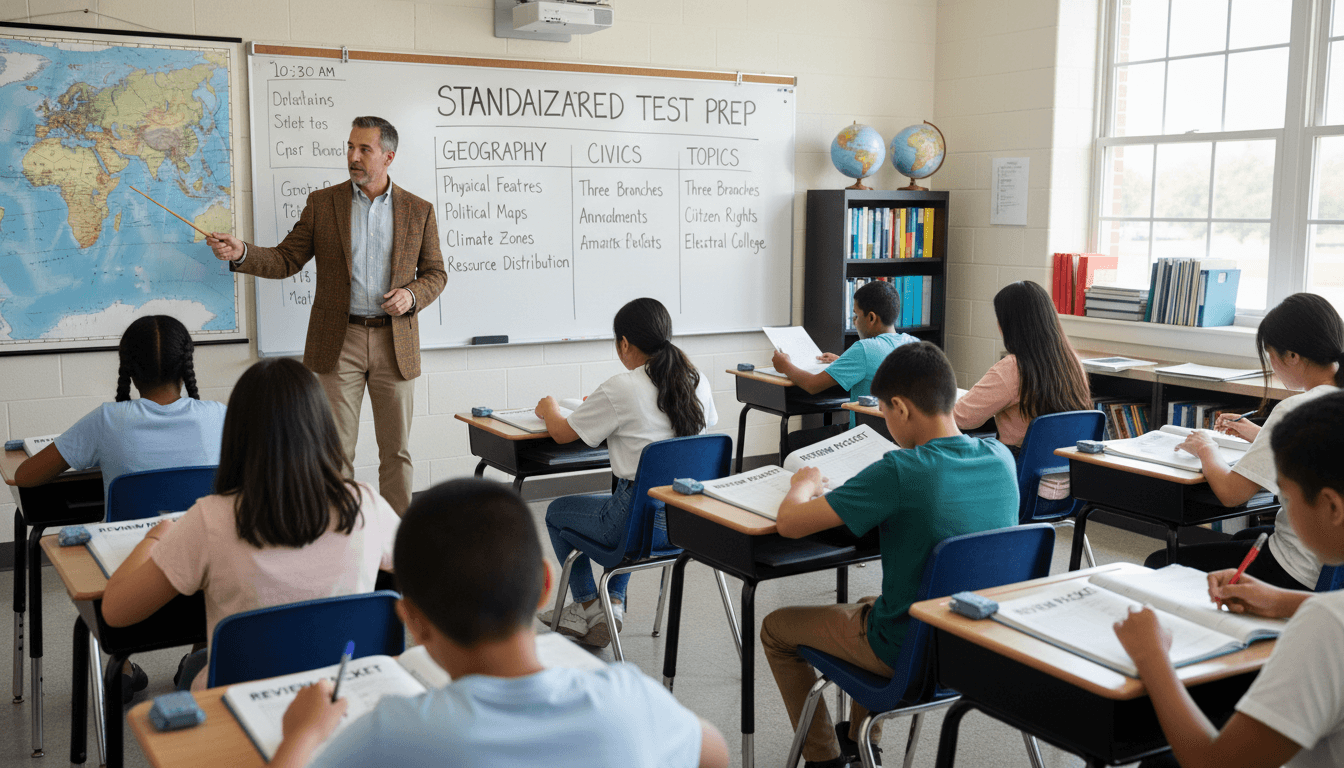
Social Studies Teacher Newsletter: Test Prep Newsletter for Parents
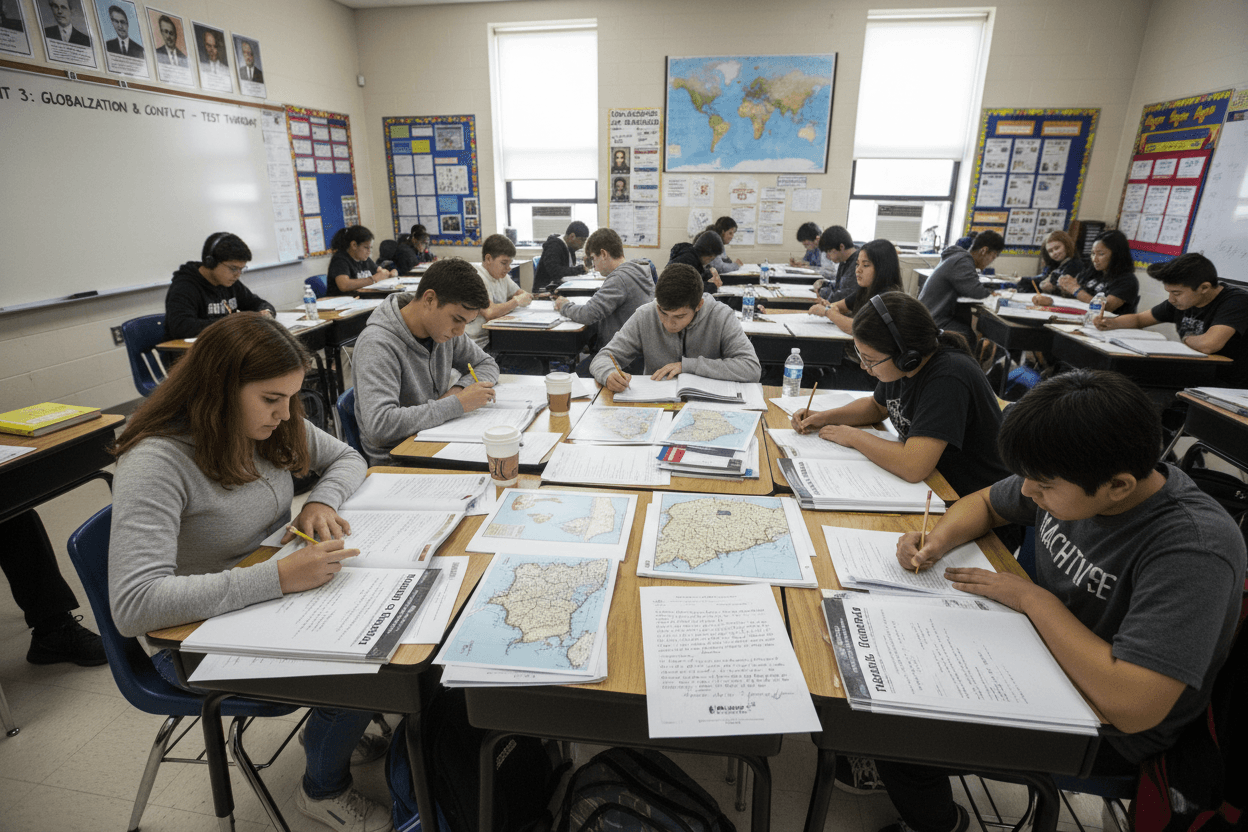
Social studies assessments cover a wide range of skills that families often do not know how to support: timeline construction, map reading, primary source analysis, geographic reasoning, and historical causation all appear on the same test. A test prep newsletter that explains what the assessment actually measures and how families can help at home turns an abstract content area into something parents can engage with.
This guide covers what to include in a social studies test prep newsletter, how to explain history, geography, and civics content clearly, and how to give families preparation strategies that match the skills the assessment measures.
Name the specific content the assessment covers
The most useful thing a social studies test prep newsletter can do is list what is actually on the test in plain language. For a history unit, that means naming the events, time periods, causes, and consequences students need to know. For a geography unit, it means identifying which regions, physical features, or map skills are covered. For civics, it means listing the governmental structures, rights, documents, and processes students are expected to understand.
Avoid vague descriptions like "students should know the material from Unit 4." A parent cannot help their student prepare without knowing what that unit actually contained. A specific content list gives families a checklist to review with their student, even if they have to look some of it up themselves.
Explain the skill types the test measures, not just the content
Social studies assessments measure analytical skills alongside factual recall. Students are typically asked to read a primary source and identify the author's perspective, analyze a political map and explain what it reveals about power or geography, construct a historical argument using evidence, or compare how two different sources interpret the same event.
Tell families this explicitly. A parent who knows that primary source analysis is a tested skill can pull up a historical document or political cartoon with their student and practice the skill at home. A parent who thinks the test is just about memorizing dates and names prepares their student for a different test than the one they are actually taking.
Give specific guidance on timeline and chronology skills
Understanding historical chronology is foundational in social studies, and it is a skill many students struggle with under test conditions. Tell families whether the assessment requires students to place events in sequence, identify cause and effect across a timeline, or explain why the order of events matters.
Suggest a specific home practice activity: make a simple five-event timeline together using events from the unit. For each event, ask the student to explain what caused it and what it led to. This exercise takes fifteen minutes and practices both chronological thinking and causation analysis, two skills that appear on most social studies assessments.
Address map skills with specificity
If the assessment includes a map component, tell families exactly what students need to be able to do: identify specific countries or capitals by location, read a political map versus a physical map, interpret a thematic map showing trade routes or population distribution, or use map scale and compass direction. These are distinct skills, and families can only support practice on the ones they know are being tested.
Suggest that families spend ten minutes with any online map resource looking at the region being assessed. Ask students to point to specific locations, describe what the physical geography of the region looks like, and explain how the terrain might have influenced where people settled or how goods were traded. These questions exercise real geographic reasoning rather than rote identification.
Explain primary source analysis as a skill, with an example
Primary source analysis is one of the most commonly tested social studies skills and one of the least familiar to parents. Many adults did not learn to analyze primary sources formally, so they do not know what the skill involves or how to support it.
Give a brief definition and one concrete example in the newsletter. Something like: "Primary source analysis means reading a historical document, speech, or image and being able to identify who created it, when, for what purpose, and what perspective or bias it reflects. For example, if students see a political cartoon from the era we studied, they should be able to explain what the cartoonist was arguing and which historical situation they were responding to." That example gives families enough to have a real conversation with their student.
Connect civics to real-world examples
Civics content becomes memorable when it is connected to real current events. If students are reviewing separation of powers, point to a recent news story where two branches of government disagreed. If they are studying the Bill of Rights, ask which amendment applies to a situation students will recognize from their own experience, like freedom of speech at school or search and seizure.
Encourage families to make these connections during regular conversation rather than creating a separate study session. A car ride discussion about why a town council decision required a vote is more effective civic education than rereading a textbook definition of local government. Current events are the best flashcards for civics.
Tell families what to expect on test day
Close with the logistics: when the assessment is, how long it takes, whether it is on paper or a device, and what types of questions appear (multiple choice, short answer, document-based question, or constructed response essay). Tell families when results will be shared.
If the assessment includes a document-based question or extended response, give families a heads-up that this section requires students to write an argument using evidence from provided sources. Students who know this is coming practice thinking argumentatively about historical material rather than just reviewing facts. That distinction in preparation makes a measurable difference in performance.
Get one newsletter idea every week.
Free. For teachers. No spam.
Frequently asked questions
What content should a social studies test prep newsletter cover?
Tell families which specific topics, time periods, and geographic regions the assessment covers. For history units, name the events, causes, and turning points students should understand. For geography, specify whether students need to know specific countries, capitals, physical features, or map reading skills. For civics, name the governmental structures, rights, and processes students are expected to know. Vague review advice like 'study the unit' is not useful. A list like 'students should be able to explain the causes of World War I, the significance of the Treaty of Versailles, and how the war changed political maps in Europe' gives families a real handle on the content.
How should social studies teachers explain primary source analysis to parents?
Many parents are unfamiliar with primary source document analysis as a tested skill. Explain that students are expected to read historical documents, political cartoons, maps, photographs, or speeches and answer questions about what the source reveals, who created it, what perspective or bias it reflects, and how it connects to the historical period. Give one brief example: 'If students see a political cartoon from 1920, they should be able to identify the main message and explain which historical event or condition it is commenting on.' This makes the skill concrete and gives parents a way to practice it at home with news articles or historical images.
What are the most important geography skills to emphasize in a test prep newsletter?
Specify whether the test includes map identification tasks, and if so, which regions or physical features students must locate. Also address geographic reasoning: understanding how physical geography influences human settlement, trade routes, and historical events. A parent can help by pulling up a map with their student and asking: 'Why do you think a major city developed here rather than there?' That question exercises geographic thinking rather than just memorization and mirrors the analytical skills most social studies assessments measure.
How do social studies teachers help families support civics test prep?
Connect civics content to real current events whenever possible. If students are reviewing how a bill becomes a law, point families to a real bill currently in the news. If students are studying the Bill of Rights, ask them which amendment applies to a situation they can see on the news or in their own school. Current connections make abstract civics content memorable, and families can naturally facilitate those connections in daily conversation without any special materials.
How does Daystage help social studies teachers send test prep newsletters?
Daystage lets social studies teachers build a test prep newsletter template they can update for each assessment. The structure stays consistent: topics covered, skill types the assessment measures, home support suggestions, and test day logistics. Families receive a clean, professional email rather than a long message buried in a classroom app. You can see who opened the newsletter so you know which families to follow up with before the assessment date arrives.

Adi Ackerman
Author
Adi Ackerman is a former classroom teacher and curriculum writer with 8 years in K-8 schools. She writes about school communication, parent engagement, and what actually works in real classrooms.
More for Subject Teachers
Ready to send your first newsletter?
3 newsletters free. No credit card. First one ready in under 5 minutes.
Get started free