
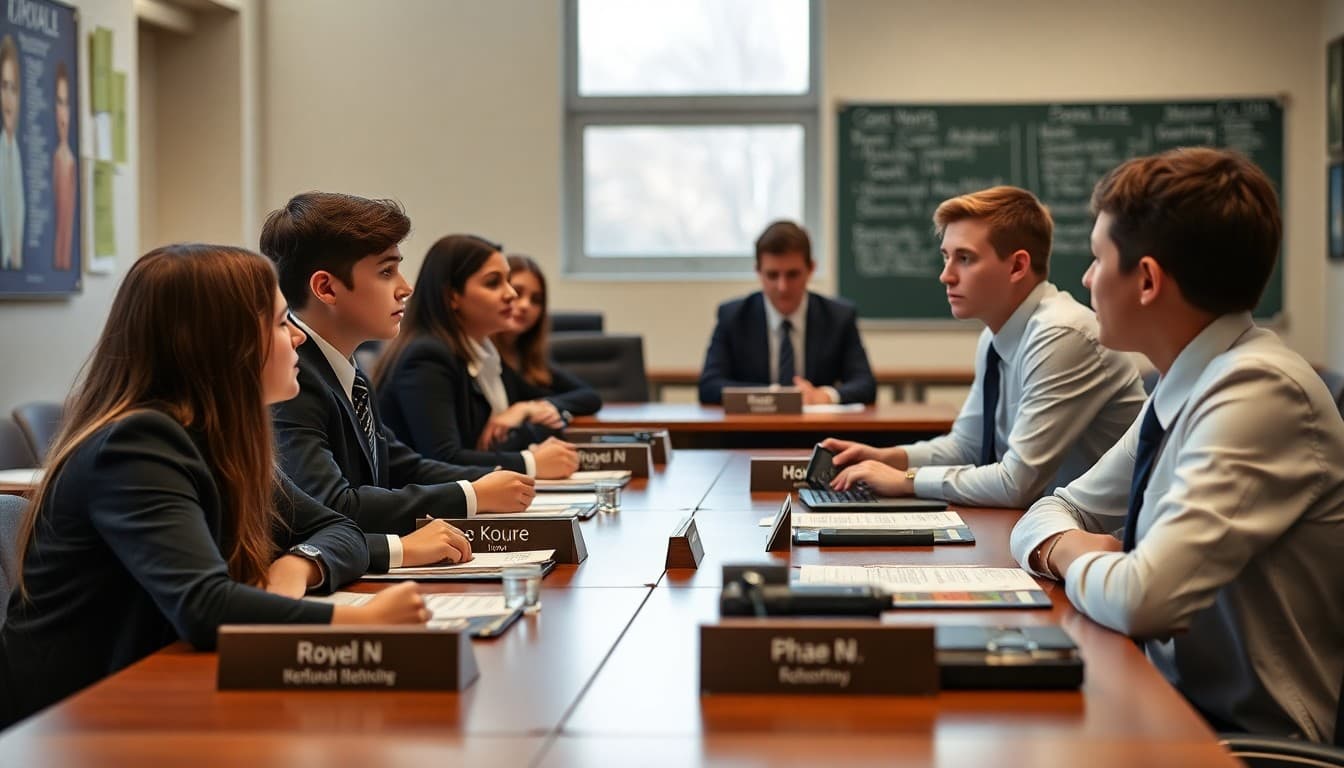
Social Studies Teacher Newsletter: Club and Activity Newsletter
Social studies extracurriculars, whether Model UN, debate team, history club, or a current events discussion group, tend to be more logistically complex than classroom work. There are competitions with travel, position papers with deadlines, and conference formats that families may never have encountered. A well-written club newsletter reduces the logistical questions to a manageable number and keeps the work of running the club focused on the students rather than parent communication.
Open with what the club is currently preparing for
"Our Model UN team is eight weeks out from the Regional Conference at Georgetown. Each delegate is now in the research phase for their committee topic. If your student is in the Human Rights Committee, they should have completed initial research on the committee's agenda item: forced displacement in the Horn of Africa, and should be working on their opening position statement." This kind of opener immediately tells families where in the cycle the club is and what students should be doing.
For debate team: "We are three weeks into the Lincoln-Douglas semester. This week's practice focused on value premise construction. Students who are competing in the November invitational should have a complete affirmative case and a basic negative block ready by October 28."
Explain the club format once, clearly, near the start of the year
Families who have never experienced Model UN or Lincoln-Douglas debate need a one-time orientation. Send this at the beginning of the year and link back to it in subsequent newsletters. "Model UN is a simulation of the United Nations. Students are assigned a country to represent, research that country's position on a global issue, and then debate resolutions in a committee format. Our club attends three conferences per year: one local, one regional, and one national. Students write position papers before each conference, debate in formal committee sessions during the conference, and often collaborate with other delegations to draft resolutions that can pass the committee."
Conference logistics newsletter template
Here is a newsletter section that covers conference logistics clearly:
"REGIONAL CONFERENCE LOGISTICS: Conference: Georgetown Model UN (GMUN). Dates: November 14-16. Departure: Friday November 14 at 6:00 AM from the main school entrance. Return: Sunday November 16 by 7:00 PM (estimated, weather permitting). Students need: Business formal attire (suit or equivalent, not business casual), laptop or printed position paper, a printed copy of the committee topic brief (provided by advisor), and $30 for meals not covered by the conference registration. What is covered: conference registration, hotel (two students per room), and most meals. Permission slip and $30 meal contribution due by November 1. Contact the office if cost creates a barrier."
Publish preparation deadlines with enough lead time to matter
Club preparation deadlines are easy for students to lose track of because they fall outside the regular class schedule. Put every deadline in the newsletter and on a paper or digital calendar students can reference. "Position paper due to advisor for review: October 28. Revised position paper due (final): November 5. Committee practice round: November 9 at 3:15. Conference departure: November 14 at 6:00 AM. Students who miss the October 28 review deadline will not receive advisor feedback before the conference."
Families who can see the full countdown understand why their student needs to be working now rather than the week before the conference.
Celebrate student achievements in club newsletters
Social studies club newsletters have more latitude than classroom newsletters to name students directly and recognize their work. "Congratulations to Diego Ramirez, who won Best Delegate in the Security Council at last month's local conference. Diego was the only freshman in the room. His position paper on nuclear non-proliferation earned specific mention from the committee chair." Named recognition in a family newsletter carries weight that a generic "great job this semester" does not.
You can also recognize milestones for the team as a whole. "Our debate team is now 9-4 on the year. That is our best record at this point in a season in four years."
Give families a way to watch or attend competitions
Many families do not know that they can attend debate tournaments or Model UN conferences as observers. Tell them. "Families are welcome to observe the preliminary rounds at the November invitational. The tournament begins at 9:00 AM at Lincoln High School. There is no admission charge. Rounds are generally open to observers unless the tournament director specifies otherwise. If you plan to attend, please let me know so I can connect you with the schedule."
Families who attend a competition once become far more engaged supporters for the rest of the year. They understand what their student is doing and why it matters, and they have something specific to ask about at dinner.
End with clear contact information for logistics questions
Club newsletters often generate more logistical questions than classroom newsletters because travel and competition are involved. Close with a clear statement of who to contact for what. "For questions about conference logistics, cost, or permission: email me at [address]. For questions about your student's debate preparation or competitive standing: come to a practice session or email me after Thursday practice." Separating logistics from academic questions helps families reach out without worrying about bothering you.
Get one newsletter idea every week.
Free. For teachers. No spam.
Frequently asked questions
What should a Model UN club newsletter cover?
It should cover the current committee topic and country assignment for each member, the conference schedule and location, preparation expectations before each meeting, any registration deadlines, and what students need to bring to conferences (typically a position paper, a placard, and appropriate business attire). Model UN parents often do not fully understand what the club entails, so a brief explanation of the format, delegates represent countries in simulated UN committees, debating resolutions and building coalitions, helps families understand why the time commitment is worthwhile.
How do I explain the debate team's format to families who have never attended a competition?
Be specific about the type of debate. 'Our team competes in Lincoln-Douglas debate, a one-on-one format where debaters argue both sides of a philosophical or policy resolution. This semester's resolution is: Resolved, that economic sanctions are a just method of international coercion. Each competitor must prepare arguments for and against the resolution before the tournament. Competitions involve multiple preliminary rounds and elimination brackets.' A concrete description of the format helps families understand what preparation looks like and what a competition day involves.
How often should I send a newsletter for a history club?
For a casual history or current events club, once a month is usually enough. For a club that is preparing for a competition or event, weekly updates in the three to four weeks before the event work well. Keep the monthly updates short, under 300 words, covering what the club discussed recently, what is coming up next, and whether there are any logistics families need to know. Families who receive regular, brief updates stay engaged without feeling overwhelmed.
My club is competing at a national Model UN conference. What should the conference logistics newsletter include?
Include the conference name and host institution, travel dates, expected departure and return times, packing list (business attire, laptop or printed position paper, any required materials), hotel or accommodation information if applicable, cost breakdown and payment deadlines, and the emergency contact procedure during the trip. Send this newsletter at least four weeks before the conference. Families who need to arrange childcare or schedule changes for other children need lead time. Include a signed permission slip deadline prominently at the top.
What platform works for social studies club newsletters?
Daystage works well because it sends directly to family email inboxes without requiring parents to install anything. For a Model UN club where both students and families need to receive different information, you can send the logistics newsletter to parents and a separate preparation reminder to students. Daystage keeps everything organized so you can look back at what you sent and when without searching through your sent email folder.

Adi Ackerman
Author
Adi Ackerman is a former classroom teacher and curriculum writer with 8 years in K-8 schools. She writes about school communication, parent engagement, and what actually works in real classrooms.
More for Subject Teachers
Social Studies Teacher Newsletter: Connecting Classroom Learning to the World Around Us
Subject Teachers · 7 min read
After-School Program Newsletter Guide: Keeping Families Engaged Beyond the School Day
Subject Teachers · 6 min read
AP Teacher Newsletter Guide: Communicating Expectations, Exam Prep, and Support to Families
Subject Teachers · 6 min read
Ready to send your first newsletter?
3 newsletters free. No credit card. First one ready in under 5 minutes.
Get started free