
Science Teacher Newsletter: Parent Conference Newsletter Template

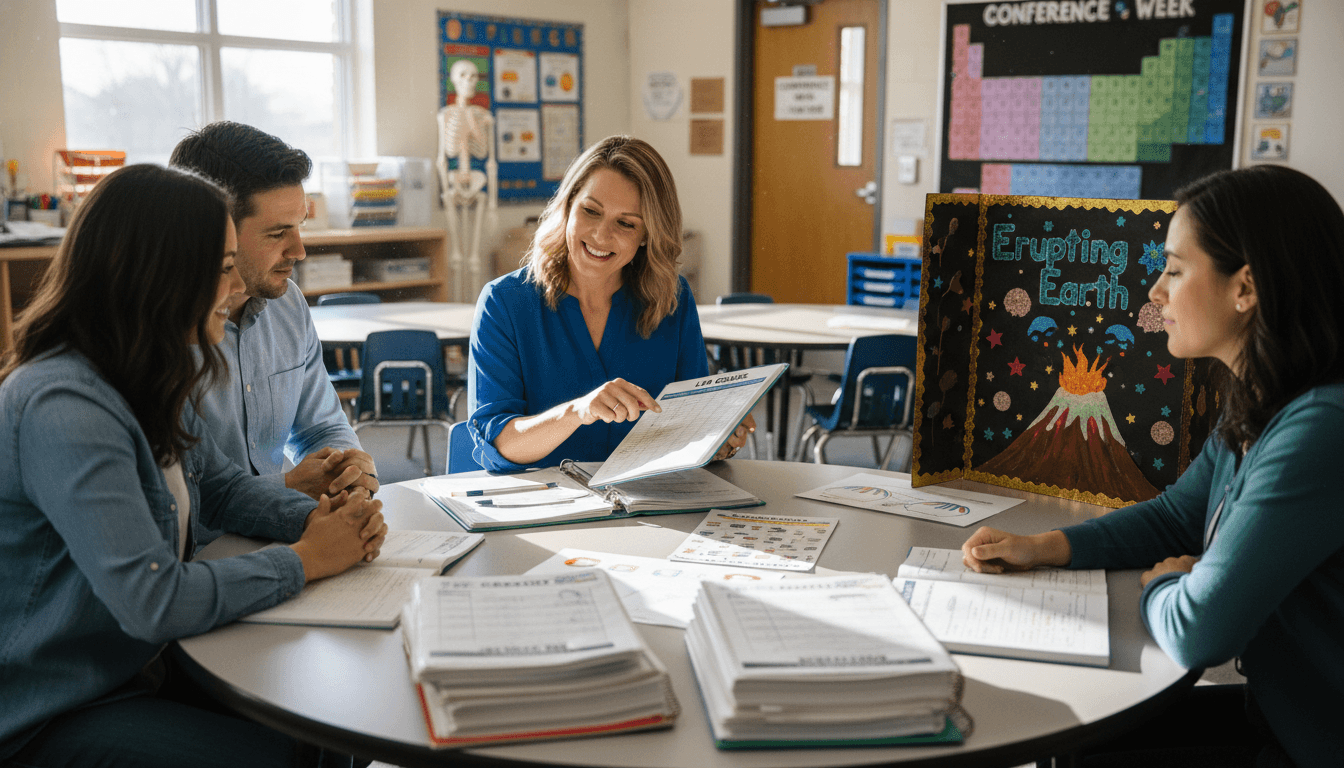
Science class involves skills that do not always translate cleanly into a single grade: lab technique, hypothesis writing, data interpretation, safety compliance, scientific reasoning, and content knowledge can all be assessed separately. A parent conference that presents only a final grade leaves families without the information they need to support their child's development. A pre-conference newsletter that explains what data you will share and how it is organized helps families arrive ready for a real conversation.
This guide covers how to write a science teacher parent conference newsletter, what data to prepare and explain in advance, and how to help families ask questions that make the conference genuinely productive.
Send the newsletter before sign-ups open
The conference newsletter has two jobs: it prepares families for the conversation and it drives sign-ups. Both work better when the newsletter arrives before the sign-up window closes rather than as a reminder after most slots are already taken.
Send it at least eight to ten days before conference week. Include the sign-up link prominently in the first and last sections of the newsletter. Families who know what to expect from the conference are more motivated to claim a slot than families who receive only a generic sign-up invitation.
Explain the different types of science data you will share
Science grades often reflect multiple distinct skill areas that families do not realize are measured separately. Tell parents in the newsletter which types of data you will bring to the conference: unit assessment scores, lab report grades, participation records, notebook or journal checks, project grades, or safety observation records.
For each type, give a one-sentence explanation of what it measures. "Lab report grades reflect whether students accurately record data during the lab, analyze results correctly, and write a conclusion that connects back to the original hypothesis." This explanation ensures that parents do not walk into the conference expecting to see only a test score and are then confused by additional data they did not know was collected.
Preview the major themes in your student data
You do not need to reveal individual results before the conference, but you can give families a general sense of what patterns you have observed across the class. "Most students this semester have shown strong understanding of life science content but are still developing their data analysis and graphing skills" gives families context for the specific conversation about their child without sharing any individual data prematurely.
This preview is especially useful in science because lab skills and content knowledge develop at different rates for different students. A parent who knows that data analysis is a class-wide growth area is better positioned to understand why their child's lab grades may differ from their test scores.
Explain what lab grades actually measure
Lab grades are the most commonly misunderstood element of a science course. Parents who received traditional science education may not know that lab work is graded on technique, data recording, analysis quality, and conclusion writing, not just on whether the experiment "worked." A student who gets an unexpected result but records data accurately and analyzes the result honestly may deserve a higher lab grade than a student who gets the expected result but skipped documentation steps.
A brief explanation of your lab grading criteria in the newsletter reduces the number of conference conversations that start with "why did my child lose points on the lab when they did the experiment correctly?" It also helps families understand the value of the skills their child is building beyond the content itself.
Give parents specific question prompts for the conference
Parents who arrive at a 15-minute science conference with specific questions get significantly more out of the meeting than parents who wait to hear what the teacher raises. Include four or five prompt questions in the newsletter:
- Is my child's written science work aligned with how they seem to understand things when we talk about science at home?
- Where is the biggest gap between my child's effort and their results?
- Is my child taking appropriate risks in lab work, or do they tend to play it safe to avoid making mistakes?
- What is the most important science skill my child should focus on developing in the next two months?
- Are there any patterns in how my child approaches problems or data that I should know about?
These questions get at the habits of scientific thinking that matter for long-term development and do not always show up transparently in a grade report.
Tell families how to support scientific thinking at home
Many parents feel they cannot support science learning at home because they do not remember high school biology or chemistry. The newsletter should address this directly by describing non-expert ways families can reinforce scientific thinking: asking their child to explain a concept they learned, watching a nature documentary together and asking questions about what they observe, or talking through the question "how would you test that?" when the child makes a claim about the world.
These activities build scientific reasoning habits without requiring parents to teach content. They also give the conference conversation a practical takeaway that families can actually act on after the meeting ends.
Describe what happens after the conference
Close the newsletter with a brief note about what comes next. When will families see any changes in their child's work reflected in updated grades or communication? If you agree on a specific support plan in the conference, how will you follow up? Is there a way for parents to reach you between conferences if they have questions?
This forward-looking close signals that the conference is the start of a conversation, not a one-time report. Families who understand that there is a follow-up mechanism are more likely to engage actively in the conference rather than treating it as a passive information download.
Daystage makes science conference newsletters easy to build and send
Daystage lets science teachers send a complete conference newsletter with the sign-up link, data preview, grading explanations, and question prompts in a single professional email to the full class list. Track who opened the newsletter so you know which families have seen the conference information and which to follow up with directly. Build the template once and update it each conference season in minutes.
Get one newsletter idea every week.
Free. For teachers. No spam.
Frequently asked questions
What data should a science teacher share at a parent conference?
Share assessment scores broken down by the major skill areas tested, lab report grades with specific feedback on lab technique or data recording, participation and engagement patterns if they affect learning, and any patterns in the student's approach to scientific reasoning tasks. Science involves multiple distinct skills and a grade that blends them hides where the student specifically needs support.
How should science teachers explain lab grades to parents?
Explain what lab grades measure: safety compliance, procedure following, data collection accuracy, analysis quality, and conclusion writing. A parent who understands that a lab grade reflects multiple distinct skills is better equipped to understand why a student can score well on written tests but struggle on lab work, or vice versa. Break the lab grade into its components and explain each one briefly.
What questions should science teachers encourage parents to ask at conferences?
Prompt parents to ask about the gap between their child's classroom discussion engagement and their written assessment performance, whether their child is taking appropriate risks in lab work or playing it safe to avoid mistakes, and what habits of scientific thinking transfer beyond the classroom. These questions get at the deeper skills that do not always show up clearly in grades.
How do science teachers communicate about scientific reasoning skills in conferences?
Describe specific behaviors you observe. 'Your child writes strong hypotheses but has difficulty interpreting data that does not match their prediction' is specific and actionable. 'Your child is doing well' is not. Parents who understand their child's specific science reasoning strengths and gaps can reinforce the strengths and ask about the gaps in ways that are relevant to the child's development.
How does Daystage help science teachers send conference newsletters?
Daystage lets science teachers send a pre-conference newsletter with the sign-up link, conference agenda, data preview, and preparation questions to the full class list in a single professional email. Open rate tracking shows which families have engaged with the newsletter and which may need a direct follow-up to confirm their conference slot before the week begins.

Adi Ackerman
Author
Adi Ackerman is a former classroom teacher and curriculum writer with 8 years in K-8 schools. She writes about school communication, parent engagement, and what actually works in real classrooms.
More for Subject Teachers
Ready to send your first newsletter?
3 newsletters free. No credit card. First one ready in under 5 minutes.
Get started free