
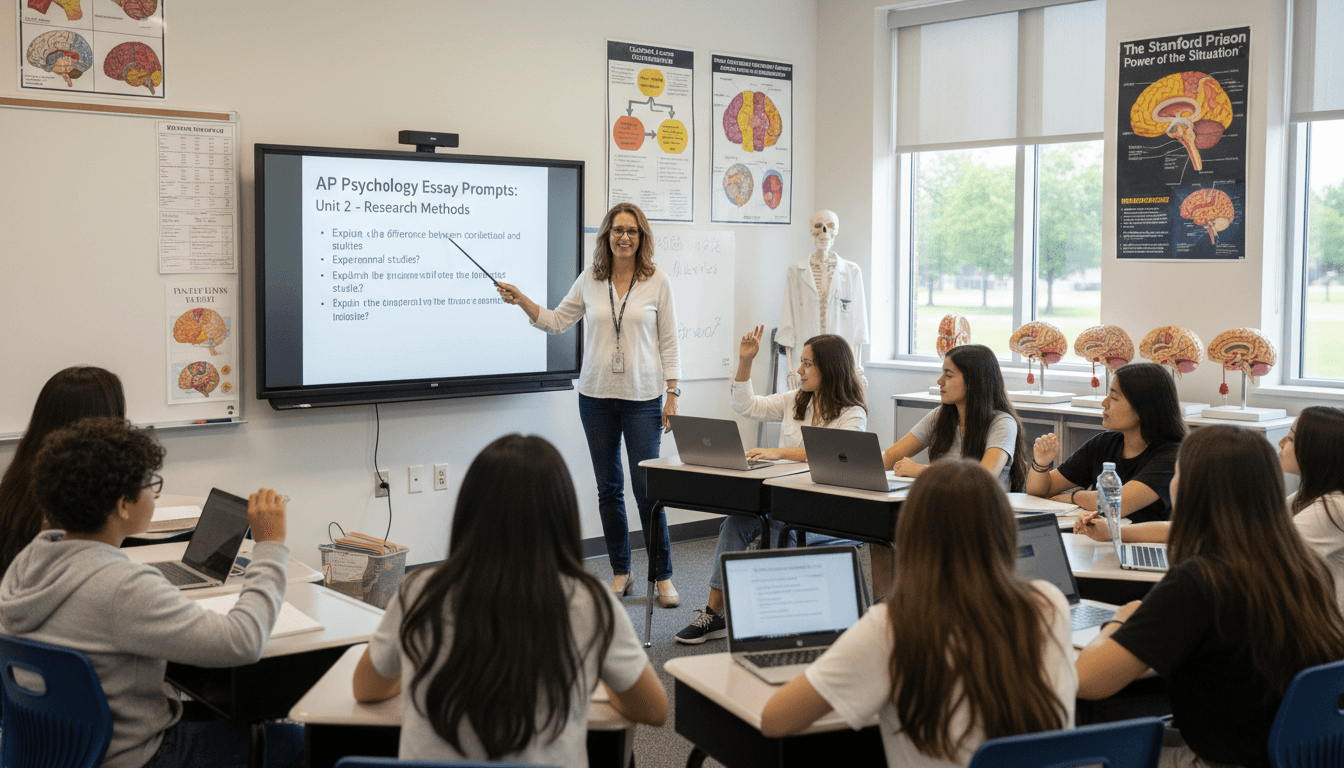
Psychology Teacher Newsletter: Test Prep Newsletter for Parents

Parents of AP Psychology students often have little frame of reference for what the course covers or how the exam works. A psychology teacher newsletter sent before a major assessment gives families the context they need to support preparation at home and removes the confusion that leads to unfocused review sessions the night before the test.
This guide covers what to include in a psychology test prep newsletter, how to explain AP exam format in plain language, and how to help families reinforce key concepts without needing a background in behavioral science.
Name the specific units and concepts under review
Start with the basics: which units does this assessment cover? AP Psychology is organized into distinct content areas, from the history and approaches to psychology through biological bases, sensation and perception, states of consciousness, learning, cognition, motivation, developmental psychology, personality, social psychology, and psychological disorders. A newsletter that names the specific units being tested gives students and families a clear scope for review rather than a sense that everything is fair game.
List the key terms and theorists that appear most frequently in the assessed units. For a learning unit, that might mean operant conditioning, reinforcement schedules, Bandura's social learning theory, and the difference between negative reinforcement and punishment. Families who can use accurate vocabulary in conversations with their student are far more helpful than families who ask vague questions like "do you know your stuff?"
Explain the AP exam format clearly
The AP Psychology exam includes two sections: a multiple-choice section with 100 questions answered in 70 minutes, and a free-response section with two questions answered in 50 minutes. Many parents and students entering AP Psychology do not fully understand what the FRQ section requires, and clarifying this in the newsletter helps families direct their preparation where it counts most.
Explain that multiple-choice questions test conceptual recognition across the full course, while free-response questions ask students to apply psychological concepts to a scenario. The scoring for FRQs rewards precision. A student who identifies the correct concept but fails to define it clearly or apply it to the specific scenario presented may earn partial credit but miss the full score. Families who understand this structure can quiz their student more effectively at home.

Walk parents through how FRQ responses are scored
One of the most useful things a psychology test prep newsletter can do is demystify the free-response scoring rubric. Each FRQ is scored by identifying discrete elements: the identification of a concept, an accurate definition, and a specific application to the scenario provided. Points are not awarded for general knowledge displayed around the edges of the answer.
Tell families that a strong FRQ response is organized and direct, not conversational. Students should not bury the concept identification in a lengthy introduction. They should name the concept, define it in precise psychological terms, and then connect it explicitly to the details of the scenario. Asking a student to practice this structure at home by responding to a practice prompt out loud is more useful than reading notes passively.
Address sensitive content that may come up in review
AP Psychology covers some content that families may not expect from a high school course. Units on psychological disorders, research ethics, historical case studies involving deception or harm to participants, and social influence research can surface difficult topics in review conversations at home.
A brief note in the newsletter about the ethical guidelines that frame how the course addresses these topics helps families understand the academic context. AP Psychology teaches students to evaluate research methods and psychological theories critically, and that includes examining the ethical standards that govern what researchers are permitted to do and why those standards exist. Families who know this going in are less likely to be caught off guard when their student mentions Milgram's obedience study or Watson's conditioning experiments during a dinner conversation.
Suggest specific review strategies that work for this subject
Psychology is a vocabulary-heavy course, and rote memorization of definitions is not sufficient preparation for the AP exam. Tell families what effective review actually looks like: using flashcards to practice defining terms and then generating an original example for each one, working through released AP practice questions from the College Board, and practicing FRQ responses with timed conditions that mirror exam constraints.
Study groups can be effective for psychology review because explaining a concept to a peer requires the same kind of articulation the FRQ demands. Encourage students to quiz each other using scenario-based questions rather than simple definition recall. A student who can apply Piaget's stages of cognitive development to a new scenario has understood the material in the way the AP exam requires.
Give families a concrete daily review schedule
Families support preparation best when they know what to expect from a daily session. A reasonable review schedule in the week before an AP Psychology unit test might be 30 minutes of vocabulary review using flashcards or a tool like Quizlet, followed by 15 minutes working through two to three multiple-choice practice questions with a focus on understanding why wrong answers are wrong. In the final two days before the exam, one full FRQ practice response written under timed conditions and reviewed the next morning is more valuable than additional vocabulary cramming.
Parents who understand what their student's review sessions look like can provide accountability without hovering. Asking "did you do your FRQ practice today?" is a more useful question than "are you ready for the test?"
Tell families what happens after the assessment
Close the newsletter with a note about what comes next. When will students receive their scores? What unit does the course move into after the assessment? If this is the final review before the AP exam in May, explain the timeline for scores and how scores are reported to colleges. Families who understand the arc of the course stay more engaged over the full year and are more likely to take future newsletters seriously when the next major assessment approaches.
Get one newsletter idea every week.
Free. For teachers. No spam.
Frequently asked questions
When should a psychology teacher send a test prep newsletter?
Send it 7 to 10 days before the assessment. For AP Psychology exams with both multiple-choice and free-response components, two weeks out gives students enough time to build systematic review habits rather than cramming the night before. For unit tests covering a single framework, such as the biological bases of behavior or the learning unit, 5 to 7 days is typically enough time for families to structure review sessions at home.
What should a psychology test prep newsletter tell parents?
Tell parents what the assessment covers and what format it takes. AP Psychology multiple-choice questions test broad conceptual understanding across the full course outline, while free-response questions ask students to apply psychological concepts to real-world scenarios. Name the specific units included, such as biological bases, learning and conditioning, memory, or social psychology, and explain what students are expected to do with that material: define terms, compare theories, or analyze a scenario using a named framework.
How can parents support AP Psychology test prep at home?
Parents do not need a background in psychology to help. The most useful support is asking their student to explain a concept out loud using an everyday example. If a student can explain classical conditioning using a personal scenario, or describe how confirmation bias shows up in real decisions, they are well prepared. Ask families to listen for clarity and ask clarifying questions rather than evaluating accuracy. Consistent daily review sessions of 20 to 30 minutes outperform single long cram sessions.
Should psychology teachers explain free-response question format in the newsletter?
Yes. Many students and parents underestimate how structured FRQ responses need to be. A well-written newsletter explains that AP Psychology free-response questions require students to identify a concept, define it accurately, and apply it to a specific scenario with precision. Partial credit depends on each discrete element being addressed. Families who understand this structure can quiz their student by asking them to walk through a scenario step by step rather than simply asking whether they know the material.
How does Daystage help psychology teachers send test prep newsletters?
Daystage gives psychology teachers a reusable newsletter template that can be updated before each unit test or AP exam. Update the units covered, the key terms list, and the assessment date, then send in under ten minutes. Families receive a clear, consistent communication rather than a rushed announcement on a classroom app, and teachers can see open rates to know which families may need a direct follow-up before the test.

Adi Ackerman
Author
Adi Ackerman is a former classroom teacher and curriculum writer with 8 years in K-8 schools. She writes about school communication, parent engagement, and what actually works in real classrooms.
More for Subject Teachers
Ready to send your first newsletter?
3 newsletters free. No credit card. First one ready in under 5 minutes.
Get started free