
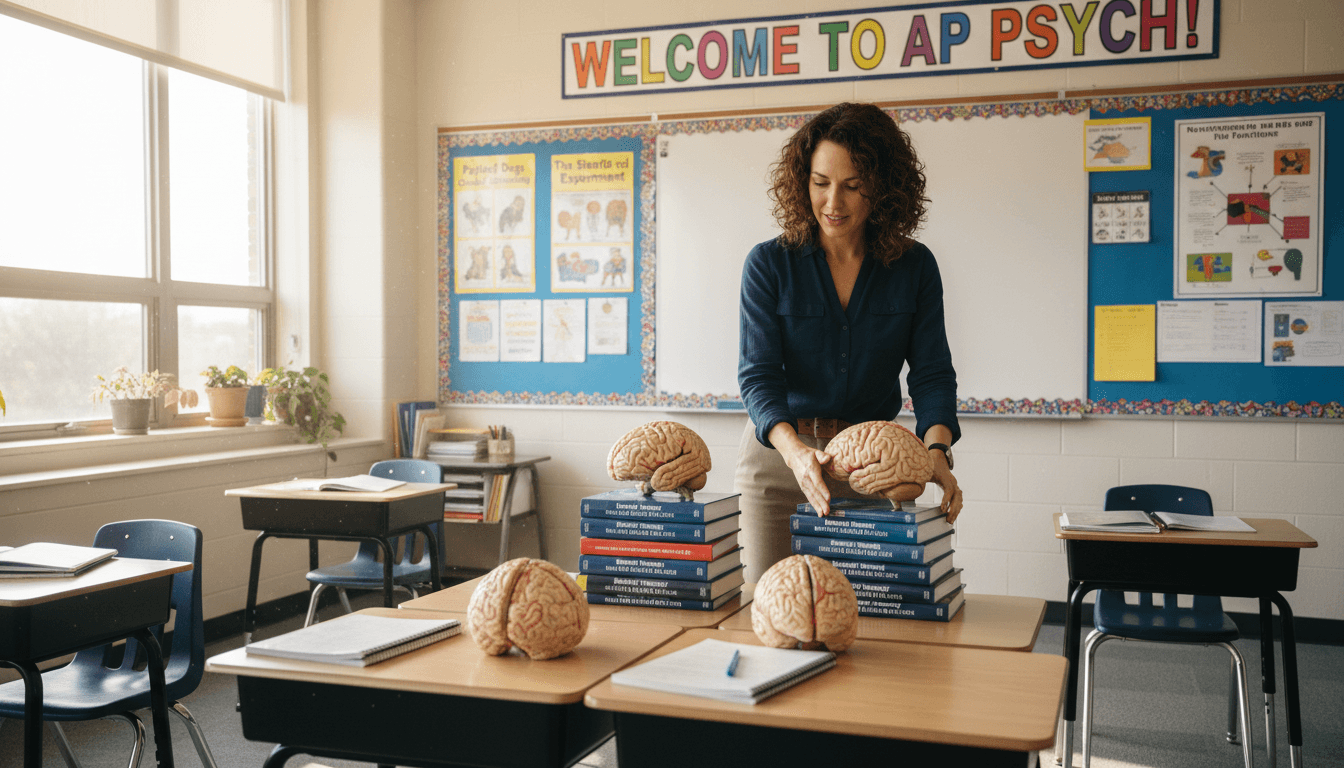
Psychology Teacher Newsletter: Back to School Newsletter for New Students and Parents

The back to school newsletter for a psychology class does more than introduce the teacher and list the supply list. It sets the tone for how families will engage with an academically demanding course that covers more sensitive material than most high school classes. Getting it right in the first week pays dividends in parent trust, student preparation, and family engagement across the full year.
This guide covers what a psychology back to school newsletter should include, how to frame the AP exam timeline for new families, and how to address sensitive course content honestly from day one.
Introduce the course as a science, not a self-help class
Many new psychology students and their families come in with a vague sense that psychology class is about understanding yourself or helping others. The back to school newsletter is the right place to correct that assumption and replace it with an accurate picture of what AP Psychology actually is.
Explain that AP Psychology is an introductory college-level course in the scientific study of behavior and mental processes. Students will use research methods to evaluate psychological claims, study neurological and biological bases of behavior, analyze learning theory, memory, and cognition, examine development across the lifespan, and apply social psychology frameworks to real-world group behavior. The course requires the same analytical rigor as AP Biology or AP Chemistry: precise vocabulary, critical evaluation of evidence, and the ability to apply concepts to novel situations. Families who understand this from the first week treat the course with the seriousness it deserves.
Map the year's unit sequence clearly
AP Psychology covers a substantial amount of content across 10 major content areas, and families benefit from seeing the full unit map before the year begins. A unit sequence list in the back to school newsletter gives families a sense of the arc of the course and lets them see how the different content areas build on each other.
Include a rough timeline for each unit if your pacing allows it. Families who know that the biological bases unit runs through October and that the learning unit begins in November can anticipate assessment dates and plan ahead for the AP exam preparation period that begins in earnest in March. A map of the year is not just informational: it signals that the course is organized, intentional, and designed with a clear purpose in mind.

Explain the AP exam structure and why it matters
Many students who enroll in AP Psychology do so because the subject sounds interesting, not because they have thought carefully about the AP exam and what it requires. A back to school newsletter that explains the exam structure from the first week sets the right expectation from the start.
Tell families that the AP Psychology exam in May consists of a 100-question multiple-choice section worth two-thirds of the score and a two-question free-response section worth one-third. Explain that FRQ responses require students to identify, define, and apply psychological concepts to presented scenarios with precision. Note that a score of 3 or higher qualifies for college credit at most institutions that accept AP scores, and that building toward that score requires consistent effort across the full year rather than an intense preparation period in April and May. Families who understand the exam structure from September are better positioned to support the kind of sustained preparation that produces strong AP scores.
Address sensitive content areas directly and early
AP Psychology covers material that surprises some families when it surfaces midyear without context. Psychological disorders, historical unethical research, social influence and obedience studies, trauma, substance use, and media portrayals of mental health are all part of the AP curriculum. A back to school newsletter that names these topics and explains the critical-thinking and ethical framework through which the course examines them prevents the defensive reactions that tend to emerge when parents encounter this material unexpectedly.
A brief paragraph in the first newsletter that says the course covers some difficult and complex topics, that all material is examined through a research-based and ethically informed lens, and that students learn to analyze rather than simply accept claims about human behavior is enough. Follow it with an invitation for parents to contact you if questions arise about specific content areas. Families who feel prepared and who know you are available respond very differently from families who feel blindsided by course material they did not anticipate.
Explain grading categories and what each one measures
Psychology grades can be difficult for families to interpret if they do not understand what each grading category is designed to measure. A back to school newsletter that describes each category in plain language helps parents understand the difference between a strong unit test score and a strong FRQ score, and what it means when those two numbers diverge significantly.
Describe what unit tests cover and how they are formatted. Explain that FRQ practice responses are designed to build the specific skill the AP exam requires: precise identification, accurate definition, and direct application. Note that participation and discussion grades reflect the quality of analytical engagement rather than simply showing up and speaking. Families who understand how grades are constructed can ask their student more targeted questions and help direct their effort toward the categories where improvement will have the most impact.
Share your communication preferences and office hours
The back to school newsletter is also the right place to establish communication norms before any questions or concerns arise. Tell families how you prefer to be contacted, what your typical response time is, when you hold office hours or availability sessions for students who need help outside of class, and what the best path is for a parent who has an urgent concern versus one that can wait for a regular check-in.
Setting these norms explicitly in the first newsletter reduces the awkward middle ground where parents do not know whether to email, call, or wait for a conference. It also signals that you are accessible and that family communication is a normal part of how you run the course, not something reserved for crises.
Give families one concrete action for the first week
The best back to school newsletters do not just inform. They give families something to do. For a psychology class, a first-week action might be asking parents to have a brief conversation with their student about why they chose to take psychology and what they hope to understand about human behavior by the end of the year. That conversation is psychologically generative: it activates prior interest and curiosity, gives the student a sense of ownership over their reasons for being in the course, and gives families a window into their student's thinking that carries into the year's first unit.
A small, meaningful first action sets the tone for the kind of family engagement that makes the rest of the year's newsletters worth reading. Families who do something with the first newsletter are far more likely to do something with the tenth, and that cumulative engagement is what turns a newsletter program into a genuine support structure for student success in AP Psychology.
Get one newsletter idea every week.
Free. For teachers. No spam.
Frequently asked questions
When should a psychology teacher send a back to school newsletter?
Send it before the first day of class or within the first two days of the new school year. Families who receive the newsletter before school starts can review course expectations with their student at home before the first lesson. Sending it by the end of the first week is the latest it should arrive. A back to school newsletter that arrives three weeks into the semester has missed the window when families are most receptive and most likely to read it carefully.
What should a psychology back to school newsletter include?
Cover the course structure and unit sequence, the AP exam format and timeline, how the class handles sensitive content areas, grading categories and what each measures, communication preferences and office hours, and one or two ways families can engage with the material at home. For AP Psychology specifically, families also benefit from a brief explanation of what AP courses require compared to standard high school courses and what a qualifying AP exam score means for college credit.
How do you introduce AP Psychology to parents who are unfamiliar with the subject?
Start with what the course is actually about, not just what it is called. AP Psychology covers the scientific study of behavior and mental processes. It is not a therapy class or a self-help course, and it is not philosophy. Students study research methodology, biological bases of behavior, sensation and perception, learning theory, memory, cognition, motivation, development, personality, social behavior, and psychological disorders. They learn to analyze claims critically and apply psychological frameworks to real-world scenarios. That description gives parents a concrete picture of what their student will spend the year doing.
How should a psychology teacher address sensitive course content in a back to school newsletter?
Address it directly in the first newsletter rather than waiting until the relevant unit arrives. AP Psychology covers psychological disorders, research ethics, historical studies involving harm to participants, and social influence topics. A back to school newsletter that acknowledges this content and explains the academic and ethical framing the course uses builds trust before any potentially difficult material is introduced. Parents who know from the first week that these topics will appear, and understand the critical-thinking lens through which they are studied, are far less likely to react defensively when the relevant units begin.
How does Daystage help psychology teachers send a strong back to school newsletter?
Daystage gives psychology teachers a newsletter tool that makes it easy to build a comprehensive welcome newsletter with course overview, AP timeline, grading structure, and contact information all in one clean, readable format. You write the template once and update it each year with current dates and any course changes. Families receive a professional first impression that sets a tone for the year, and you can see which families opened the newsletter so you know who may need a direct outreach if they have not yet engaged with course expectations.

Adi Ackerman
Author
Adi Ackerman is a former classroom teacher and curriculum writer with 8 years in K-8 schools. She writes about school communication, parent engagement, and what actually works in real classrooms.
More for Subject Teachers
Ready to send your first newsletter?
3 newsletters free. No credit card. First one ready in under 5 minutes.
Get started free