
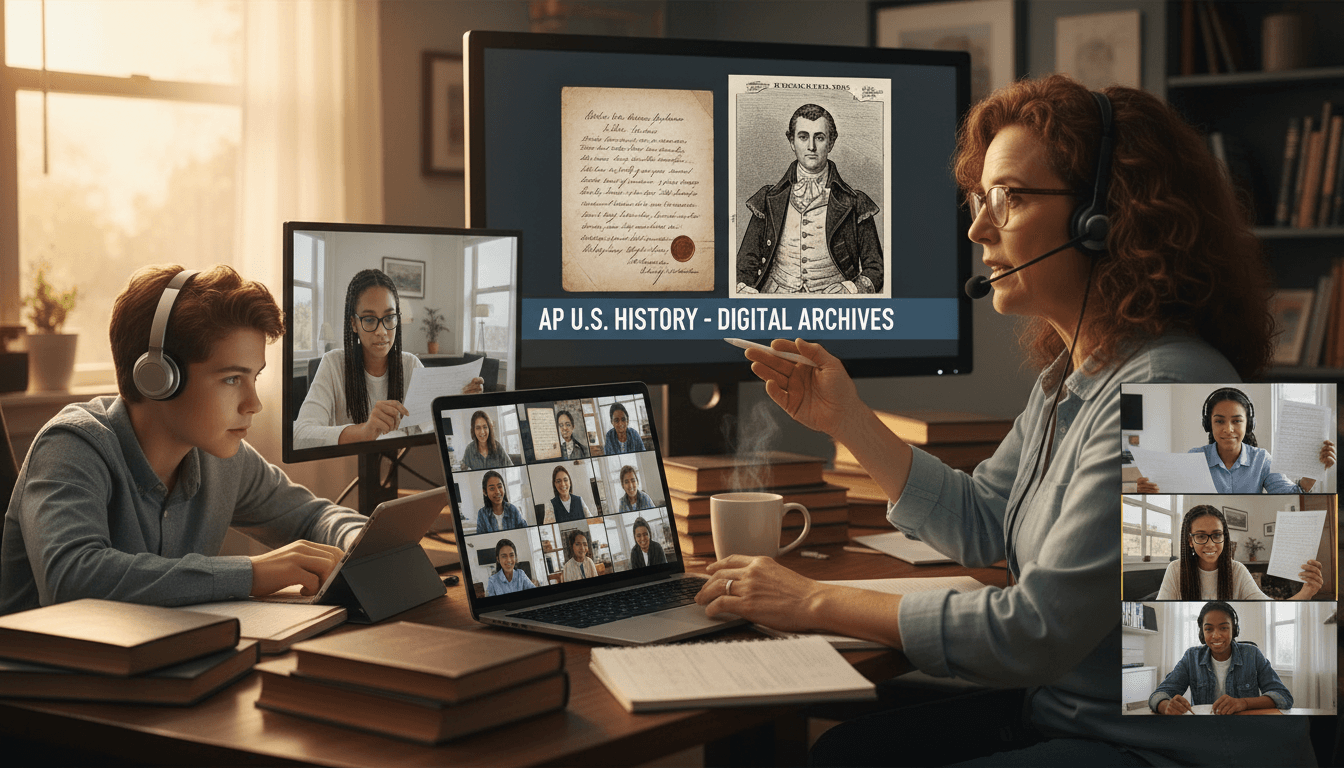
History Teacher Newsletter: Remote and Hybrid Learning Newsletter Guide

Remote and hybrid history instruction removes much of the in-person scaffolding that makes AP history manageable for students: the group discussion that surfaces different interpretations, the teacher annotation of a primary source on the board, and the in-class essay workshop where students see how their peers structure historical arguments. A regular history newsletter during remote or hybrid semesters compensates for some of that lost scaffolding by keeping families oriented to the course content, assessment expectations, and ways to support historical thinking at home.
This guide covers what to include in a remote learning history newsletter, how to explain AP essay formats and digital primary source work to families, and how to maintain meaningful parent engagement when the classroom is virtual.
Open each unit with an orientation newsletter
Remote learning students miss the passive orientation that happens in a classroom when a teacher introduces a new unit, posts materials on the board, and responds to student energy during the first lesson. At home, a student who misses the first video session of a new unit or attends without full attention may not know what the coming weeks cover or why the historical period matters.
A unit-start newsletter solves this by naming the period or theme, framing the central historical questions the unit addresses, and connecting the content to AP exam preparation. For AP US History, that might mean explaining that the coming weeks cover the Progressive Era and its challenges to Gilded Age economic and political structures, that this period appears frequently in AP LEQ prompts about continuity and change, and that students will analyze both the achievements and the limits of Progressive reform. Families who understand the scope and significance of a unit from the start can reinforce its relevance in everyday conversations with their student.
Provide complete logistical information for the remote week
Every history newsletter during a remote or hybrid semester should include the week's synchronous class schedule with video platform links, the assignment submission platform and any deadline changes, office hours schedule and how students can access them, and a list of the week's key deadlines. This information sounds basic, but for families managing multiple students across multiple courses and platforms, a single place to find all logistical details prevents the confusion that leads to missed submissions and missed class sessions.
For hybrid classes that split students into in-person and remote cohorts, tell families which mode applies to their student each day and what content both cohorts will be covering. Parents of in-person students want to know what happens on remote days so they can support continuity. Parents of remote students need to know how virtual attendance and assignment submission work when the class is partially in person. A newsletter that addresses both cohorts avoids the two-tier communication problem that hybrid models create.

Explain how digital primary source work is assessed remotely
One of the most distinctive challenges of remote AP history instruction is teaching primary source analysis without the ability to walk around a classroom, look over a student's shoulder, and catch misconceptions in real time. Digital primary source assignments completed at home require students to apply the HAPP framework independently: identifying Historical context, Audience, Purpose, and Perspective for each document they analyze.
A newsletter that explains how digital primary source work is graded helps families support this process at home. Tell parents what the assignment asks students to do: not just summarize the document's content but identify who wrote it, for whom, under what circumstances, and how the author's position shapes what they chose to say. Families who understand this framework can ask their student to walk through a document's HAPP elements out loud before writing their analysis, which is one of the most effective preparation activities available outside the classroom.
Address DBQ preparation for remote learning specifically
The Document Based Question is the most complex assignment format in AP history, and remote learning removes the in-class workshop environment where teachers typically scaffold DBQ preparation most intensively. A newsletter that addresses DBQ preparation specifically during a remote semester gives families the context they need to support this work at home.
Explain the DBQ structure in plain language: students receive 5 to 7 documents and must write a historical argument essay that uses those documents as evidence. The essay earns points for a defensible thesis, accurate use of at least three documents, contextualization beyond the immediate period, outside evidence, and complexity. Tell families what the most common preparation gap is for remote students working on DBQs: many students understand the documents individually but struggle to integrate them into a coherent argument rather than summarizing each one in sequence. Ask families to encourage their student to state their thesis and name their three strongest supporting documents out loud before sitting down to write. This verbal rehearsal produces more focused essays than sitting down to write with a blank page and seven documents to navigate.
Give families specific remote study strategies for AP history
AP history requires students to build both content knowledge and analytical writing skill simultaneously, and remote learning tends to favor content review at the expense of analytical practice. Students who spend most of their study time reviewing notes and timelines without practicing thesis formation, document analysis, and essay structure arrive at the AP exam with strong knowledge and weak application skills.
A newsletter that names specific remote study strategies for AP history gives families actionable guidance. Encourage families to support students in using timed writing practice: setting a 15-minute timer and writing a thesis plus evidence outline for a practice essay prompt before checking notes. Suggest that students review using active recall rather than passive reading: covering their notes and attempting to reconstruct the major causes, effects, and examples for the period being studied. Recommend the College Board's free AP Classroom resources, which include released practice questions and sample scored essays that are the most accurate preparation tool available. Families who know these strategies exist and understand why they work are more likely to encourage their student to use them.
Include a historiography or interpretation note when relevant
One of the intellectually rich aspects of AP history instruction is the attention to historiography: the ways historians have interpreted and debated the same events over time. Remote learning is a particularly good time to include a brief historiography note in a newsletter because it gives families a window into the kind of sophisticated historical thinking the course requires.
A newsletter note about historiography does not need to be long or technical. A single paragraph that says "Students in the current unit are examining how historians have debated the causes of World War I, with some emphasizing German responsibility and others emphasizing the role of alliance systems and miscalculation across multiple powers. Understanding that historical interpretation changes over time and involves genuine scholarly debate is one of the core skills AP history develops" gives families a meaningful picture of what their student is learning that goes beyond dates and events.
Close with a direct invitation for family engagement
Remote learning increases the distance between families and the school. The informal touchpoints that keep parents connected during an in-person school year, a brief conversation at pickup or a note on a returned assignment, disappear during remote semesters. The newsletter fills some of that gap, but only if families feel it is a two-way communication channel rather than a broadcast.
Close each newsletter with a specific invitation: a historical discussion question families can explore with their student at dinner, a suggestion for a documentary or reading that connects to the current unit, or a note about upcoming office hours where parents can ask questions directly. Families who engage with the course material at home produce students who engage more actively in remote class sessions, and that engagement is what sustains the quality of AP history learning even when the classroom is entirely virtual.
Get one newsletter idea every week.
Free. For teachers. No spam.
Frequently asked questions
How often should a history teacher send newsletters during remote learning?
Send a unit-start newsletter at the beginning of each new historical period or thematic unit, a pre-assessment newsletter before each major test or essay, and a brief weekly summary in the first or last day of each week. For AP history, add a specific newsletter when DBQ or LEQ practice is assigned so families understand what the writing task requires and how to support the process at home. Three to four newsletters per unit strikes the right balance between keeping families informed and avoiding inbox fatigue.
What should a remote learning history newsletter cover?
Cover the week's synchronous class schedule and video platform links, what period or theme students are studying and why it matters for AP exam preparation, how online assignments and participation are graded, and where students can access digital primary source collections and practice materials. For AP history, include a note on how remote learning affects the essay practice schedule and what additional resources are available for students who need to build context for the period under study. Logistical clarity combined with academic context reduces the number of individual parent questions you field each week.
How do you help parents support AP history essay preparation during remote learning?
Tell parents what essay format students are working on and what the specific challenge is for that type. For DBQ preparation, explain that students need to practice reading documents for author purpose and historical context, not just content, and that the most useful family support is asking their student to explain a document's perspective out loud before they write about it. For LEQ preparation, tell parents that the most common gap is students who know the content but struggle to form a clear thesis, and that asking 'what is your argument?' rather than 'do you know the material?' is the more useful question.
How do you maintain meaningful historical discussion in a remote learning newsletter?
Include a discussion prompt or historical question in each newsletter that connects the current unit to something in the present or to a student's personal experience. For example, during a unit on propaganda in World War I, you might ask families to discuss with their student one example of persuasive messaging they have encountered recently and how it compares to the techniques they have studied. These prompts extend the historical thinking that happens in class into the home environment and keep history feeling relevant rather than academic in the abstract sense.
How does Daystage support history teachers during remote and hybrid learning?
Daystage gives history teachers a streamlined newsletter tool that makes it fast to send unit-start updates, pre-assessment reminders, DBQ preparation guides, and weekly logistical summaries during remote semesters. You build the template once and update the period-specific content, platform links, and assignment deadlines for each send. Families receive organized, readable emails instead of piecing together information from a learning management system. Teachers can see open rates and know which families are engaged throughout the remote learning period.

Adi Ackerman
Author
Adi Ackerman is a former classroom teacher and curriculum writer with 8 years in K-8 schools. She writes about school communication, parent engagement, and what actually works in real classrooms.
More for Subject Teachers
Ready to send your first newsletter?
3 newsletters free. No credit card. First one ready in under 5 minutes.
Get started free