
Foreign Language Teacher Newsletter: Teacher Newsletter Examples That Actually Work
Foreign language teachers have a communication challenge that most subject teachers do not face. The parents reading your newsletter largely cannot evaluate what their child is learning by looking at homework or tests. They do not speak the language. They may not know what proficiency levels mean or why vocabulary acquisition follows a particular sequence. And yet their involvement at home, even at the level of curiosity and encouragement, meaningfully affects how quickly students develop fluency.
The newsletter examples below show what works, organized by format and purpose. Each one solves a different communication problem that world language teachers face throughout the school year.
The monthly unit overview newsletter
Send this at the start of each new unit. Include the communicative theme (travel, family, food, environment, social issues depending on the course level), the vocabulary categories students will build, the grammar structures being introduced, and the can-do statements that define the unit's proficiency targets. End with one or two conversation prompts families can use at home.
An effective opener for a Spanish 2 unit on environment and sustainability might read: "This month students are learning to discuss environmental problems and propose solutions using the subjunctive mood. By the end of the unit, they should be able to express opinions about environmental issues and discuss what communities should do to address them." That sentence gives families a clear picture without requiring any background in Spanish pedagogy.
The vocabulary of the week newsletter section
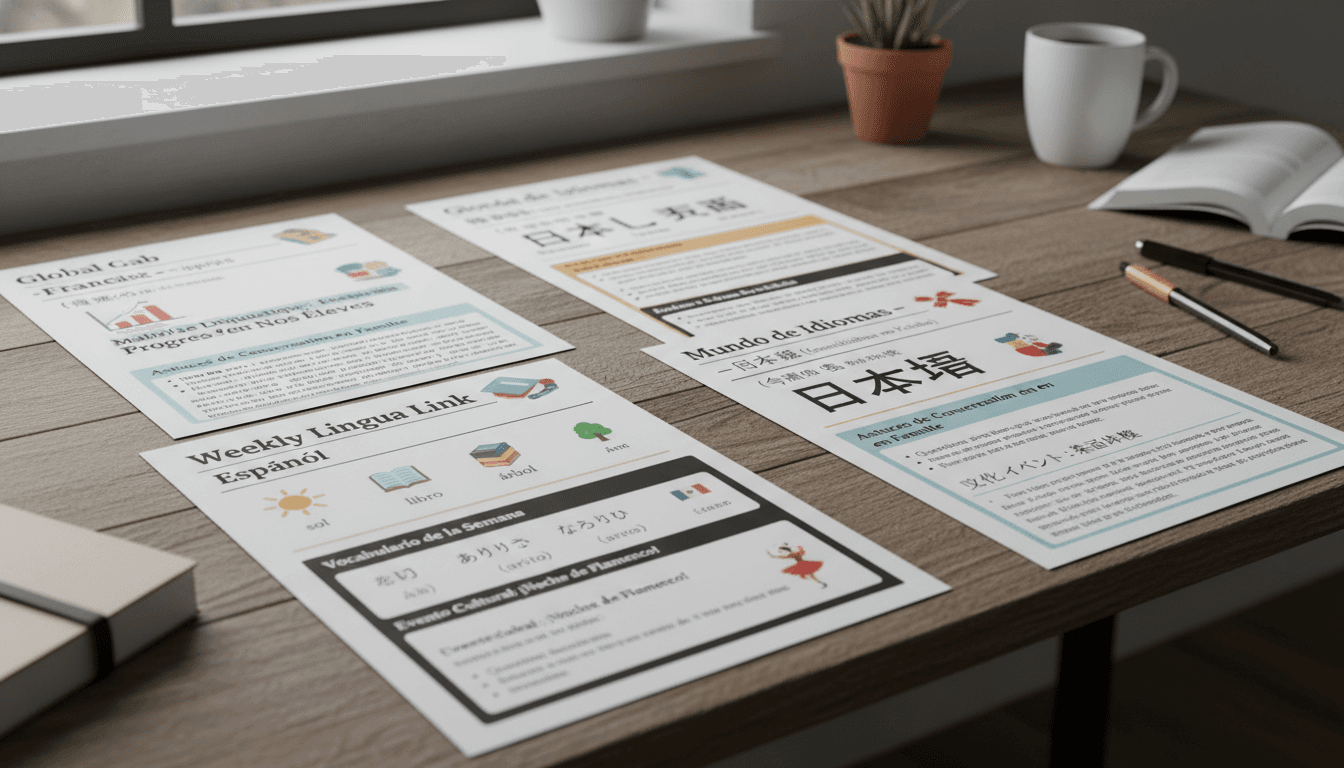
A vocabulary of the week section is one of the most family-friendly features a world language newsletter can include. Choose three to five words or phrases from the current unit. Write each one in the target language, include an approximate pronunciation guide in parentheses, and give the English meaning. Add one sample sentence that uses the word in context.
This section works because it is actionable. A parent who reads "bienvenido (bien-ven-EE-do) means welcome" can greet their student with it when they get home from school. That 10-second interaction reinforces the word more effectively than another review drill.
The cultural spotlight newsletter
A cultural spotlight newsletter is most powerful when it connects directly to the unit in progress. If the class is studying a unit on markets and commerce in a Spanish-speaking country, the cultural spotlight might describe the tradition of the tianguis market in Mexico, explain how it differs from a supermarket, and include one or two photographs. If the class is in a French unit on regional identity, the spotlight might describe how Quebecois French differs from Parisian French and why that distinction matters for students who want to travel.
Cultural content that connects to classroom vocabulary and themes teaches both culture and language simultaneously. Families who read the spotlight often bring it up with their student later, which deepens cultural understanding without the teacher having to engineer the conversation.
The proficiency progress newsletter
Send this once or twice a year, timed around report cards or parent conferences. Describe the proficiency range the class is currently working within using can-do language. "At this point in the year, most students in Spanish 3 can handle an unrehearsed conversation about familiar topics for two to three minutes, read a newspaper article with some use of context clues, and write a structured paragraph with minimal major errors." That description gives families a real benchmark rather than a letter grade they cannot interpret.
For courses aligned to AP or IB exams, include the relevant performance benchmarks. AP French Language and Culture, for example, targets a range from Intermediate High to Advanced Low on the ACTFL scale. Families who understand where the exam is targeting can make informed decisions about whether their student is on track.
The AP and IB exam preparation newsletter
For AP Spanish, AP French, AP Chinese, AP Italian, AP Japanese, AP Latin, or IB Language B courses, send a dedicated exam preparation newsletter in January or February. Describe the exam format in plain language: the sections, the time allotments, the task types, and the scoring rubrics. Explain what the Interpersonal Writing, Presentational Writing, Interpersonal Speaking, and Presentational Speaking tasks look like for AP Language courses.
Give families specific resources students should be using at home during the preparation period: AP Classroom practice sets, College Board sample responses, and the scoring guidelines that describe what a score of 3, 4, or 5 looks like on the free-response section. Families who understand the exam structure ask better questions and create better conditions for independent study at home.
The end-of-year celebration newsletter
End the year by naming what students can now do in the language that they could not do in September. List the communicative themes covered, the proficiency movement made, and two or three highlights from student work during the year. If students produced a video project, performed a skit, wrote a short story, or delivered a presentational speech, name those accomplishments specifically.
This newsletter is also the right place to recommend summer maintenance strategies. Languages fade without use. Suggesting specific apps, streaming content, or community events in the target language gives students a way to maintain their proficiency over the summer without formal instruction.
What every good world language newsletter shares
Every example above gives families something concrete to do or understand. They use plain language to describe abstract proficiency concepts. They connect cultural content to classroom instruction. And they give families a way to participate in language learning without requiring fluency. That combination, specific, accessible, actionable, is what makes a foreign language newsletter worth reading every time it arrives.
Get one newsletter idea every week.
Free. For teachers. No spam.
Frequently asked questions
What makes a world language newsletter different from newsletters in other subject areas?
Foreign language newsletters need to communicate the value of language learning to families who may not speak the language themselves, translate abstract proficiency concepts into observable behaviors, and give families concrete ways to support language practice at home without requiring fluency. They also carry the unique opportunity to include target-language content directly in the newsletter as a teaching tool.
Should foreign language newsletters include content written in the target language?
Yes, strategically. A short greeting in the target language at the opening of the newsletter, a vocabulary word of the week with pronunciation guide, or a cultural quote with translation are all accessible and purposeful inclusions. They reinforce to families that the language is alive and being used, not just studied. Avoid including large blocks of target-language text without translation, which excludes the families you are trying to engage.
What is the vocabulary of the week section and how should it work in a newsletter?
A vocabulary of the week section typically features three to five words or phrases from the current unit, written in the target language with pronunciation guidance and an English translation. It may include a sample sentence. The goal is to give families something they can use at home: asking their student to use the word of the week in a sentence, or trying to say the phrase themselves at dinner, creates low-stakes reinforcement of classroom learning.
How should a foreign language newsletter handle the cultural spotlight feature?
A cultural spotlight should connect directly to the unit in progress rather than being a standalone cultural fact. If students are studying a unit on food and markets, the cultural spotlight might describe a specific market tradition in a Spanish-speaking country. If students are studying housing and family structures, the spotlight might compare family dynamics across French-speaking regions. Connection to curriculum gives the cultural content instructional weight.
How does Daystage help foreign language teachers produce newsletters that families look forward to reading?
Daystage gives world language teachers a structured, professional newsletter format that parents open consistently because it looks polished and arrives on a predictable schedule. You can build recurring sections like vocabulary of the week and cultural spotlight into your template so the structure stays consistent and your prep time is spent on content, not layout. Families who expect a newsletter on Monday morning read it.

Adi Ackerman
Author
Adi Ackerman is a former classroom teacher and curriculum writer with 8 years in K-8 schools. She writes about school communication, parent engagement, and what actually works in real classrooms.
More for Subject Teachers
Ready to send your first newsletter?
3 newsletters free. No credit card. First one ready in under 5 minutes.
Get started free