
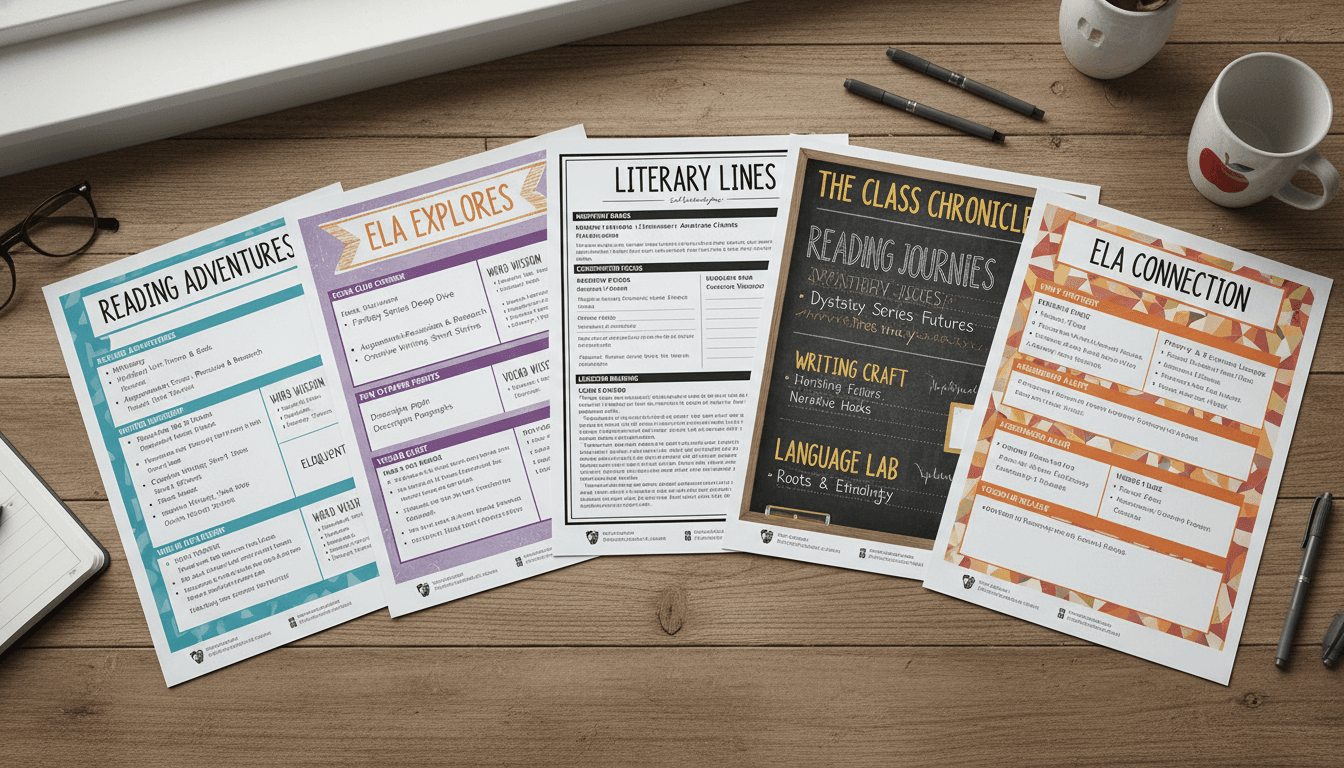
English Language Arts Teacher Newsletter: Teacher Newsletter Examples That Actually Work
Most ELA newsletters fail for the same reason: they describe what is happening in class without explaining why it matters or what families can do with the information. A newsletter that says "we are working on reading comprehension and writing this week" is accurate but useless. A newsletter that explains which comprehension strategy students are practicing, which text they are practicing it on, and how a parent can ask one good question at dinner is genuinely valuable.
This guide breaks down what effective ELA newsletter sections look like with concrete examples, so you have a model to build from rather than starting from scratch every week.
The reading section: what works and what does not
A weak reading section: "Students are reading a novel and working on comprehension." A strong reading section: "This week students are reading Chapters 8 through 12 of Esperanza Rising. We are working on the skill of identifying how a character's perspective shifts over time. Ask your student: how is Esperanza's attitude toward her new life in California different now compared to when she first arrived, and what happened that changed it?"
The difference is specificity at every level. The text is named. The pages are specified. The comprehension skill is named in plain language. And the conversation prompt at the end gives families a way to engage with the content without needing to have read the book themselves. Build your reading section this way every week and families will start reading it.
The writing section: process over product
ELA newsletters typically report on writing in terms of final products: "students are working on their persuasive essays." Families learn more from understanding where students are in the writing process and what specific craft move they are practicing this week.
A stronger format: "Students are in the revision stage of their argument essays. This week they are focused on one specific revision skill: strengthening the evidence they use to support their claim. We practiced the difference between evidence that restates the claim and evidence that actually proves it. Before final drafts are due Thursday, ask your student to explain their strongest piece of evidence and why it proves their argument." This version tells families what stage the writing is in, what skill is being developed, and how they can ask a useful question.
The vocabulary section: fewer words, more depth
A vocabulary list of twenty words with definitions is something students study for a quiz and forget by the following week. A newsletter vocabulary section of four to five words with context and a conversation hook lasts longer and teaches more durably.
For each word, give the definition, show it used in a sentence from the current text, and provide one question for home. For a word like "infer": "To infer means to figure out something the author implies but does not say directly. Example: when Steinbeck writes that Lennie 'did not look at his hands,' we infer he feels ashamed of what happened. Ask your student: what have you inferred recently from someone's behavior that they did not say out loud?" The question grounds the academic vocabulary in real-world thinking.
Grammar and conventions: connect it to student writing
Grammar instruction is most effective when it is connected to students' own writing rather than presented as abstract rules. When you cover a grammar concept in class, reflect that in the newsletter by connecting it to what students actually wrote.
For example: "This week we looked at how sentence variety affects the rhythm and pace of writing. Students revised a paragraph from their own draft by combining two short sentences into one compound or complex sentence. Ask your student to read you one sentence from their essay that they revised and explain why the new version is stronger." This transforms a grammar lesson into a communicable achievement families can engage with directly.
The discussion prompt: the single most underused newsletter tool
Every ELA newsletter should include one conversation prompt for families to use at home. This is the section with the highest potential impact and the lowest effort cost. One well-chosen question can spark twenty minutes of literary discussion at a dinner table, which is more reading practice than most students get from a homework assignment.
The prompt should be connected to the current reading or writing, open-ended enough that there is no single right answer, and simple enough that a parent who has not read the text can still ask it. "What was the most surprising thing that happened in your reading this week?" works. "What is the theme of the novel?" does not, unless you have also explained in the newsletter what theme means in literary terms.
The upcoming deadlines section: specific dates only
"Coming up soon" is not useful. "Final narrative essay due Thursday, November 14th by 11:59 PM via Google Classroom. Reading log for Unit 3 due Friday, November 15th at the start of class" is useful. Families plan around specific dates. Vague time references create confusion and last-minute panic for students and parents alike.
List every deadline in the upcoming two weeks with the specific date and time, the assignment name, and the submission method. Keep this section short and scannable. Families reference it multiple times during the week to help their students stay on schedule.
The teacher voice: brief and personal
One or two sentences of genuine teacher voice make a newsletter feel human instead of institutional. This is not a place for educational jargon or motivational language. It is a place for a real observation: "The writing I read this week was genuinely surprising. Students took risks with their leads that I was not expecting, and several of them landed."
Short, honest, specific. That is the voice that makes families look forward to the newsletter rather than filing it away unread. It signals that there is a person on the other side of the email who is paying close attention to what their student is doing every day.
Get one newsletter idea every week.
Free. For teachers. No spam.
Frequently asked questions
What makes an ELA newsletter actually useful to parents?
Specificity. A newsletter that tells parents 'we are reading this week' is not useful. A newsletter that says 'students are reading Chapters 12 through 15 of Hatchet and identifying how the author uses survival details to reveal Brian's changing character' gives a parent something to ask about and a context to help their student think inside of. The subject expertise you have as an ELA teacher is exactly what parents lack. When you translate curriculum content into specific, plain-language descriptions, you make it possible for families to be genuine partners.
What is an example of a strong reading section in an ELA newsletter?
A strong reading section names the text, the pages or chapters, the comprehension skill students are practicing, and one discussion question for home. For example: 'This week: Tuck Everlasting, Chapters 8 through 12. We are working on identifying the theme of a text and distinguishing it from the plot. Ask your student: what do you think the author wants us to understand about life and time from this story? There is no single correct answer.' That example is specific, skill-connected, and gives families a real conversation prompt.
What does a strong writing update look like in an ELA newsletter?
A strong writing section describes what students are working on, what stage of the writing process they are in, and what the final product will look like. For example: 'Students are in the drafting stage of their personal narrative essays this week. They are focusing on writing a compelling lead that drops the reader into the middle of the moment rather than starting with 'I am going to tell you about.' The final draft is due Friday and should be 400 to 600 words.' This tells families what their student is doing, why that specific skill matters, and when it is due.
How do ELA teachers write a vocabulary section families will actually use?
Keep it to five words or fewer. Give each word a plain definition, one example sentence that comes from the text students are reading, and one question families can ask at home. For example: 'Connotation: the emotional feeling a word carries beyond its dictionary meaning. Example from this week's poem: the author chose 'whispered' instead of 'said,' which creates a feeling of secrecy. Ask your student: what connotation does 'damp' have compared to 'wet'?' Five words with this level of support are more valuable than twenty words with just definitions.
How does Daystage help ELA teachers send newsletters that look and read like the examples above?
Daystage gives ELA teachers a clean newsletter format where they fill in the content and the layout handles itself. You write the reading section, writing update, vocabulary words, and upcoming deadlines, and families receive a professional-looking email that is easy to scan and reference throughout the week. You can build a template for your weekly newsletter once and reuse the structure for every issue, which means the quality stays consistent even when you are short on time.

Adi Ackerman
Author
Adi Ackerman is a former classroom teacher and curriculum writer with 8 years in K-8 schools. She writes about school communication, parent engagement, and what actually works in real classrooms.
More for Subject Teachers
Ready to send your first newsletter?
3 newsletters free. No credit card. First one ready in under 5 minutes.
Get started free