
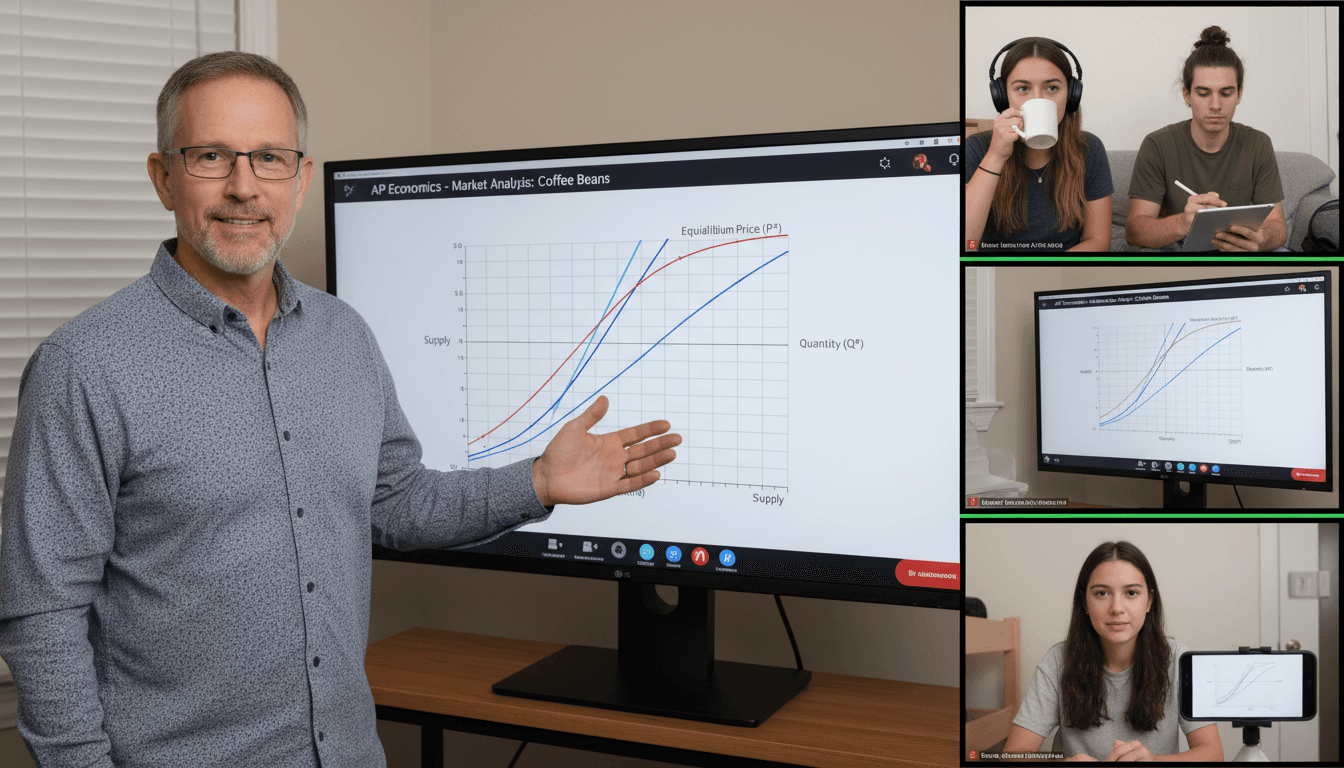
Economics Teacher Newsletter: Remote and Hybrid Learning Newsletter Guide

Remote and hybrid economics classes create a specific communication challenge: families who cannot observe their student in class have limited visibility into how demanding the content is, how the AP exam timeline is progressing, and whether their student is keeping up with the pace of a course that covers six units of rigorous economic theory in under nine months. A well-written weekly newsletter closes that visibility gap and gives families the context they need to support their student's learning at home.
This guide covers what to include in a remote economics newsletter, how to communicate about AP exam preparation over a distributed learning environment, and how to design at-home activities that work for economics at every level.
Set the weekly unit context clearly
Remote learning students can fall behind in ways that are invisible to their families because there is no physical commute to class, no textbook coming home in a backpack, and no face-to-face check-in with a teacher to signal that something is not going well. A weekly newsletter that names exactly what unit is being covered, what concepts are in focus, and what was assessed in the past week gives families a real-time picture of where the class is in the curriculum.
For AP economics, this weekly context is especially important because the course moves at a pace that leaves little room for recovery if a student falls behind on foundational units. A family who knows from the newsletter that "we are now in Unit 4: Business Cycles, Unemployment, and Inflation, and students completed the Phillips Curve quiz on Wednesday" has a frame for asking their student meaningful questions about the content rather than a general "how is economics going?"
Communicate live session expectations specifically
Remote and hybrid economics classes use live sessions differently, and families need to understand what their student is expected to do during and after each session. Tell families whether live sessions are mandatory or supplemental, whether they are recorded, how participation is assessed, and what the makeup process is for students who miss a live session.
For economics specifically, note whether live sessions include active graph drawing exercises, discussion of current events, or practice free-response walkthroughs. Families who understand what the live session involves are more likely to protect that time in the student's schedule rather than scheduling other activities over it or treating it as optional because it happens at home.

Name the digital tools and platforms students are using
Remote economics classes rely on digital tools that families may not know exist: virtual stock market simulations, Federal Reserve education platforms, economics simulation games, current event analysis tools, and the class learning management system. When a new tool is introduced, name it in the newsletter and give a one-sentence description of what it does and how students access it.
A note like "This week students will begin working on the MarketWatch Virtual Stock Exchange simulation. Each student manages a $100,000 virtual portfolio using real market data. The simulation runs for four weeks and accounts for 15% of the unit grade. Students access it through the link posted on our class page" gives families everything they need to help their student get started without having to contact the teacher for basic setup information.
Address AP exam preparation as an ongoing newsletter section
For AP Macroeconomics and Microeconomics teachers, the AP exam countdown deserves its own recurring section in every newsletter from January through May. Name the number of weeks until the exam, what units remain to be covered, what practice resources are available, and what the current class average looks like on practice assessments if that information is appropriate to share.
Families who receive an AP countdown in every newsletter develop an accurate sense of the exam's proximity and importance that families who only hear about the exam at the start and end of the year never develop. That ongoing awareness translates into more consistent study habits at home and a stronger family role in protecting study time as the exam approaches.
Design at-home economics activities for real-world connection
The most effective at-home economics assignments are ones that connect textbook concepts to the student's actual economic environment. A newsletter that explains how to turn everyday household decisions into economics learning gives families a practical way to reinforce classroom concepts without requiring economics expertise.
For a personal finance unit, suggest that families review a utility bill, a grocery receipt, or a pay stub with their student and identify the concepts covered in class: marginal cost, opportunity cost, fixed versus variable expenses, or tax incidence. For a market structures unit, suggest that students identify two products they use regularly and compare them using the market structure framework from class. These activities are low-burden for families and high-value for students because they anchor abstract concepts in real, familiar contexts.
Be transparent about how remote assessments work
Remote economics assessments raise legitimate questions for families: are tests open-note, are they timed, how is graph drawing assessed digitally, and how are free-response answers submitted and graded? Address these questions proactively in the newsletter before each major assessment rather than waiting for individual parent inquiries.
Explain the assessment format, the timing, the submission method, and any academic integrity expectations that apply to remote testing. For free-response practice, note whether students should write their answers by hand and photograph them for submission, type them in the class platform, or use a drawing tool for graph components. Families who understand the assessment format can help their student prepare for it accurately rather than preparing for the wrong type of test experience.
Close with what is coming next week
End each remote learning newsletter with a brief preview of the following week: what concept or unit will be introduced, whether there is a live session or a major assignment due, and any AP exam preparation milestones. This closing section is especially valuable in a remote setting because it gives families the information they need to help their student plan and prioritize their week before it begins.
A consistent newsletter structure in a remote or hybrid class builds something that is genuinely difficult to replicate in other ways: the sense that the teacher is present and organized even when students and families cannot see the classroom. That perception of organized, consistent communication is one of the strongest predictors of family confidence in the course and in the teacher, which matters more than ever when the classroom is inside a screen.
Get one newsletter idea every week.
Free. For teachers. No spam.
Frequently asked questions
How often should an economics teacher send newsletters during remote or hybrid learning?
Weekly newsletters work well for most remote economics classes. The pace of AP economics content is demanding, and families who do not receive regular updates often underestimate how much work their student is doing or how far behind they may be falling. For AP sections specifically, increase newsletter frequency in the six weeks before the exam: a weekly update that tracks units covered, practice exam scores if applicable, and preparation resources gives families the real-time visibility they need to support their student in the final push.
What should a remote economics newsletter include?
Cover the current unit topic, the week's lesson focus, any digital simulations or tools students need to access, how assessments will be submitted, live session attendance expectations, and any AP exam preparation updates for AP sections. For personal finance units, include a brief note on the at-home component, such as a family budget review activity or a savings goal exercise, so families understand how to support the work without it seeming like homework directed at the adults.
How should an economics teacher explain remote free-response practice to parents?
Tell families that free-response writing is the most important skill for the AP exam and that remote practice looks different from in-class practice. Students should be timed when writing responses at home, writing for the full allotted time without notes, and submitting their work through the class platform for teacher feedback. Families can support this by ensuring their student has a quiet 20-minute window for timed writing exercises and by understanding that these are graded practice responses rather than open-book assignments.
What virtual simulations work well for remote economics classes?
Several free platforms support remote economics learning effectively. The Federal Reserve Bank's education site offers economic simulations and lesson tools for teachers and students. MarketWatch's virtual stock exchange allows students to manage a simulated portfolio using real market data. Econlowdown offers free AP economics resources directly from the Fed. In the newsletter, name the platform and the simulation, tell families what the activity involves, and note the submission deadline so the assignment does not get lost in the general homework pile.
How does Daystage support economics teachers sending newsletters for remote and hybrid classes?
Daystage lets economics teachers build a weekly newsletter template with sections for the current unit, AP exam countdown updates, live session links, and digital resource links. For AP economics teachers managing both remote and in-person students in a hybrid model, having a single, consistent newsletter that goes to all families reduces the coordination overhead of managing two communication streams. Open rate tracking shows which families are reading the newsletters, which is especially useful in the final weeks before the AP exam when every family needs to be engaged and informed.

Adi Ackerman
Author
Adi Ackerman is a former classroom teacher and curriculum writer with 8 years in K-8 schools. She writes about school communication, parent engagement, and what actually works in real classrooms.
More for Subject Teachers
Ready to send your first newsletter?
3 newsletters free. No credit card. First one ready in under 5 minutes.
Get started free