
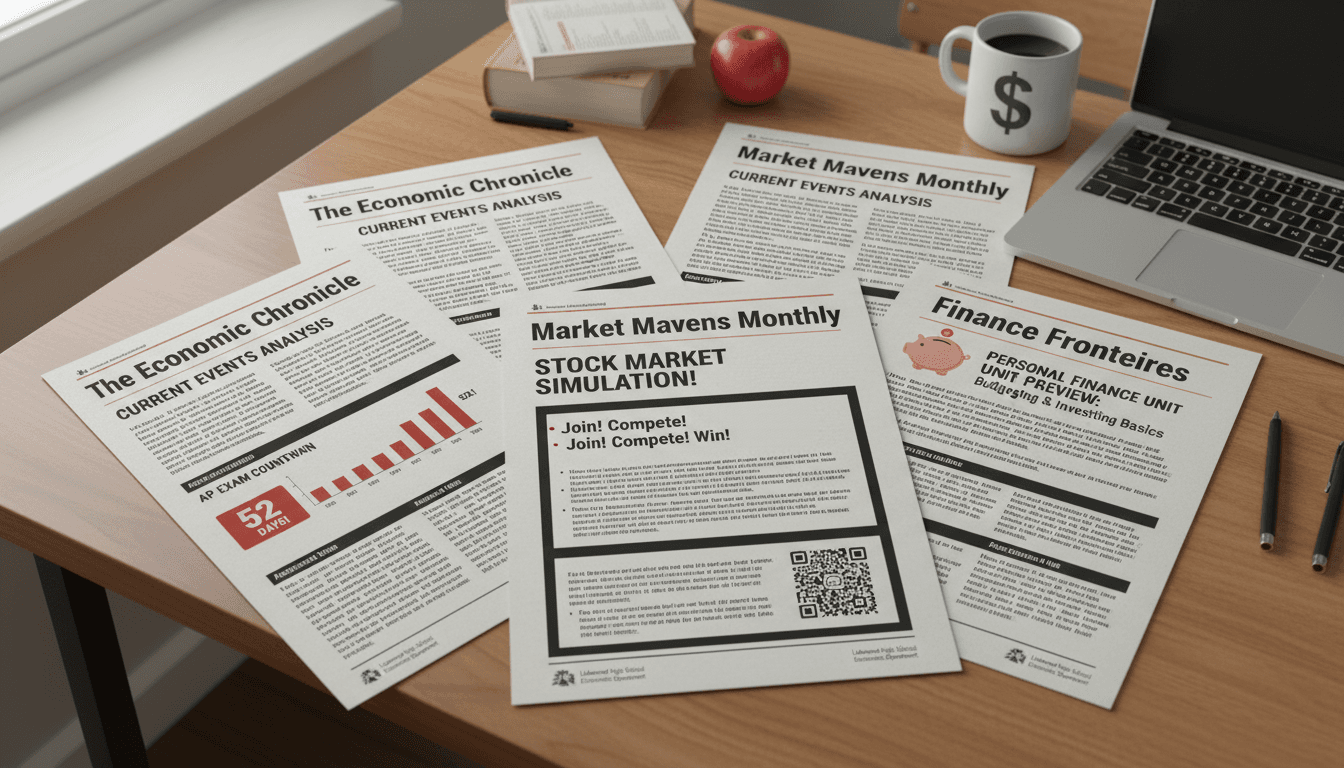
Economics Teacher Newsletter: Teacher Newsletter Examples That Actually Work

Economics teachers send newsletters across a wider range of situations than most families realize. An AP exam countdown, a stock market simulation kickoff, a current events analysis introduction, a personal finance challenge, and a unit test preview all require different tones and structures. The teachers who communicate most effectively do not start from scratch each time. They have a clear model for each newsletter type that they update and improve across the year.
This guide breaks down what strong economics newsletters look like across the most common communication scenarios, with specific language examples and structural notes you can apply immediately.
The AP exam countdown newsletter
AP economics teachers who send a running countdown newsletter from January through the May exam window produce significantly more prepared students than those who mention the exam only at the start of the year and again in April. The countdown newsletter does not need to be long. It needs to be consistent.
An effective AP countdown newsletter sounds like: "Eight weeks until the AP Macroeconomics exam. This week we completed Unit 4 on national income accounting and the multiplier effect. Next week we move into Unit 5: aggregate demand, aggregate supply, and the business cycle. Practice multiple choice sets for Units 1 through 4 are posted on the class page. Students who are struggling with any Unit 1 through 3 content should use this week's review materials before we move further into the exam timeline." Specific, action-oriented, and always connected to the countdown. Families who receive this newsletter every week develop a realistic picture of where the class is and what their student needs to do.
The stock market simulation kickoff newsletter
Stock market simulation announcements are some of the most engaging newsletters economics teachers send, but they often undersell the academic purpose. The best kickoff newsletters lead with the learning objective, not the competitive element.
A strong example: "This week students begin a four-week MarketWatch stock market simulation. Each student will manage a $100,000 virtual portfolio using real-time market data. The assignment is not about finishing in first place. It is about making and documenting investment decisions that reflect the concepts we have studied: opportunity cost, risk versus return, market information, and diversification. Each week students submit a one-page portfolio update explaining two decisions they made and the economic reasoning behind them." This framing tells families that the simulation is a graded academic exercise with specific skill targets, not a game. That distinction matters when families are deciding how much to engage with their student's portfolio choices as a learning conversation.

The current events analysis newsletter
Economics is one of the few high school subjects where the news is literally the curriculum. The Federal Reserve's interest rate decisions, inflation data, unemployment reports, and fiscal policy debates are all classroom material, and a newsletter that connects these events to what students are studying is one of the most effective engagement tools an economics teacher has.
An effective current events newsletter includes one or two news items from the past week, a one-sentence explanation of how each connects to the current unit, and a question families can ask their student: "The Consumer Price Index rose 3.2% this month. In class we discussed what causes inflation and how it affects purchasing power. Can your student explain what CPI measures and why it matters for economic policy?" Families who use this question learn something, and students who can answer it know their material. The newsletter becomes a feedback loop for learning.
The personal finance unit newsletter
Personal finance units generate more family engagement than any other economics topic because the content is immediately relevant to household decisions families are making right now. A personal finance newsletter should lean into this relevance rather than treating it as a side note.
A strong personal finance newsletter connects the unit to decisions families can discuss together: "This week students are building a personal budget using the 50/30/20 framework: 50% for needs, 30% for wants, and 20% for savings and debt repayment. A useful conversation at home: review your monthly income and one category of household spending together and estimate whether it falls under 'needs' or 'wants' in the framework. You do not need to share actual numbers. The goal is to help students see how the model applies to a real household." This kind of practical, opt-in family engagement suggestion is far more effective than a generic note to talk about money with your student.
The unit test preview newsletter
An economics unit test preview newsletter needs to do more than name the test date. Families need to understand what type of assessment is coming, what the high-weight concepts are, and what good preparation looks like in the week before the test.
A useful preview for a supply and demand unit test might read: "The Unit 2 test on Thursday covers supply and demand graphs, price elasticity, consumer and producer surplus, and government interventions including price ceilings and floors. Students should be able to draw and analyze a supply and demand graph from memory, calculate percentage changes for elasticity problems, and explain the effects of a price ceiling or floor using both a graph and written analysis. The most common gap I see on this test is mislabeled graphs. Students who practice drawing the key graphs by hand without notes before Thursday will perform significantly better than those who only review their class notes." Specific, technical, and directly useful for families who want to help but do not know where to start.
The Federal Reserve visit preview newsletter
A newsletter announcing an upcoming Federal Reserve visit works best when it is both logistically complete and academically grounding. Give the date, the logistics, the dress code, and the permission form deadline, but also give families a genuine sense of what makes this visit educationally significant.
"When we visit the Federal Reserve next month, students will be stepping inside the institution that sets the interest rates we studied in Unit 4 and manages the money supply systems we modeled in Unit 5. Meeting the economists who work there and seeing the operational scale of the central bank turns policy decisions from textbook examples into real institutional choices." This kind of framing earns family enthusiasm for a field trip that might otherwise seem like just a building tour, and it gives students a sense of purpose about what they are going there to learn.
The end-of-year economics reflection newsletter
An end-of-year economics newsletter that summarizes what students have studied and how far they have come is a powerful communication tool that many teachers skip because the year is winding down and the urgency feels low. Do not skip it.
A brief summary of the units covered, the skills students developed, and the real-world economic events that shaped the year's learning gives families a clear picture of what their student achieved in your class. For AP students who sat for the exam, a note about what to expect from the score release and how to think about the 5-point scale in context of the course's content depth closes the communication loop for families who have been tracking their student's preparation all year. Families who feel that a teacher valued their engagement throughout the year are the ones who most strongly recommend that teacher to others.
Get one newsletter idea every week.
Free. For teachers. No spam.
Frequently asked questions
What makes an economics teacher newsletter effective?
An effective economics newsletter is specific, timely, and grounded in what students are actually doing in class. It names the unit, explains what concepts are being covered, and tells families exactly what they can do at home to reinforce the learning. The newsletters that generate the most parent engagement are ones that connect classroom economics to real-world news events or household decisions that families recognize. Abstract economic theory becomes approachable when the newsletter points to a current interest rate decision or a price change families have noticed at the grocery store.
What is a good example of an economics newsletter for an AP exam prep period?
A strong AP prep newsletter names the exam date, the number of weeks remaining, what units are still being covered, and what free-response question types have appeared most frequently in recent years. It includes one or two specific study strategies with time estimates: 20-minute timed free-response sessions three times per week, one practice multiple choice set per night, and one graph drawing drill using key models. It closes with a list of free AP prep resources and a note on when the teacher is available for extra help.
How should an economics teacher newsletter introduce a stock market simulation?
A simulation kickoff newsletter should explain what the simulation is, how long it runs, what students are expected to do each week, how it is graded, and what the learning objectives are. Tell families that students will manage a virtual portfolio using real market data and that the goal is not to pick winners but to understand how investment decisions involve trade-offs, risk tolerance, and opportunity cost. Include the platform name and explain that students access it through the class site. Families who understand what the simulation involves are more likely to engage with their student's portfolio decisions as a learning conversation rather than dismissing it as a game.
Can economics newsletters be used to introduce current events analysis assignments?
Yes, and this is one of the most effective uses of a regular economics newsletter. When you are assigning a current events analysis, include one or two recent news items that connect directly to the unit in the newsletter. A note like 'This week the Federal Reserve announced a 0.25% rate increase. In class we discussed how this connects to the money market model we built in Unit 4. Your student can explain why the Fed raised rates and what effect it is expected to have on inflation and unemployment' gives families a window into what their student is learning and turns the news into a household conversation rather than a textbook abstraction.
How does Daystage help economics teachers build and send newsletter examples efficiently?
Daystage lets economics teachers build a library of newsletter templates organized by communication type: AP exam countdown, unit kickoff, stock market simulation launch, current events analysis, and field trip preview. Because the economics curriculum follows a predictable annual structure, these templates can be reused year after year with updates to dates and current events. The time saving across a full school year is significant. Daystage also tracks which families open each newsletter, so teachers can identify early which families are disengaged and follow up before a student falls seriously behind.

Adi Ackerman
Author
Adi Ackerman is a former classroom teacher and curriculum writer with 8 years in K-8 schools. She writes about school communication, parent engagement, and what actually works in real classrooms.
More for Subject Teachers
Ready to send your first newsletter?
3 newsletters free. No credit card. First one ready in under 5 minutes.
Get started free