
Drama Teacher Newsletter: Parent Conference Newsletter Template
Parent conferences in drama class often start from the same point: the parent does not fully understand what their student does in the room each day. Drama is not math. There is no graded worksheet to pass across the table. Without context, the conference can drift into vague territory and end without either party feeling like progress was made.
A pre-conference newsletter solves this. Sent 3 to 5 days before the meeting, it orients families to the portfolio, the growth areas being discussed, and the language of the program. This guide covers what to put in that newsletter and how to structure the conversation that follows.
Explain what the portfolio contains before the conference begins
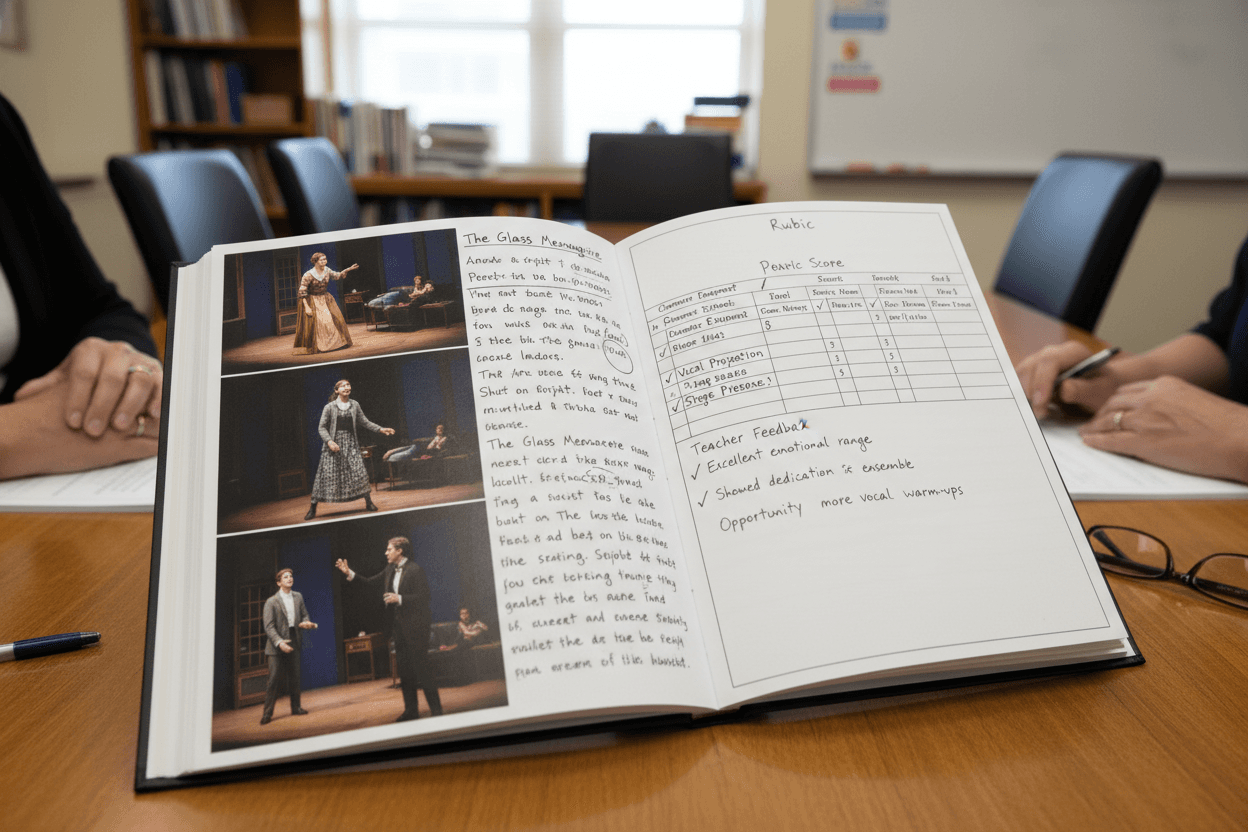
A drama portfolio is not a stack of graded tests. It typically includes annotated scripts, performance self-evaluations, teacher rubric scores, rehearsal journal entries, character analysis notes, and sometimes photos or video stills from productions. Parents who arrive without knowing this may not understand what they are looking at when you open the portfolio at the start of the conference.
Name the portfolio sections in the newsletter. Tell parents what each one represents and why it matters. An annotated script shows how a student breaks down a text analytically. A self-evaluation shows whether the student can see their own performance with honesty and precision. A character analysis note shows the research and intellectual work that happens before the student ever steps on stage. Naming these items in advance makes the conference feel like a conversation about real evidence rather than a subjective opinion about talent.
Set the growth framework before the meeting
Drama growth is rarely linear and often hard to see from outside the room. Parents may know their student was in the fall production but have no sense of how their skills developed between September and the conference date. The newsletter is the place to preview the arc of the year.
Name two or three specific areas of growth the conference will address: ensemble listening, physical expression, script memorization fluency, cold reading confidence, or stage presence under pressure. Give one brief concrete example for each. A parent who arrives knowing that you are planning to discuss their student's growth in cold reading has already started processing that conversation. The conference can then go deeper rather than staying at the surface level of basic explanations.

Talk about stage fright in terms families can use
Stage fright is one of the most common parent concerns in drama conferences and one of the most misunderstood. Many parents believe the goal of drama class is for students to overcome stage fright entirely. A newsletter that reframes this expectation before the conference makes the conversation much more productive.
Tell parents that pre-performance anxiety is present in virtually every performer at every level and that what the class teaches is not the elimination of nerves but the ability to work through them and perform anyway. Name the tools students have practiced: physical warm-ups, breath work, preparation routines, ensemble trust exercises. Suggest that families ask their student to teach them one of these tools. Teaching a technique to someone else is one of the most effective ways to reinforce it.
Walk parents through how to read rubric scores
A drama rubric with categories like "physical commitment" or "vocal variety" and scores from 1 to 4 tells a parent very little without context. The pre-conference newsletter is the right place to decode this so the meeting does not stall on basic explanations of what the scale means.
Explain briefly what each score level represents in observable terms. A 4 in physical commitment means the student's entire body, not just their face, expresses the character's emotional state throughout the performance. A 2 means the student is physically present but standing still and delivering lines without embodied expression. When parents understand the scale before the conference, the rubric scores become a conversation about the student's specific performance rather than a confusing number that needs to be decoded on the spot.
Address production participation and its place in the grade
If production participation, whether in a lead role, a supporting role, or as crew, is part of your program, the conference is the place to discuss it honestly. Some students thrive in rehearsal but withdraw when the production gets closer to opening night. Some students who struggled in class found something in the structure of a full production that unlocked their growth.
Tell parents what you observed during the production process and how it relates to the student's grade or overall assessment. If a student's growth in ensemble work was most visible during the production rather than during class assessments, say so. If a student consistently missed rehearsals, explain the impact and what the path forward looks like. Production participation is rich with observable evidence, and a conference is the best place to connect that evidence to the student's larger growth story.
Give parents concrete ways to help at home
Drama is a subject where parental support at home often feels unclear. Parents who do not have a theatre background may not know what they can do beyond saying "that was great" after a run-through. The conference newsletter is the place to give them specific, accessible roles.
Ask families to read cue lines for their student when they are memorizing scenes. Suggest they let their student perform a monologue or scene for them at home before a production or assessment, and to respond as a real audience rather than as a critic. Ask them to watch one professional performance together, whether a play, a film performance, or a stage musical, and to discuss one acting choice the performer made. These activities are low-effort, high-impact, and give the student a sense that what happens in the drama room matters outside of school as well.
Close with what the next semester or unit will focus on
End the conference newsletter with a brief look ahead. What is coming next? A new genre, a new production, a new skill focus? Families who understand the arc of the year stay more engaged and more supportive than families who only hear from the drama teacher when an assessment or production is imminent.
A single sentence is enough: "Next semester we are moving into improvisation and devised theatre, which means students will be creating original work from scratch rather than interpreting existing scripts. It is a very different set of challenges and one where ensemble trust will matter a lot." That kind of forward-looking framing keeps the conference from feeling like a report card delivery and makes it a real conversation about the student's ongoing development as a performer.
Get one newsletter idea every week.
Free. For teachers. No spam.
Frequently asked questions
What should a drama teacher send parents before a conference?
Send a brief newsletter 3 to 5 days before the conference that explains what the portfolio contains, what growth areas the conference will address, and what questions are most productive to bring. Parents who arrive at a drama conference without context often spend the limited meeting time orienting themselves rather than having a real conversation. The newsletter does that orientation work so the meeting can focus on the student.
How should a drama teacher discuss stage fright with parents?
Frame stage fright as a normal part of performing rather than a problem to fix. Tell parents that some degree of pre-performance anxiety is present in nearly every performer and that the goal in class is to build tools for managing it, not to eliminate it. Share specific strategies the student has practiced: breathing exercises, physical warm-ups, preparation routines. Give parents a role: ask them to run lines with their student before performances and to celebrate the attempt rather than critiquing the result.
How does a drama teacher explain growth in ensemble skills to parents?
Ensemble growth is abstract to families who have never been in a theatre program. Use specific, observable examples: this student used to break character when a scene partner made an unexpected choice; now they stay present and respond. This student would not make eye contact during a scene in September; in December they initiated physical contact with a scene partner. Concrete before-and-after examples make ensemble growth legible to parents and give students something specific to be proud of.
Should drama teachers review script annotation in a parent conference?
Yes, if annotating scripts is part of your curriculum. Show parents how their student marks emotional beats, pauses, and character intentions in the text. A well-annotated script is evidence of analytical thinking, not just performing ability. Parents who see detailed annotations understand that drama class involves intellectual work and are more likely to take the subject seriously and support their student's practice at home.
How does Daystage help drama teachers prepare for parent conferences?
Daystage makes it easy to send a pre-conference newsletter to all drama families in one send rather than writing individual emails. Build a template that explains the portfolio structure, names the growth areas you will discuss, and gives parents questions to bring. Update it each conference cycle and track which families opened it before the meeting. That open rate tells you which parents are walking in cold and may need more background at the start of the conference.

Adi Ackerman
Author
Adi Ackerman is a former classroom teacher and curriculum writer with 8 years in K-8 schools. She writes about school communication, parent engagement, and what actually works in real classrooms.
More for Subject Teachers
Ready to send your first newsletter?
3 newsletters free. No credit card. First one ready in under 5 minutes.
Get started free