
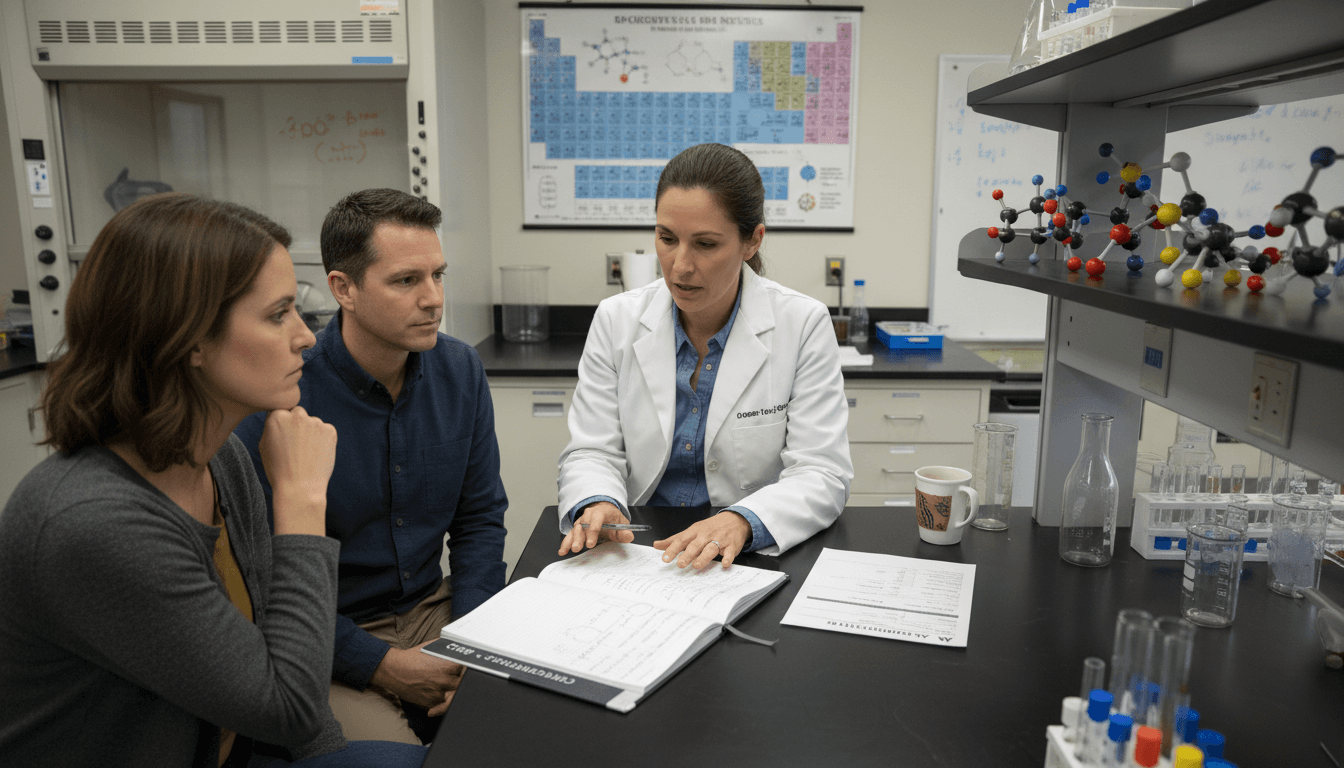
Chemistry Teacher Newsletter: Parent Conference Newsletter Template

Chemistry parent conferences are most productive when families arrive with context. A pre-conference newsletter that explains the course structure, the lab report rubric, and the specific progress markers for AP Chemistry turns a 10-minute catch-up meeting into a focused conversation about what comes next for the student.
This guide covers what a chemistry parent conference newsletter should include, how to address common parent questions about lab safety and chemical disposal, and how to frame AP Chemistry progress in a way families can understand and act on.
Send the newsletter one week before conferences
Timing is everything with a pre-conference newsletter. A newsletter sent the day before conferences is too late to be useful. Send it a week out so families have time to look at their student's grade, review any work samples available online, and form specific questions before they sit down with you.
Tell families in the newsletter what the conference will include: how long each meeting is, whether students attend, and what materials you will have available. If you plan to show specific lab report grades, a unit assessment breakdown, or an AP practice score summary, say so in the newsletter. Families who know what to expect walk in prepared rather than reactive.
Explain the chemistry grade breakdown
Chemistry grades often confuse families because the weight distribution between lab work and written assessments is not obvious. Tell families explicitly how the grade is calculated. Lab reports, lab practicals, unit tests, quizzes, and homework each carry a different weight, and a family who understands that lab reports account for 35% of the course grade interprets a struggling lab report grade very differently from a family who assumed tests were the primary grade driver.
Give families a brief sense of what each component tests. Unit tests measure content knowledge and problem-solving under timed conditions. Lab reports measure the ability to collect accurate data, identify sources of experimental error, and connect empirical results to chemical theory. Quizzes check whether students are keeping up with the pace of new content introduction. That framing helps families read a grade breakdown with more precision during the conference.

Describe the chemistry lab report rubric
Lab reports are one of the most significant grade components in a chemistry course and one of the most misunderstood by families. Explain the sections of a chemistry lab report and what distinguishes a strong report from an average one. A chemistry lab report typically includes a purpose or hypothesis, a materials list, a procedure summary, a data table, calculations, an error analysis, and a conclusion.
Tell families that the error analysis and conclusion sections are where most students either earn or lose points. An error analysis that only says "human error" is insufficient. A strong error analysis identifies specific sources of experimental error, explains how each one affected the results, and estimates whether the error produced data higher or lower than the theoretical value. Families who understand this distinction can ask their student specific questions about error analysis during homework time rather than asking only whether the lab report is done.
Address chemical disposal and lab safety questions
Parent questions about chemical disposal and lab safety are common during conferences and in parent emails. A pre-conference newsletter that addresses these proactively reduces the number of individual inquiries you receive and demonstrates that you take lab safety seriously.
Tell families that all chemical waste from lab activities is disposed of according to your school and district safety protocols. Name the types of chemicals typically used in your course and describe them in accessible terms: "Most chemicals we use are dilute acid and base solutions at concentrations similar to household cleaning products, with appropriate safety equipment including goggles and gloves worn at all times." Tell families that no chemical materials leave the school building in student belongings and that students follow a standardized disposal procedure at the end of every lab session.
Explain stoichiometry and quantitative chemistry progress
Stoichiometry is often the unit where families first notice their student struggling, because it requires mathematical fluency in multi-step unit conversions combined with conceptual understanding of chemical reactions. If conferences fall during or after the stoichiometry unit, address it directly in the pre-conference newsletter.
Explain what stoichiometry involves in plain language: given a balanced chemical equation, students calculate the quantities of reactants and products involved in the reaction using mole ratios. The calculation chain is: grams to moles, moles to moles using the equation ratio, moles to grams or liters as the problem requires. Tell families that students who struggle with stoichiometry typically have one of two difficulty patterns: they rush the conversion steps and lose track of units, or they understand individual steps but cannot execute the full multi-step chain under assessment conditions. Naming these patterns prepares families for the specific conversation during the conference.
Share AP Chemistry progress in context
For AP Chemistry sections, a section of the pre-conference newsletter devoted to AP-specific progress is worth the space. AP Chemistry grades reflect mastery of challenging content and skill in written explanation, not just correct calculation. Tell families that a student's AP practice exam scores and free-response writing quality are separate data points from their unit grade, and explain what each reveals.
If the AP exam is still months away, give families a general sense of the preparation timeline. If conferences fall in November, explain that the course will continue building foundational content through winter, with a shift toward AP exam preparation in the spring. That arc helps families understand the pace of the course and when they should expect an intensified preparation push.
Close with next steps and how to follow up
End the newsletter by telling families what the conference is meant to accomplish and what comes after it. If you plan to send resources home after the conference for families to review, say so. If you are available for a follow-up email exchange or a second meeting for families with complex concerns, name that as an option.
A chemistry course is demanding, and families whose student is struggling need to know that the conference is the beginning of a support plan, not the end of the conversation. Closing the newsletter with a clear invitation to continue the dialogue builds the trust that makes your subsequent communication more effective across the rest of the year.
Get one newsletter idea every week.
Free. For teachers. No spam.
Frequently asked questions
Why should a chemistry teacher send a newsletter before parent conferences?
Chemistry has course-specific vocabulary and assessment formats that most parents have not encountered since their own high school or college chemistry class, if at all. A pre-conference newsletter gives families the language and context they need to follow the conference conversation. When parents arrive knowing what a limiting reagent problem looks like, why significant figures matter in a lab report, and how AP Chemistry progress is tracked, the conference can focus on the specific student rather than on explaining the course architecture.
What chemistry-specific content should the pre-conference newsletter cover?
Cover how the grade is structured between lab work, unit assessments, quizzes, and AP practice components. Explain what a chemistry lab report is graded on: the quality of the hypothesis, the accuracy of data tables, the depth of error analysis, and the connection between the experimental results and the underlying chemical concept. Name the current unit and where students are in the course progression. If conferences fall during a particularly challenging unit like electrochemistry or thermodynamics, acknowledge that and tell families what the common difficulty patterns are.
How should a chemistry teacher address chemical disposal questions from parents?
Chemical disposal questions come up regularly from parents who are concerned about what students are handling in the lab and how waste is managed. Address it directly in the pre-conference newsletter. Tell families that all chemical waste in your lab is disposed of according to school and district safety protocols, that students follow a standardized disposal procedure for every lab, and that no chemical waste leaves the school building in student belongings. If you use only small quantities of low-hazard chemicals in the types of labs your class conducts, say so. Proactive transparency on lab safety and disposal prevents the anxiety that comes from partial information.
How should AP Chemistry parent conference communication differ from standard chemistry?
Devote a section to AP-specific progress. AP Chemistry parents often come to conferences wanting to understand the gap between a student's unit grade and their AP exam readiness. Explain that the AP Chemistry exam tests both mathematical problem-solving and conceptual written explanation in ways that unit tests do not always capture. A student with strong quiz scores who struggles with free-response writing may still need targeted support before the exam. Telling families this clearly in the newsletter sets up the conference for a more specific and productive conversation.
How does Daystage help chemistry teachers manage conference-season communication?
Daystage makes it easy to send a pre-conference newsletter to all families on a consistent schedule without building it from scratch each semester. Update the current unit, the grade breakdown, and any course-specific notes for the conference season, then send it with one click. After conferences, use Daystage to send a brief follow-up to any families you did not meet with, so no family feels excluded from the communication cycle. Consistent, structured communication across conference season signals to families that your class is organized and that their student is being carefully tracked.

Adi Ackerman
Author
Adi Ackerman is a former classroom teacher and curriculum writer with 8 years in K-8 schools. She writes about school communication, parent engagement, and what actually works in real classrooms.
More for Subject Teachers
Ready to send your first newsletter?
3 newsletters free. No credit card. First one ready in under 5 minutes.
Get started free