
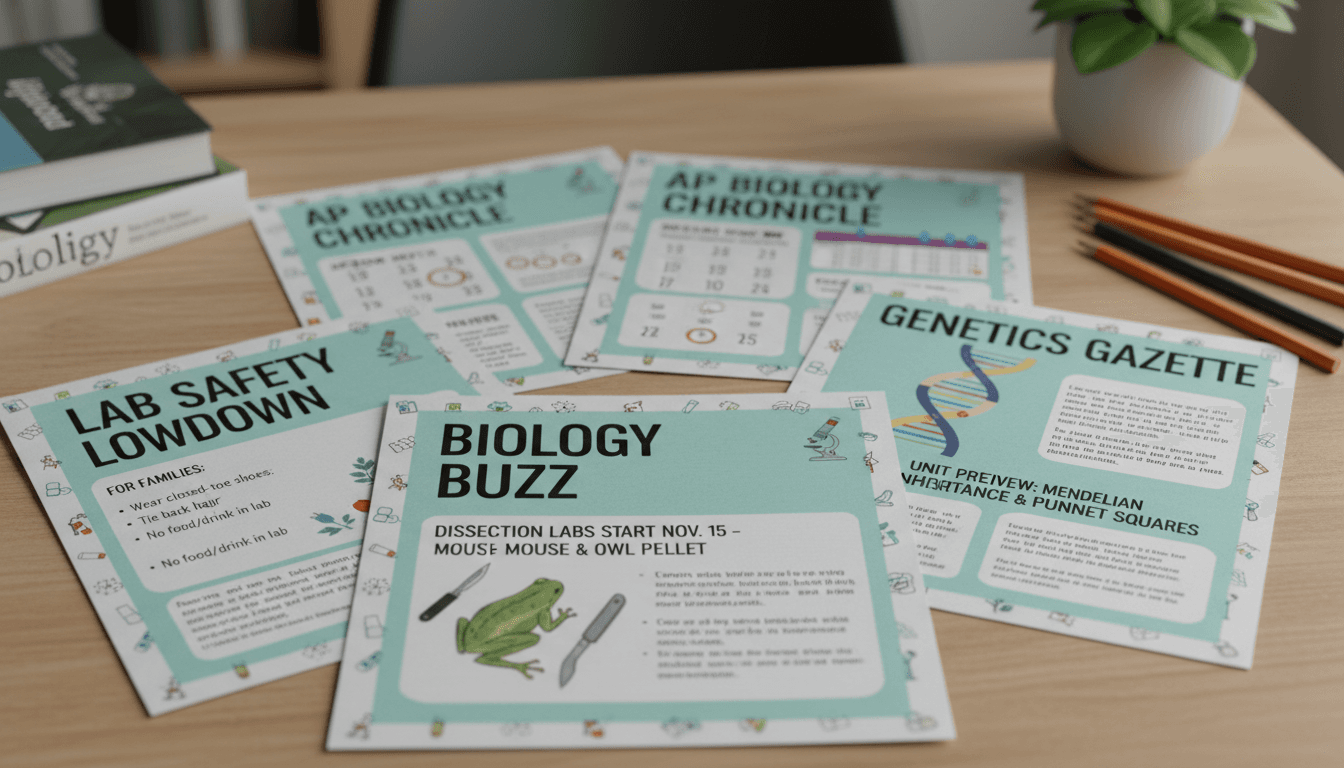
Biology Teacher Newsletter: Teacher Newsletter Examples That Actually Work

A biology newsletter that works does not announce what students will study. It gives families the context they need to understand why a unit matters, what to expect from lab work, and how they can support their student between class sessions. The best biology newsletter examples are specific, clear, and built around the actual communication challenges the subject creates.
This guide breaks down the newsletter types that biology teachers find most useful, with examples of what each type should include and why it works.
The unit preview newsletter
Send a short newsletter at the start of every new biology unit. Name the unit, describe the core concepts students will study, name any labs that are part of the unit, and tell families how long the unit runs. For a cell biology unit: "We are beginning our cell biology unit this week. Students will study the structure and function of eukaryotic and prokaryotic cells, organelle roles, cellular transport mechanisms, and cell division. Labs this unit include a microscopy session examining prepared slides and a diffusion and osmosis experiment. The unit runs approximately four weeks."
That level of specificity takes 60 words and gives families everything they need to support the unit at home: vocabulary to look for when their student mentions class, a sense of how long the content will run, and advance notice of lab sessions.
The dissection notification newsletter
Dissection newsletters are one of the most important communication tools a biology teacher has. Send this newsletter at least two weeks before the dissection begins. Name the specimen, the biological system or anatomy it is being used to study, and the educational purpose. Explain that dissection gives students direct exposure to anatomical structures that cannot be fully replicated in a diagram or simulation.
Include the alternative assignment clearly and without framing it as a lesser option. A student who completes a detailed virtual dissection alternative with full written analysis is meeting the same learning objective as a student who completes the physical dissection. Tell families the deadline for requesting the alternative and the exact process for doing so.

The lab safety reminder newsletter
A lab safety newsletter sent at the start of the year and before any lab-intensive unit reinforces the expectations that govern student behavior in the biology lab. Name the core lab safety rules: closed-toe shoes required, hair tied back when working with open flames, safety goggles worn during all chemical or biological handling, no eating or drinking at lab benches, and proper disposal of biological materials.
Tell families that lab safety rules are enforced and that students who arrive unprepared for a lab session (without appropriate footwear, for example) will complete an alternative assignment that day rather than the lab. Clear communication of this consequence eliminates the negotiation that happens when a student shows up in sandals on lab day.
The AP Biology exam countdown newsletter
For AP Biology sections, a newsletter sent 14 days before the AP exam is among the most valuable communications you will send all year. Name the exam date, the two main sections, the number of questions in each, and the approximate time allocation. Explain the science practices the free-response section tests: constructing arguments from data, designing controlled experiments, evaluating models, and applying mathematical reasoning.
Include a two-week daily study plan that families can use to structure home review. Assign specific content areas to each day and name the free-response question types students should practice. Families who have a concrete plan are far more effective at supporting AP exam preparation than families who only know the exam is coming and that their student should study.
The free-response practice schedule newsletter
AP Biology free-response practice is distinct enough from general studying that it deserves its own newsletter. Tell families that free-response practice requires a pencil, blank paper, and uninterrupted time because students are constructing written responses that integrate biological concepts, experimental reasoning, and data interpretation into a single answer.
Name the free-response question types students should practice at home: long free-response questions that ask students to design an experiment, analyze a graph, and connect findings to a broader biological concept, and short free-response questions that require a concise, evidence-based claim. Give families a suggested number of practice prompts per week and tell them where students can access past AP Biology free-response questions on the College Board website.
The genetics unit newsletter
Genetics units generate more family questions than most other biology topics because the content feels personal. A proactive newsletter before the unit begins addresses the most common concerns before families raise them.
Tell families what genetics concepts students will study: Mendelian inheritance, pedigree analysis using fictional case studies, non-Mendelian patterns, and introductory molecular genetics. If there is a take-home family trait activity, explain what it involves and how to opt out. If pedigree analysis uses only classroom-generated or fictional family data, say so explicitly. Families who understand that the genetics unit uses general biological principles rather than their specific family history approach it with far less anxiety.
The post-lab reflection newsletter
A brief newsletter after a significant lab session gives families a window into what their student experienced and connects the lab to the classroom content. "Students completed their enzyme activity lab this week, testing how temperature and pH affect the rate of catalase-driven hydrogen peroxide breakdown. Lab reports are due Friday and should include a data table, a graph of reaction rates at each condition tested, and a written analysis explaining the results in terms of enzyme structure and function."
That level of detail tells parents what their student should be working on, what the deliverable looks like, and what the underlying science is. A parent who reads this newsletter can ask "how did the enzyme react at different temperatures?" instead of "did you do something in class today?" The quality of the family conversation that follows directly reflects the quality of the newsletter that preceded it.
Get one newsletter idea every week.
Free. For teachers. No spam.
Frequently asked questions
What makes a biology newsletter different from a general science newsletter?
Biology newsletters deal with content that can be personal or emotionally charged in ways that other science subjects rarely are: dissections, genetics and heredity, reproduction, and human body systems. A biology newsletter needs to handle those topics directly and proactively rather than waiting for families to raise concerns. Naming what is coming in a unit, explaining the educational purpose clearly, and giving parents an opt-out or alternative path for sensitive content is standard practice in biology communication. That proactive transparency is what makes biology newsletters distinct.
What is a good biology newsletter example for announcing a dissection?
A strong dissection announcement newsletter names the specimen, the unit it connects to, the educational purpose, the date it occurs, whether there is an alternative assignment available for students with concerns, and the opt-out process and deadline. 'Students in AP Biology will complete a fetal pig dissection during the week of November 11 as part of our anatomy and physiology unit. Students who prefer not to participate may complete a detailed virtual dissection alternative using a 3D digital model. Please contact me by October 28 if your student would like the alternative.' That level of specificity answers most parent questions before they are asked.
How should a biology newsletter explain genetics content to parents?
Genetics units often cover topics that feel personal, including inherited disease patterns and probability of trait inheritance. Tell families what specific genetics concepts students will cover: Mendelian inheritance, pedigree analysis, non-Mendelian patterns like codominance and incomplete dominance, and introductory molecular genetics. Reassure families that pedigree analysis uses fictional or generalized case studies rather than personal family data unless the teacher has explicitly designed a take-home family trait activity with clear opt-in consent. Clear framing in the newsletter prevents the concern that genetics homework is an invasion of family privacy.
How often should a biology teacher send a newsletter?
Every unit transition, before every major lab that requires family awareness (especially dissections), before every major assessment, and during any period of schedule disruption. For AP Biology, add newsletters before AP practice exams and in the final 6 weeks before the AP exam. Most biology teachers find that 8 to 12 newsletters per semester is the right volume: enough to keep families informed without creating inbox fatigue. Consistent timing, like sending at the start of each new unit, trains families to look for your newsletter and pay attention when it arrives.
How does Daystage help biology teachers build reusable newsletter examples?
Daystage lets biology teachers build a library of reusable newsletter templates for their most common communication types: unit preview, dissection notification, AP exam countdown, lab safety reminder, and post-assessment reflection. Each template keeps the format and structure consistent while letting you update the specific content each time. Teachers who use Daystage report spending under ten minutes sending a newsletter that would otherwise take 30 minutes to draft from scratch, which makes consistent communication across a busy semester realistic rather than aspirational.

Adi Ackerman
Author
Adi Ackerman is a former classroom teacher and curriculum writer with 8 years in K-8 schools. She writes about school communication, parent engagement, and what actually works in real classrooms.
More for Subject Teachers
Ready to send your first newsletter?
3 newsletters free. No credit card. First one ready in under 5 minutes.
Get started free