
Biology Teacher Newsletter: Back to School Newsletter for New Students and Parents

The first newsletter you send as a biology teacher sets up every family communication for the rest of the year. Students who start the year knowing what to expect from a biology lab, what the course covers, and how you communicate with families are more prepared and less anxious. Families who receive a clear first-week newsletter have a reference point for every question they ask afterward.
This guide covers what to include in a biology back-to-school newsletter, how to introduce lab safety to families in a way that sticks, and how to set up the communication habits that will carry you through to AP exam season.
Introduce yourself and the scope of the course
Open with a brief introduction and a one-paragraph overview of what biology covers this year. For a standard biology course: "Welcome to Biology. This year students will study cell biology, genetics, evolution, ecology, and human body systems. They will complete regular lab investigations, analyze biological data, and develop skills in scientific reasoning and written analysis." For AP Biology: "Welcome to AP Biology. This is a college-level course covering all major biological domains at the depth of a university introductory biology course. Students will develop strong skills in experimental design, data analysis, and scientific argumentation in preparation for the AP exam in May."
That level of framing tells families immediately what kind of course this is and what they are supporting. Parents who understand the scope from the first week engage more effectively when specific units, labs, and assessments come up across the year.
Map the year's unit sequence
Give families a simple overview of the units students will study across the year and roughly when each one occurs. You do not need to list every lesson. A sequence of six to eight unit names with approximate time frames is enough to give families a mental map of the year.
For a standard biology course: Cell Biology (September to October), Genetics and Heredity (November), Evolution (December to January), Ecology (February to March), and Human Body Systems (April to May). For AP Biology, align the unit sequence with the AP exam timeline so families understand that the spring semester pace is deliberately compressed to allow for AP exam review before May. Naming the sequence in the back-to-school newsletter prevents the mid-year confusion of families who did not realize how much content the course covers.

Introduce lab safety expectations
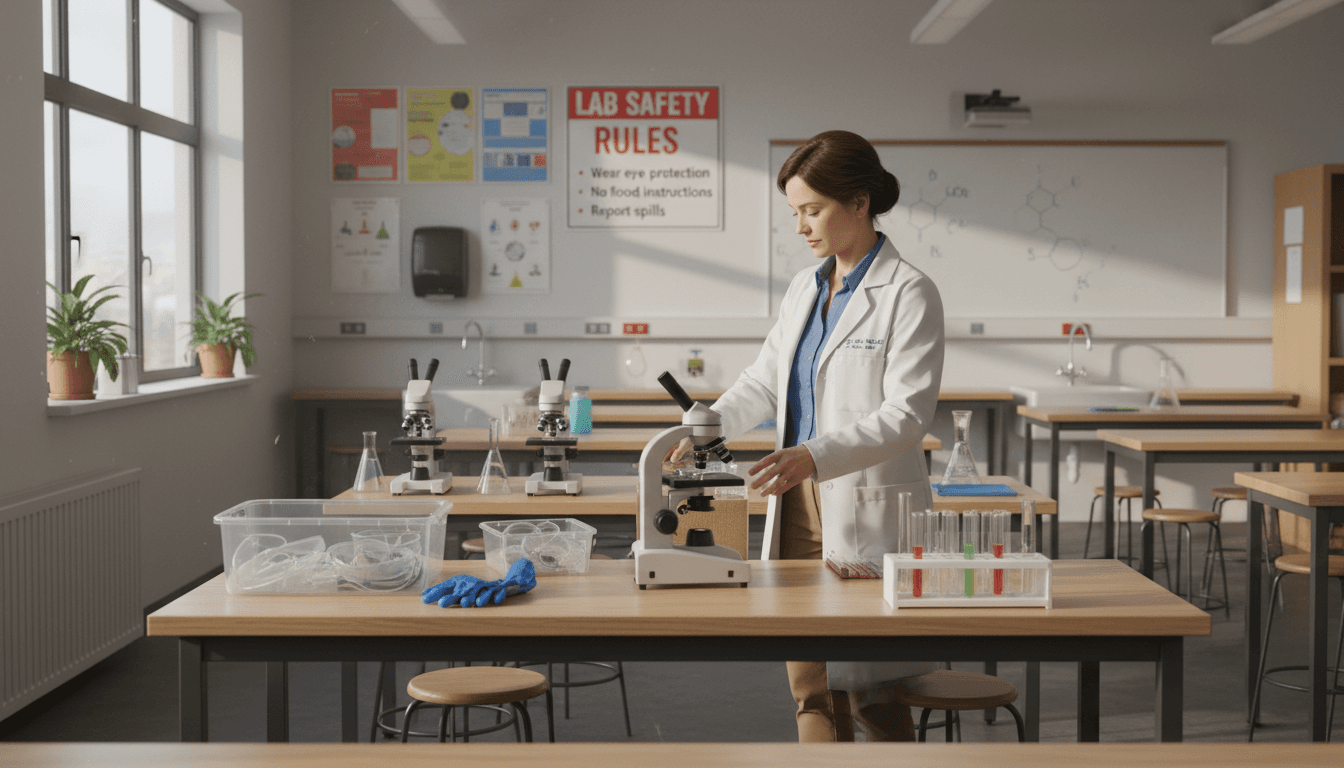
Lab safety is the most important practical content in a biology back-to-school newsletter. Tell families the core rules that apply every time students enter the lab: closed-toe shoes (sandals and open-heeled shoes are not permitted on lab days), hair tied back when working with specimens or open flames, safety goggles required for all biological and chemical handling, no eating or drinking at lab benches, and proper disposal of biological materials in designated containers.
Explain that students who arrive to class without appropriate footwear or without completing required safety training will complete an alternative assignment that day rather than participate in the lab. Stating this clearly in the back-to-school newsletter eliminates most of the negotiation that happens when students show up unprepared for a lab session and sets the expectation that lab safety is a non-negotiable part of the course.
Mention dissection plans and the notification process
Families who learn about dissections mid-year without advance notice are more likely to react with concern than families who were told at the start of the year that dissections are part of the curriculum. Mention in the back-to-school newsletter that the course includes dissection labs, name the specimens if you know them at the start of the year, and explain that you will send a dedicated newsletter before each dissection with specific information about the educational purpose, the alternative assignment option, and the opt-out process.
Framing dissection as a standard part of biology education with clear alternatives available reduces anxiety and prevents the late opt-out requests that create logistical problems. Families who know it is coming and know they have a clear path for their student's alternative can make that decision calmly rather than reactively.
Explain the grading structure
Tell families how the biology grade is calculated across the year. Lab work and lab reports, unit assessments, quizzes, homework, and for AP sections, AP practice components, each carry a different weight. Name the percentages so families can interpret grade fluctuations accurately across the year.
A student who earns a strong quiz grade but a weak lab report grade is showing a specific pattern: content knowledge without the analytical writing skills the lab report requires. A student with the reverse pattern is showing another: strong lab performance but difficulty with high-stakes written assessments. Families who understand the grade breakdown can notice those patterns and ask useful questions rather than seeing only a single number.
Tell families what to do if their student struggles
Give families a clear, early statement of what resources are available when a student is struggling. Whether that is teacher office hours, a school tutoring program, specific online review resources, or a combination, name it in the back-to-school newsletter so families know what to do before they need it rather than searching for answers in the middle of a difficult unit.
For AP Biology specifically, tell families that starting strong in September matters because the course is cumulative. A student who struggles with cell biology in the first unit will have a harder time with metabolism and genetics later in the year. Encouraging families to flag concerns early, before a difficulty compounds, is one of the most useful things a back-to-school newsletter can do.
Close with your communication plan for the year
End the newsletter by telling families how you will communicate across the year, how often, and through what channels. If you send a newsletter at the start of each unit and before each major assessment, say so. Tell families how quickly they can expect a response to an email and what the best way to reach you is for a time-sensitive question.
A back-to-school newsletter that closes with a clear communication commitment trains families to expect regular contact and to look for it. That habit makes every subsequent newsletter more likely to be opened, read, and acted on. The first newsletter you send is also an investment in the attention families give every newsletter that follows.
Get one newsletter idea every week.
Free. For teachers. No spam.
Frequently asked questions
What should a biology teacher include in a back-to-school newsletter?
Cover the course overview and unit sequence, the lab safety rules students will follow all year, the grading breakdown, how you will communicate across the year, and any upcoming lab activities or assessments that require advance family awareness. For AP Biology, include a brief explanation of the AP exam format and how the course content maps onto it. The goal of the first newsletter is to give families a clear mental model of the year so they can support their student effectively from day one.
How should a biology teacher introduce lab safety to families in a newsletter?
Name the core lab safety rules and explain why each one matters in a biology-specific context. Closed-toe shoes protect against chemical spills and broken glassware. Safety goggles prevent eye exposure to biological specimens, chemical reagents, and projectile debris. Hair tied back prevents contact with open flames and specimen materials. Proper disposal of biological waste prevents contamination of shared spaces. Families who understand the purpose of the rules enforce them more consistently at home when preparing their student for a lab day.
Should a biology back-to-school newsletter mention dissections?
Yes. Dissections are a significant enough event in a biology year that early notice is always appropriate. Tell families which dissections are planned for the year, which units they connect to, and what the alternative assignment process looks like. You do not need to describe each dissection in detail in the first newsletter. A brief sentence noting that dissection labs are part of the curriculum with detailed notification sent in advance of each one gives families enough to prepare without overwhelming the back-to-school message.
How should an AP Biology back-to-school newsletter differ from a standard biology newsletter?
Include an additional section explaining what AP Biology involves and how it differs from a standard high school biology course. Tell families that AP Biology is a college-level course covering all major biological domains at a depth that requires consistent study habits from the first week. Explain that the AP exam in May tests science practices as well as content, meaning students are evaluated on their ability to reason from data and design experiments, not just recall terms. Setting that expectation in the first newsletter prevents the mid-year surprise when families realize the workload is heavier than expected.
How does Daystage help biology teachers set up their back-to-school newsletter?
Daystage gives biology teachers a clean, mobile-friendly template that can be updated quickly for each new school year. Save your lab safety section, course overview, and communication norms as a reusable base. Update the unit schedule, assessment dates, and any course-specific changes for the new year, then send in under ten minutes. Daystage also shows you which families opened the newsletter, which is useful in the first week of school when you want to confirm every family is connected to your communication channel before the year gets busy.

Adi Ackerman
Author
Adi Ackerman is a former classroom teacher and curriculum writer with 8 years in K-8 schools. She writes about school communication, parent engagement, and what actually works in real classrooms.
More for Subject Teachers
Ready to send your first newsletter?
3 newsletters free. No credit card. First one ready in under 5 minutes.
Get started free