

Before and After Care Teacher Newsletter: Communicating Program Activities, Policies, and Staff Updates to Families
Before and after care programs are not supplemental to the school day. For many families, they are essential. Parents who depend on before and after care to match their work schedule need reliable communication about anything that affects the program: hours, closures, policy changes, and who is watching their child. A consistent newsletter from the program builds the trust that holds a care community together across a school year.
This guide covers what to include in a before and after care newsletter, how to communicate the practical logistics families need, and how to introduce the enrichment and relationship dimensions of the program that go beyond supervision.
The start-of-year newsletter: covering the essentials
The first newsletter of the year establishes the foundation for everything that follows. Cover your daily schedule, arrival and dismissal procedures, authorized pickup policies and how to update them, communication channels for same-day messages, the program's behavior expectations, and what students do during program hours. Families who receive this information clearly at the start of the year do not need to ask the same questions individually throughout the year.
Staff introductions belong here too. Tell families who is working in the program each day. Include each staff member's name, a brief background, and one personal detail that makes them feel like a person rather than a credential. Families who know the staff by name communicate differently with the program than families who hand off their child to an anonymous group of adults.
Holiday closures and schedule changes
Holiday closures and schedule changes are the most time-sensitive communications a before and after care program sends. Families whose work schedules depend on the program need closure notices as early as possible. A newsletter that covers the full list of program closures for the year, sent in September, gives families maximum planning time.
When unexpected closures arise (a snow day, a facility issue, a staffing emergency), communicate immediately through whatever channel reaches families fastest. The newsletter is for planned communication. Emergency closures need a faster channel and a direct message.
Communicating enrichment activities
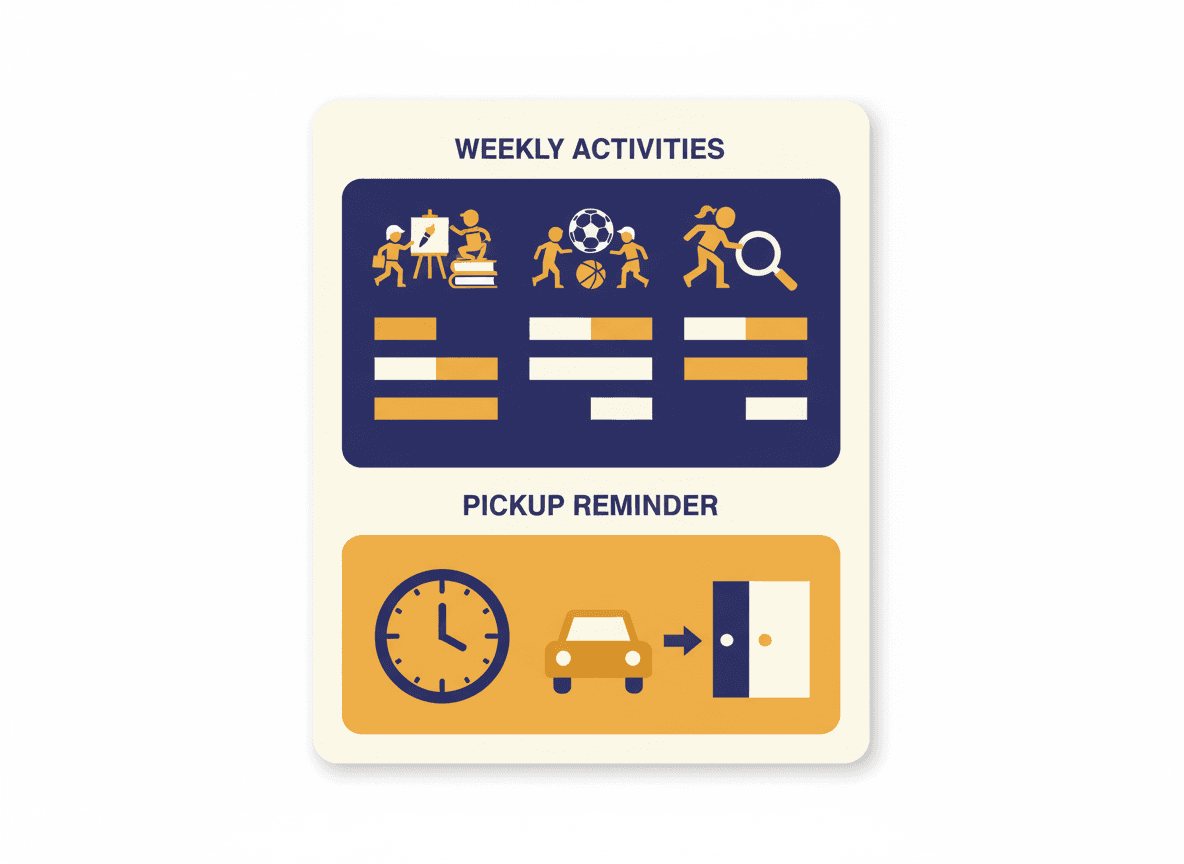
Many before and after care programs offer enrichment beyond homework help and free play. Arts and crafts, STEM projects, reading programs, physical activity, and special guests all add value that families may not fully appreciate if they are not communicated about. A monthly newsletter that previews what enrichment is planned gives families something to ask their student about, which reinforces the program's value to families who pay for it and whose students attend.
When a particularly engaging activity happens, a brief description or a photo in the following newsletter tells families what their child experienced that day. "On Wednesday students built bridges out of popsicle sticks and tested how much weight they could hold. The winning bridge supported 18 pennies." That kind of reporting makes the afternoon feel meaningful rather than merely supervised.
Pickup policies and safety communication
Pickup policy is one of the most important things a before and after care program communicates, and one of the most common sources of confusion when it is not communicated clearly. State the policy directly: who is on the authorized pickup list, how to add or remove someone, what identification staff requires, what happens when someone not on the list arrives. These are not bureaucratic obstacles. They are child safety measures, and families who understand them in those terms cooperate with them rather than feeling inconvenienced.
Include the process for late pickup and what happens if a family is more than 15 minutes late. Families who know the policy in advance manage their schedules around it better than families who learn it when they arrive late.
Building community through the newsletter
Before and after care programs are where children spend a significant portion of their day. The friendships formed, the habits built, and the staff relationships developed in this setting are real and lasting. A newsletter that reflects the community dimension of the program, through student spotlights, photos from activities, and descriptions of the social dynamics you are fostering, tells families that this is more than babysitting. It is a second learning environment with its own culture.
Using Daystage for before and after care newsletters
Daystage is well-suited for before and after care communication. Build a subscriber list from your enrolled families, create a monthly template that covers your standard sections (schedule updates, enrichment highlights, policy reminders), and send on the first Monday of each month. A program that communicates consistently and professionally through Daystage signals to families that their child is in organized, trustworthy hands every day.
Get one newsletter idea every week.
Free. For teachers. No spam.
Frequently asked questions
What should a before and after care newsletter include?
Cover your program schedule and daily structure, any changes to hours or policies, what enrichment activities are happening this month, upcoming closures or holiday schedules, and how families can communicate with staff about pickup arrangements or special instructions. Families who use before and after care depend on your program for their work schedule. Reliable communication about anything that affects pickup logistics is essential.
How often should a before and after care program send newsletters?
Monthly works for most programs. Send additional targeted communications whenever there are schedule changes, holiday closures, policy updates, or staff changes. Families whose workday depends on your program being open need advance notice for closures with enough lead time to arrange alternative care.
How do I communicate pickup policy and authorized pickups without being bureaucratic?
State the policy clearly and explain the reason briefly. Families understand why authorized pickup lists matter. A straightforward explanation, such as confirming that staff will only release children to people on the authorized list and how to update it, is not bureaucratic. It is reassuring.
How do I introduce new staff to families through a newsletter?
Give each new staff member a few sentences covering their background, what they enjoy doing with kids, and one interesting fact. A brief, warm introduction to a new face in the program removes the anxiety a child might express at home about someone unfamiliar. Families who know who is in the room are more comfortable and more trusting of the program.
How does Daystage help a before and after care program maintain consistent family communication?
Daystage lets the program director build a monthly newsletter template and send it to enrolled families without managing a separate email system. For a program that families depend on daily, consistent professional communication from Daystage signals that the program is organized and reliable. That trust is exactly what working families need from their childcare provider.

Adi Ackerman
Author
Adi Ackerman is a former classroom teacher and curriculum writer with 8 years in K-8 schools. She writes about school communication, parent engagement, and what actually works in real classrooms.
More for Subject Teachers
School Enrichment Teacher Newsletter: Communicating Deep Learning Activities and Student Curiosity to Families
Subject Teachers · 6 min read
Sixth Grade Teacher Newsletter Guide: Communicating Through the Middle School Transition
Subject Teachers · 6 min read
Athletic Coach Newsletter: Communicating Season Updates, Expectations, and Team News to Families
Subject Teachers · 6 min read
Ready to send your first newsletter?
3 newsletters free. No credit card. First one ready in under 5 minutes.
Get started free