
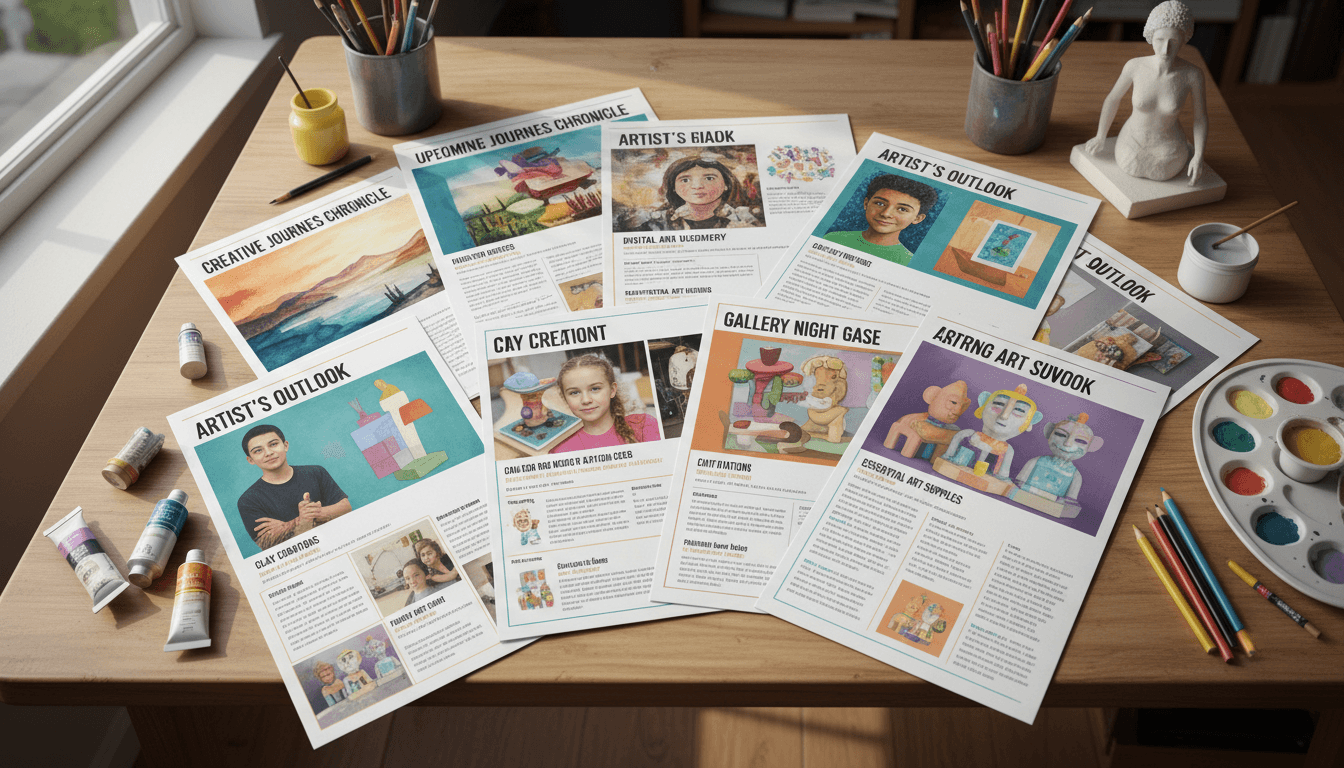
Art Teacher Newsletter: Teacher Newsletter Examples That Actually Work

Art teacher newsletters fail in one consistent way: they describe outcomes without explaining the learning. "Students finished their watercolor paintings this week" tells a family their child was busy. "Students completed their first watercolor study, building on the wet-on-wet technique we practiced to create soft, diffused backgrounds before adding detailed foreground elements with a dry brush" tells them what their child was learning and what skill they were developing. The second version creates a family that can have a real conversation about the work.
These examples show what art teacher newsletters look like when they do both jobs: communicate the logistics families need and translate the learning into language that gives families real insight into what is happening in the art room.
The studio project launch newsletter
When you begin a new studio project, send a dedicated newsletter that explains the concept, the medium, and the learning goals before students bring anything home. Example opening: "This week we are launching our printmaking unit, beginning with relief printing using foam plates. The artistic question driving this unit is: how does reducing the artist's control over the mark-making process change the visual outcome? Students will design a composition, transfer it to a foam plate, and explore how the printing process transforms their original drawing."
Follow with a one-sentence vocabulary preview: "Two terms to know this unit: relief print, where ink is applied to a raised surface and pressed onto paper, and edition, which is a numbered series of prints made from the same plate." Close with the home prompt: "Ask your student what they are printing and what they expect the print to look like compared to the original drawing. After they have pulled their first print, ask them what actually changed."
The weekly studio update newsletter
A weekly update does not need to be long. Three sections in 200 to 250 words: what students are working on, one specific skill or technique they are developing, and a conversation prompt for home. Example: "Students are in the middle of their figure drawing unit. This week the focus is on proportion, specifically the rule that the human figure is approximately seven to eight heads tall. We are practicing measuring relationships between body parts rather than drawing what we think we see."
Home prompt: "Ask your student to measure their own head height with their hands and then estimate how many heads tall they are. Then ask them to look at a figure in a painting or drawing they see this week and tell you whether the proportions look accurate or distorted, and why the artist might have made that choice." This turns an ordinary evening observation into a curriculum connection.
The critique preparation newsletter
Critique is one of the most misunderstood parts of visual arts education. A newsletter that prepares families for it reduces anxiety and produces more thoughtful student participation. Example: "On Thursday, we will hold our first formal critique of the semester. Critique in our class follows a structured format: students display their work, the class begins with description only, no opinions, then moves to analysis, where we discuss how the formal elements function, then interpretation, where we discuss what ideas or feelings the work communicates, and finally evaluation, where we discuss how effectively the work achieves its stated goal."
Home preparation: "Ask your student to practice describing their own work using only what they can see: the colors, the lines, the shapes, the composition. Not 'I like it' or 'it did not turn out how I wanted.' Just what is there. That description practice is exactly what critique asks for."
The art history connection newsletter
When the class is studying an art movement or period alongside studio work, give families the historical context. Example: "This week we began a two-week exploration of Abstract Expressionism, the American art movement of the late 1940s and 1950s. The central idea is that the act of painting, the physical gestures, the speed, the material choices, can communicate emotional content directly. Students are responding to a set of Pollock and de Kooning reproductions and then making their own gestural paintings using similar physical approaches."
This context turns what might look like a messy paint session into a legible academic exercise. "Your student is not just flinging paint. They are exploring what Abstract Expressionist painters were arguing: that mark-making itself carries meaning." One sentence like that changes how families receive the homework.
The gallery walk newsletter
When students' work is displayed for a gallery walk, whether in the art room, in the hallway, or at a school event, send a newsletter that explains the format and invites families. Example: "Next Thursday, the art room will be set up gallery-style for our annual in-school exhibition. Students will display their best piece from the semester with a short artist statement they have written. During class, we will conduct a silent gallery walk where students view each other's work and leave written feedback using our formal analysis vocabulary."
If families can attend: "The exhibition will be open for family viewing during after-school hours from 3:00 to 4:30. When you visit, ask your student to read their artist statement aloud to you and then point to one specific decision they made in the work that the statement describes." If it is students-only: "Ask your student which piece from their classmates they found most compelling and what made it work."
The end-of-semester newsletter
At the end of a semester or year, send a newsletter that summarizes what students studied and built, names the skills they developed, and gives families a framework for what growth looks like across the period. "This semester students worked in three media: graphite, watercolor, and collage. They developed their observational drawing skills, explored the expressive potential of a wet medium, and learned to build composition through the physical arrangement of found materials. Each medium asked for a different kind of attention and produced a different relationship between intention and accident."
Close with a home activity: "Ask your student to put three pieces from the semester side by side and explain what changed between the earliest and the most recent piece. Not which one they like more. What they can do now that they could not do before." This question names growth without requiring the student to rank their own work, and it gives families a concrete way to see the learning rather than just hear about it.
Get one newsletter idea every week.
Free. For teachers. No spam.
Frequently asked questions
What is the most important element of an effective art teacher newsletter?
Specificity about what students are learning, not just what they are making. A newsletter that says 'students are painting this week' is nearly useless to a family. A newsletter that says 'students are painting a monochromatic study using a single color mixed with white and black to create a full value range, applying what we have been studying about how light hits three-dimensional forms' gives families a real picture of the learning. That specificity is what separates newsletters that build understanding from newsletters that just inform.
Should art teacher newsletters include images of student work?
Yes, when possible and with appropriate permissions. A single in-progress photograph of a student project, selected with care, communicates more about what is happening in the art room than three paragraphs of description. Families who can see the work understand it. Families who only read about it guess. Check your school's photo policy for student image use in newsletters and get permission at the start of the year for families who are comfortable with it. For families who have opted out, describe the work in specific enough detail that they can visualize it.
How do I explain elements of art and principles of design to parents without a visual arts background?
Use everyday comparisons. Value is the range from light to dark, like how a photograph looks different in bright sunlight versus shade. Balance is the visual weight of a composition, like why a room with all the furniture on one side feels uncomfortable. Emphasis is what your eye goes to first, the thing that stands out because of its size, color, or position. One clear comparison per term is enough to give parents a handle on the concept. You do not need to teach art history. You need to give families enough vocabulary to have a real conversation with their student.
How long should an art teacher newsletter be, and how often should I send one?
Weekly during active studio work: 200 to 350 words covers a concept summary, what students are working on, a home conversation prompt, and any upcoming logistics. For major project launches or critique weeks, a dedicated newsletter up to 500 words is appropriate. Avoid newsletters longer than 500 words in the main body. If families need more context for a major unit, attach a one-page project description document rather than making the newsletter longer.
How does Daystage help art teachers send better newsletters more consistently?
Daystage gives art teachers a standing template structure they update each week rather than reformatting from scratch in a document or classroom app. Build your sections once: this week's concept, what students are creating, home conversation prompt, logistics. Update the content weekly and send in minutes. Because Daystage is built for school communication, the formatting holds across devices and email clients, so your newsletter looks professional whether families open it on a laptop or a phone. Open-rate data also tells you which families are consistently missing your newsletters so you can follow up before a major deadline.

Adi Ackerman
Author
Adi Ackerman is a former classroom teacher and curriculum writer with 8 years in K-8 schools. She writes about school communication, parent engagement, and what actually works in real classrooms.
More for Subject Teachers
Ready to send your first newsletter?
3 newsletters free. No credit card. First one ready in under 5 minutes.
Get started free