

Occupational Therapy School Newsletter for Families
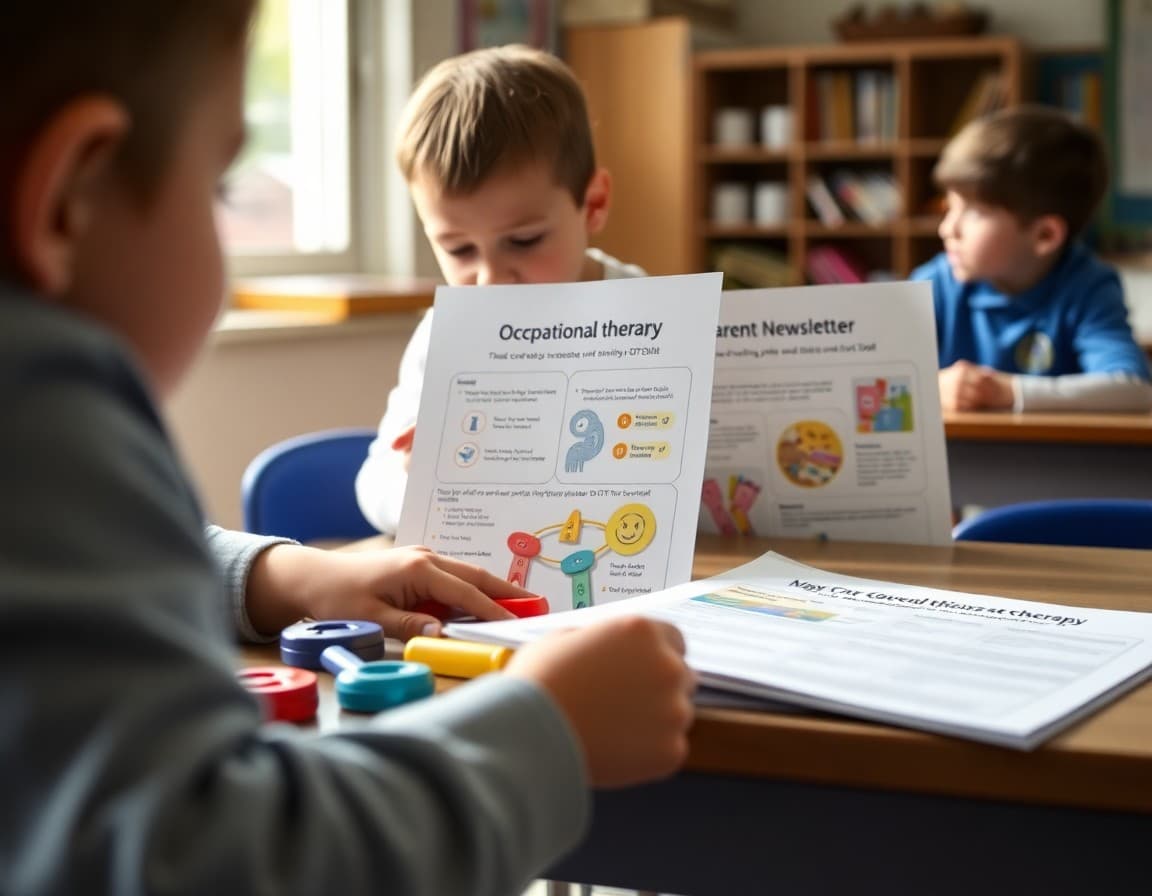
Occupational therapy is one of the most misunderstood services in schools. Families sometimes assume OT is only for children with physical disabilities or that it involves some version of play therapy. A newsletter that explains what school OT actually addresses gives families the understanding they need to be effective partners in their child's progress.
The Scope of School-Based Occupational Therapy
School occupational therapists focus on the skills required for students to participate fully in their educational environment. This is a broad mandate that covers fine motor skills, visual-motor integration, sensory processing, self-regulation, and daily living skills. The guiding question for school OT is not "what can this child not do" but "what is getting in the way of this child accessing their education."
A student who cannot write legibly enough to complete class work has an educational need that OT addresses. A student who cannot regulate sensory input enough to stay focused during reading instruction has an educational need that OT addresses. A student who melts down at lunch because the cafeteria is overwhelming has an educational need that OT addresses.
Fine Motor Goals: What They Mean at Home
Fine motor IEP goals often involve tasks like handwriting legibility, scissor skills, pencil grip, and using classroom tools like staplers or glue sticks. When you explain these goals to families, connect them to observable daily activities.
"We are working on [student's] ability to form letters consistently and legibly. At this stage, practice should focus on [specific letter formations] with the correct starting point. Writing on slightly raised surfaces or using thicker pencils can make practice more productive. We recommend 5 to 10 minutes of guided handwriting practice three to four times per week at home."
That is specific enough to be actionable without requiring families to understand everything about fine motor development.
Sensory Processing: Explaining It Without Overcomplicating It
The sensory system includes not just the five commonly known senses but also proprioception (awareness of where your body is in space) and the vestibular system (balance and movement). Students whose sensory systems process input differently may seek extra movement, avoid certain textures, become overwhelmed by noise, or crave deep pressure input. These behaviors are communication about what the nervous system needs, not intentional misbehavior.
A newsletter that explains the sensory system in these terms gives families a framework for understanding their child's behavior that is accurate, compassionate, and actionable. A family who understands that their child's need to touch everything is sensory-seeking, not defiant, responds very differently at home.
Template: OT Monthly Newsletter Section
"Hello, families. Here is your monthly occupational therapy update.
Fine motor focus this month: we are working on letter formation for lowercase letters, specifically b, d, p, and q, which are commonly reversed. At home, practice can look like tracing in sand, forming letters with playdough, or using dot markers to trace letters before writing them.
Sensory focus: several of our students benefit from movement before and during sitting tasks. If your child struggles to settle into homework, a 10-minute active play break before starting can significantly improve focus. Heavy work activities like carrying groceries, doing push-ups against a wall, or bear walking across the room provide proprioceptive input that supports regulation.
Questions about your child's home program: please contact me at [email]. Home programs are individualized and I am happy to review your child's specific activities with you."
When to Connect Families with Outside Supports
School OT is limited to educationally necessary goals. A student who would benefit from OT support beyond what is educationally necessary may need private or clinic-based OT as well. A newsletter can explain this distinction without making families feel like the school is offloading responsibility. "If you feel your child needs OT support beyond what the school setting addresses, I am happy to connect you with community resources and explain what school OT can and cannot provide." That transparency builds trust rather than creating confusion.
Get one newsletter idea every week.
Free. For teachers. No spam.
Frequently asked questions
What does a school occupational therapist actually do?
School OTs address skills that affect a student's ability to participate in the educational environment. This includes fine motor skills like handwriting, cutting, and using classroom tools; visual-motor integration; sensory processing and self-regulation; organizational skills; and daily living skills like managing a locker, opening containers at lunch, or dressing after PE. School OT is specifically tied to educational participation, which distinguishes it from medical OT in a clinic setting.
How should an OT explain sensory processing to families?
Use concrete, everyday examples rather than clinical language. 'Sensory processing affects how the brain organizes and responds to sensory input. Some students are more sensitive to touch, sound, or movement than others, which can make a busy classroom or cafeteria overwhelming. We use sensory supports to help students regulate their nervous system so they can focus on learning.' That explanation is accurate and accessible without requiring a neuroscience background.
What home strategies should OTs share in a newsletter?
Focus on specific activities families can build into daily routines. For fine motor development: playdough, pegboards, opening small containers, using utensils. For sensory regulation: predictable daily routines, outdoor play with movement and resistance, deep pressure activities like carrying heavy books or doing wall push-ups. Name specific activities rather than general categories, and connect them to what you are working on in school.
How do I explain a sensory diet in a family newsletter?
Explain that a sensory diet is a personalized plan of sensory activities distributed throughout the day to help a student stay regulated and ready to learn. It is not a food diet. 'Just like some students need glasses to see clearly, some students need regular sensory input to maintain attention and behavior.' Then describe the specific activities in the plan in plain terms. A sensory diet that families understand gets implemented. One that does not get explained does not.
Can newsletter communication improve OT carryover at home?
Yes, significantly. Students who practice OT-aligned activities at home generalize skills faster than those who practice only in school. Daystage newsletters let OTs share monthly activity ideas, home program updates, and strategy reminders in a format that reaches families directly. A brief monthly newsletter from the OT team has measurable impact on how consistently families implement home programs.

Adi Ackerman
Author
Adi Ackerman is a former classroom teacher and curriculum writer with 8 years in K-8 schools. She writes about school communication, parent engagement, and what actually works in real classrooms.
More for Special Education
Ready to send your first newsletter?
3 newsletters free. No credit card. First one ready in under 5 minutes.
Get started free