
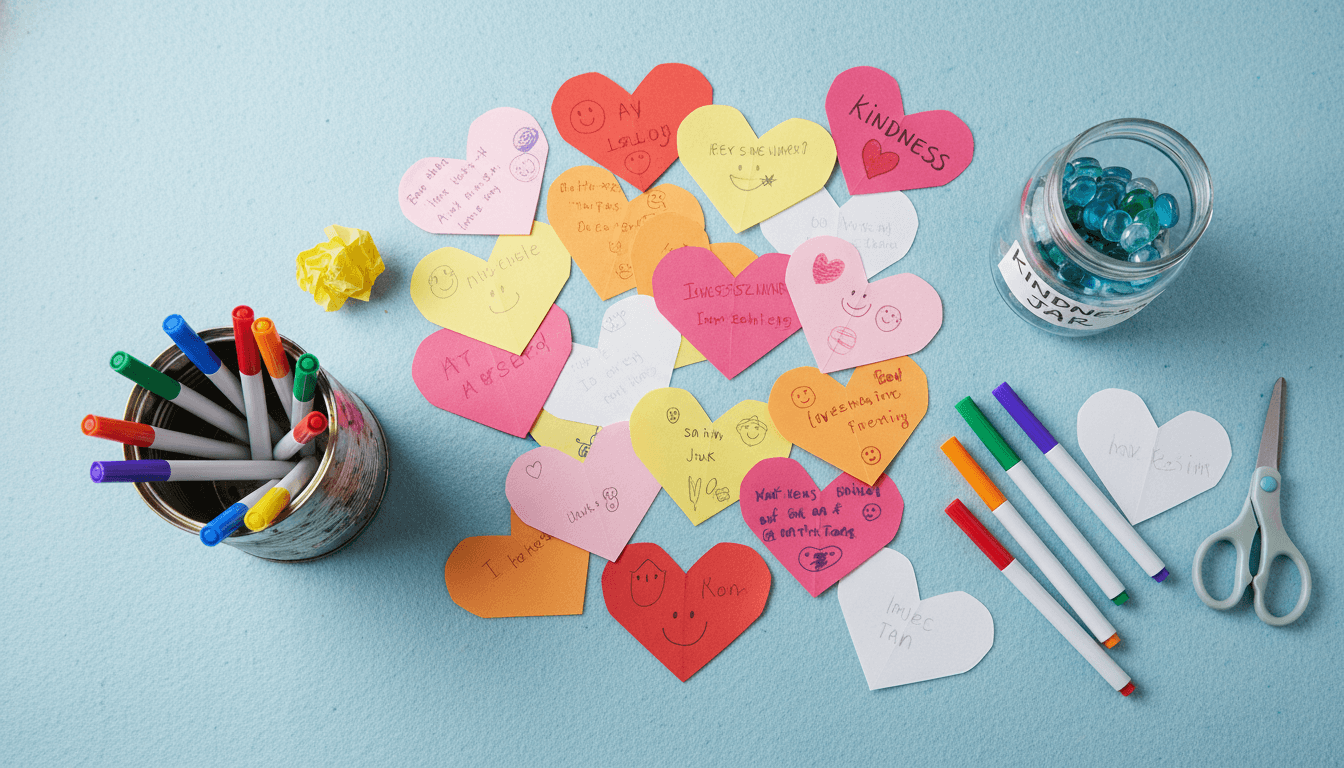
SEL Newsletter on Relationship Skills: What to Send Home

Relationship skills is the fourth CASEL competency, and it is the one that shows up in the most daily moments. Partner work. Group projects. Recess. The lunchroom. Walking in line. Every day at school is a thousand small chances to practice working with other people. A newsletter that names what cooperation looks like, what repair sounds like, and what to try at home gives parents real material to use.
What relationship skills actually means
It is the skill of working with other people, including the parts nobody likes. Listening when you would rather talk. Compromising when you would rather be right. Saying sorry and meaning it. Asking for help when you need it. These are not personality traits. They are practiced behaviors. Every kid can build them.
Cooperation is not the same as taking turns
Most K-2 classrooms teach sharing and turn-taking, which is fine but limited. Cooperation is the next step. It is two kids who actually plan something together and adjust to each other as they go. In Room 5, two third graders, a kid I will call A and a kid I will call B, built a paper city for our community unit last week. They had to agree on what streets to draw, who would cut and who would tape, and how to handle the moment when A wanted a park where B wanted a school. They did all of that without adult help. That is the relationship-skills muscle at work.
Teach the repair, not just the apology
Apologies on demand do not build skill. Repair does. A repair has three steps. Name what happened. Name how it landed. Decide what comes next. "I took the marker without asking. You looked sad. I will ask next time." That is a full repair, and it is more useful than a forced "sorry." Teaching the three steps lets kids do it without prompting after a while.
A short section parents will actually read
On Wednesday, two kids in our class had a small fight over a shared pencil case. One of them, a kid I will call M, used the repair steps we have been practicing. She said, "I grabbed it. That was not fair. I will ask next time." Her friend said, "Thanks, that helped." They got back to work in under a minute. A month ago, that same fight would have lasted twenty.
The skill we have been practicing is called relationship skills. It is everything that goes into working with other people. At home, you can build this with one prompt at dinner: "Tell me about a moment today when you had to figure something out with someone else. What worked? What was hard?"
Ask for help is a relationship skill
Most newsletters skip this one. Asking for help is part of the competency, and it is harder than it sounds. A kid who can say "I do not understand this, can you show me" is building a skill that will carry into middle school, high school, and adult life. We practice it in class by normalizing not knowing. Every adult I know who is good at their job is also good at asking for help.
What to skip in the newsletter
Skip "kindness" as a one-word theme. It is too vague. Replace it with the specific behavior. Skip phrases like "social capital" or "interpersonal effectiveness." Replace them with what the kid did. Skip the generic call to "build strong relationships." Replace it with one prompt parents can use tonight.
Common pitfalls in relationship-skills newsletters
The first pitfall is using the phrase "social capital" or any adult workplace language. It alienates parents. The second is confusing compliance with cooperation. A kid who does what an adult says is not necessarily cooperating, just complying. The third is glossing over the repair step. Real repair has three parts, not one apology. Name them every time you write about a fight.
Subject lines that get opened
"How M repaired with her friend in under a minute" gets opened. "Weekly SEL Update" does not. Try "The three-step repair we use in Room 5" or "One sentence to use the next time your kids fight." Specific over generic. Name a kid, name a moment, name a sentence. Parents click on stories.
Length, cadence, and visuals
Aim for 350 to 500 words total. Two short sections. One photo of partner work or a group project, with permissions cleared. Send every two to three weeks. The cadence is what makes the skills stick at home. Sporadic newsletters get ignored. Consistent ones get opened, even when they are short.
How Daystage helps with relationship skills newsletters
Daystage takes a few notes from your week and drafts a parent newsletter in plain language. The relationship skills template includes a classroom moment, a short skill explanation, and one prompt for the dinner table. You edit, send. Most teachers finish the whole thing in under ten minutes.
Get one newsletter idea every week.
Free. For teachers. No spam.
Frequently asked questions
What are relationship skills in SEL?
The CASEL competency covers communication, cooperation, listening, working through disagreement, and asking for help. In a K-5 classroom, that mostly looks like partner work, group projects, and figuring out what to do after a fight.
What is the difference between cooperation and taking turns?
Taking turns is one part of cooperation, but it is not the whole thing. Cooperation means two people working toward a shared goal. Two kids who take turns on the swing are sharing. Two kids who plan and build a tower together are cooperating. The second is harder and worth teaching.
How do kids learn to repair after a fight?
By practicing it. A repair has three parts. Name what happened. Say what was hard about it for you. Decide what you want to do differently next time. Younger kids need adult scaffolding for each step. Older kids can do it on their own once they have done it ten or twenty times with support.
What can parents do at home to build relationship skills?
Two things. Let siblings work out small disagreements without jumping in to solve them, while staying close enough to help if it escalates. And model repair after your own missteps. A parent who says 'I yelled before, that was not okay, I am sorry, next time I will take a breath first' is teaching the skill in real time.
Does Daystage have a relationship skills newsletter template?
Daystage has templates for all five CASEL competencies including relationship skills. You type your notes from the week, Daystage drafts a newsletter with a real classroom moment, a plain-language explanation, and a parent prompt. Total time, under ten minutes.

Adi Ackerman
Author
Adi Ackerman is a former classroom teacher and curriculum writer with 8 years in K-8 schools. She writes about school communication, parent engagement, and what actually works in real classrooms.
More for Social-Emotional Learning
SEL Newsletter on Conflict Resolution: A Quick Template
Social-Emotional Learning · 6 min read
SEL Newsletter on Social Awareness: A Template Worth Keeping
Social-Emotional Learning · 6 min read
Classroom Community Building Newsletter: What to Send the First 30 Days
Social-Emotional Learning · 6 min read
Ready to send your first newsletter?
3 newsletters free. No credit card. First one ready in under 5 minutes.
Get started free