
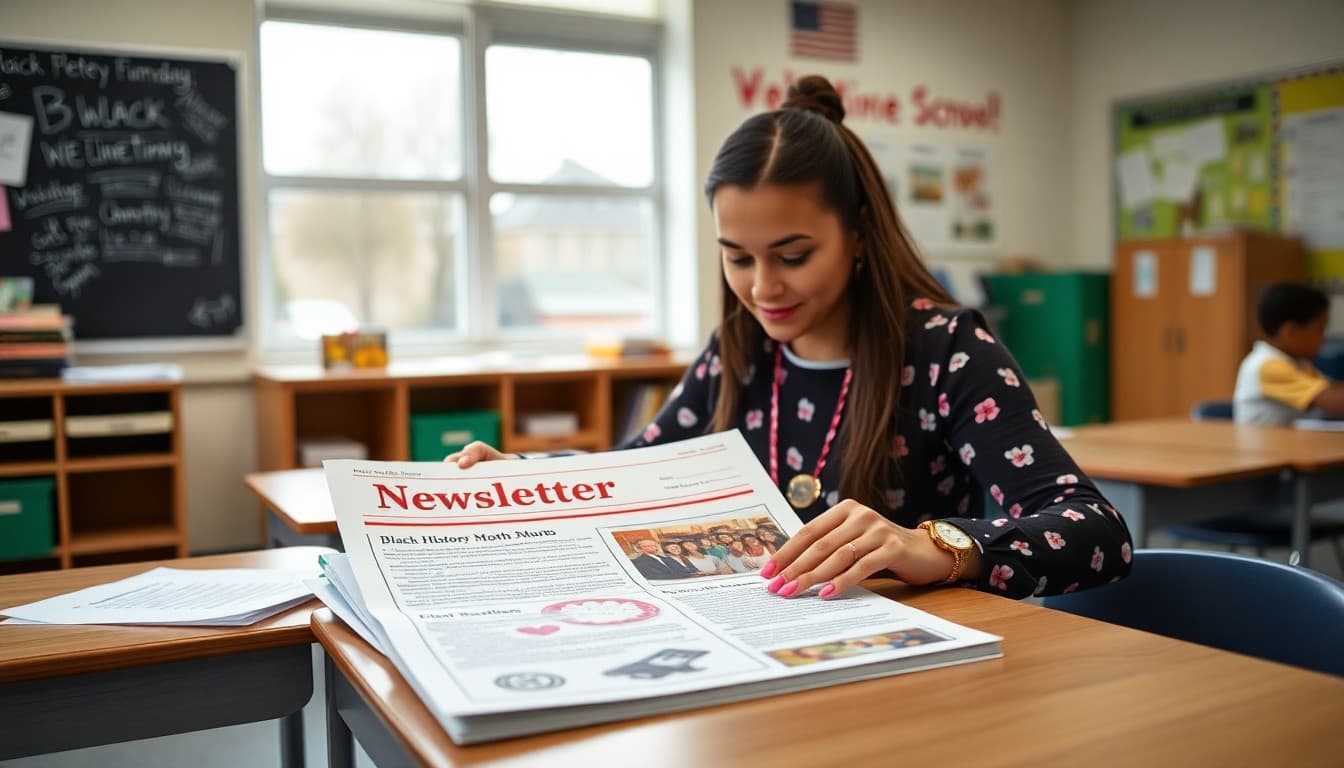
February School Newsletter Template for Teachers
February is one of the richest months in the school year for newsletter content. Black History Month, the mid-year academic check-in, Valentine's Day logistics, and social-emotional learning themes all converge in four weeks. The challenge is covering what matters without producing a newsletter that is too long to read. Here is a structure that works.
Lead with Black History Month content
Black History Month deserves the lead position in the February newsletter. Be specific about what students are learning. "In February, our class is reading biographies of civil rights leaders and exploring primary sources from the 1950s and 1960s. Students are analyzing the strategies and language of the movement and connecting that history to present-day civic participation. At home, the library has an excellent display of related books for all reading levels." Specific content is more credible than general celebration language.
Mid-year academic update
February is often the midpoint of the school year. Give families a brief status update. "Heading into the second half of the year, students have built strong skills in [areas]. The coming months will focus on [what's next]. Report cards will be distributed on [date] and will reflect progress through [date]. If you have questions about your student's progress before then, please reach out." This keeps families oriented without requiring a full progress conference.
Valentine's Day classroom logistics
For grades where Valentine's Day is classroom-relevant, share the specifics clearly. "Our class celebration will be on [date]. Students may bring cards for all 24 students if they choose. Please remember our classroom's nut-free policy for any treats. A class list will come home this week." Keep this section brief and practical. It is logistics, not a celebration narrative.
Home activity for February
Connect a home activity to the current academic focus. If February is biography month: read a short biography together and talk about what the person faced and chose. If February math focuses on geometry: find geometric shapes in architecture on a walk. If February is literary analysis: practice the 'what is the author trying to show us' question during any reading.
Template: February teacher newsletter
"February Update , [Class/Grade] | [Teacher Name] Black History Month: [3-4 sentences on the specific content, books, and projects students are doing]. Mid-year check-in: [2-3 sentences on academic progress and upcoming formal assessments]. Valentine's Day: [If applicable , dates, card policy, allergy reminders]. Try at home: [One specific activity]. February calendar: [3-5 bullet points with dates]."
Daystage makes it easy to build this February newsletter from a reusable template structure and update only the current month's content, keeping your communication consistent throughout the year.
Get one newsletter idea every week.
Free. For teachers. No spam.
Frequently asked questions
What should a February teacher newsletter include?
A February teacher newsletter should cover: Black History Month and how it is being addressed in the classroom (this is the most important February topic and deserves a clear, substantive paragraph), Valentine's Day logistics if applicable to the grade level, mid-year academic progress and what families should expect in terms of assessments or report cards, any upcoming school events or breaks, and one home-support suggestion connected to current learning. February is also a strong month for social-emotional learning content.
How should teachers address Black History Month in a February newsletter?
Be specific about what students are learning, not just that you are celebrating it. 'In February, our class is studying the civil rights movement through primary sources and biography. Students are reading [specific text or author] and creating [specific project].' Generic statements like 'we celebrate the contributions of Black Americans' are less credible than specific descriptions of the actual curriculum. Families notice the difference.
How should teachers handle Valentine's Day in a newsletter?
Valentine's Day communication depends on school policy and grade level. For younger grades: share the classroom policy on cards and treats, remind families of allergy policies, and give families enough notice to prepare. For older grades: Valentine's Day may not be classroom-relevant, and the newsletter does not need to address it. Never assume all families celebrate Valentine's Day. Present the classroom policy without framing it as a celebration everyone shares.
What mid-year academic update should be in a February newsletter?
February is typically mid-year, which makes it a natural time for a brief academic progress update. Share what skills students have mastered since September, what the class is currently working toward, and what families can expect in terms of formal feedback (report cards, conferences, progress reports). This gives families context for interpreting whatever formal assessments are coming up.
How does Daystage support February teacher newsletters?
Daystage lets teachers embed links to Black History Month reading recommendations, February event details, and parent-teacher conference scheduling directly in the newsletter. A February newsletter with embedded links to specific books or resources is far more useful than a newsletter with general recommendations. Daystage also maintains consistent branding so each monthly newsletter looks professional and connected to the class's overall communication.

Adi Ackerman
Author
Adi Ackerman is a former classroom teacher and curriculum writer with 8 years in K-8 schools. She writes about school communication, parent engagement, and what actually works in real classrooms.
More for Professional Development
Ready to send your first newsletter?
3 newsletters free. No credit card. First one ready in under 5 minutes.
Get started free