
12th Grade Social Studies Newsletter: Connecting Senior Year Civics, History, and AP Content to Families
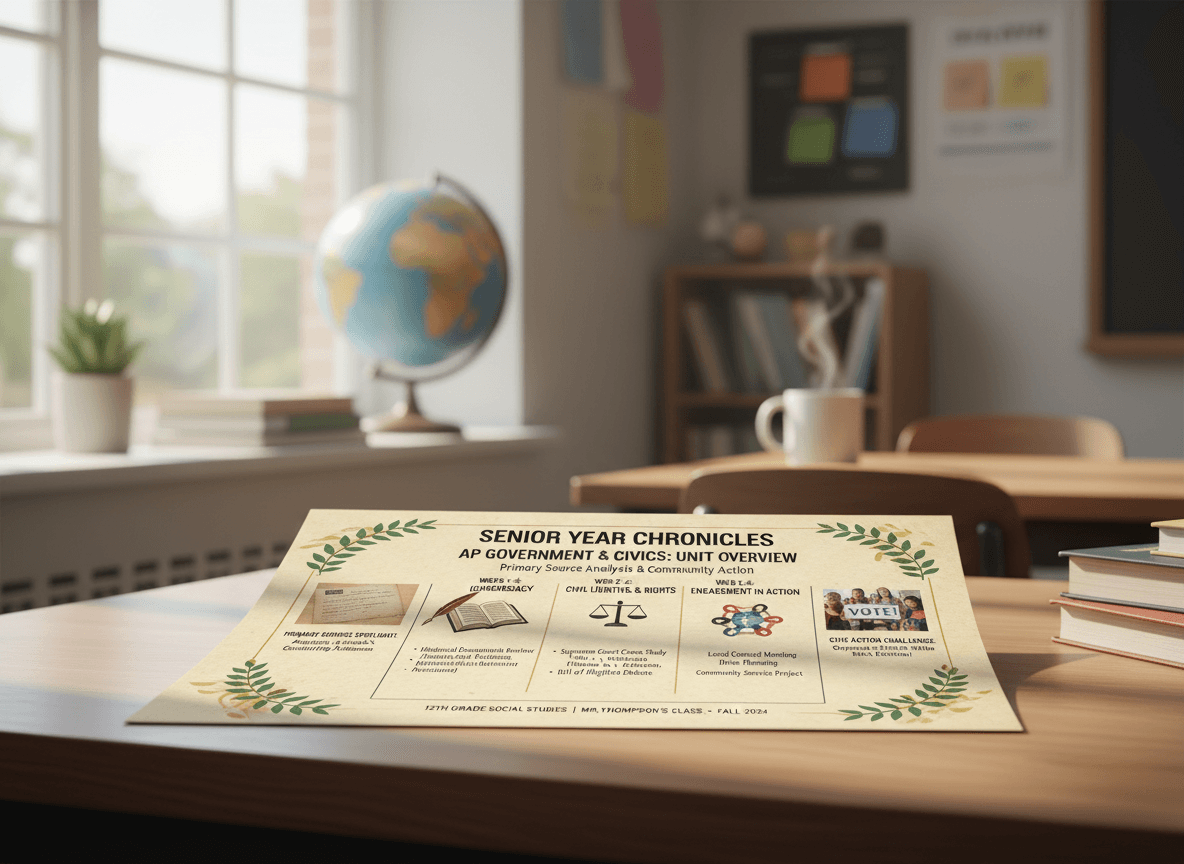
Social studies in senior year occupies a unique place in the curriculum. Students in AP Government, AP US History, AP Economics, AP Human Geography, or senior civics are studying the systems that will define their adult lives at the exact moment those lives are beginning. Many of them are 18 years old, voting for the first time, and preparing to enter an economy and civic society they will soon navigate independently.
A 12th grade social studies newsletter that acknowledges this context will mean more to families than one that simply announces the next test date. This guide covers how to write unit newsletters that connect the content to real student experience, support AP exam preparation, and help families engage with what their student is learning.
Why Senior Year Social Studies Hits Differently
The abstract quality that sometimes makes social studies feel distant in middle school dissolves in 12th grade. A unit on the electoral process in AP Government arrives at the same time many students are registering to vote. A unit on economic policy in AP Economics lands while students are comparing financial aid offers and thinking about student loan implications. A unit on constitutional rights arrives as students are legally entering adulthood and those rights become personally applicable.
Families who understand this connection are more likely to engage with the course content in productive ways, asking their student questions about what they are studying, connecting class discussions to news they are following, or simply understanding why the subject matter has more energy in senior year than it might have had in 10th grade.
Explaining AP Exam Alignment Without Overwhelming Families
AP social studies exams have specific formats that families deserve to understand before the exam arrives in May. AP US History, AP Government, AP Economics, and AP Human Geography all include a combination of multiple choice questions, short-answer responses, document-based questions, and long essay responses. The skills these exams test include primary source analysis, argument construction, and evidence-based reasoning, not just content recall.
Your unit newsletter should explain what skills this particular unit develops and how they connect to the exam. For a document-based question unit in AP US History, you might write: "This unit focuses on analyzing primary sources from multiple perspectives and constructing a coherent argument, which is exactly what the AP exam's document-based question requires." Families who understand the skill being developed understand why the work matters.
Current Events and Civic Engagement
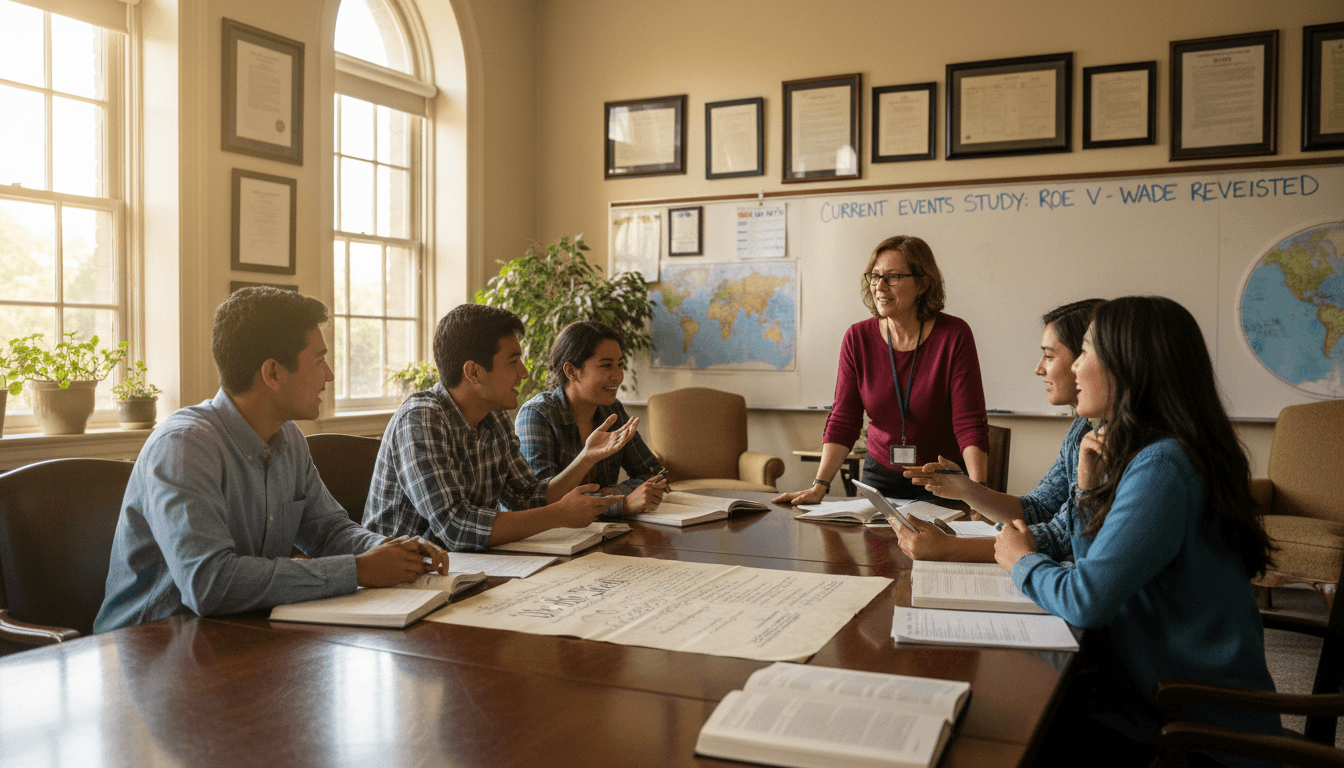
Social studies courses that include a current events component in senior year are engaging students with material that is genuinely live. Your newsletter can reflect this. When your class is analyzing a recent Supreme Court decision, a legislative debate, or an economic indicator, name it in the newsletter and tell families what questions students are wrestling with.
This kind of specific, timely content in a newsletter serves a real purpose: it gives families conversation starters. A parent who knows their student spent the week analyzing a specific Supreme Court case can ask a specific question about it at dinner rather than the generic "how was school." Those conversations reinforce learning in ways that do not happen without the newsletter as a bridge.
Voter Registration for Seniors Turning 18
Senior year social studies is the natural home for voter registration communication. Students turning 18 during the school year are becoming eligible voters, and many states have school-based registration programs. Your newsletter is an appropriate place to mention registration opportunities, the dates of any local or state elections during the school year, and how your class connects to civic participation.
This is not partisan communication. It is civics in practice. A social studies teacher who actively connects classroom learning to civic participation is modeling exactly what the discipline is for. Families across the political spectrum generally support the goal of students becoming engaged citizens, even when they disagree on policy substance.
Navigating Politically Sensitive Content
Senior social studies covers material that is politically charged: immigration policy, economic inequality, civil rights history, foreign policy, and constitutional interpretation are all subjects where families hold strong and differing views. Your newsletter should describe how you approach this content, not what conclusions you draw from it.
Explaining your pedagogical framework builds trust. "We analyze these issues using primary sources, examine multiple historical and contemporary perspectives, and practice evidence-based argumentation" is more reassuring to families than leaving them to imagine what happens in the classroom. Families who understand the framework trust that their student is being taught to think, not told what to think.
Research and Writing Projects
Many senior social studies courses include substantial research and writing components: a policy analysis paper, a historical thesis, a mock Supreme Court brief, or an economic research project. These assignments overlap with the college application writing period, and families need advance notice to help students plan.
When a major research project is assigned, the newsletter for that unit should include the project overview, the timeline, any in-class research days scheduled, the evaluation criteria, and guidance on academic integrity. Students who are writing college application essays and a research paper simultaneously benefit from a family that understands both demands exist and can help them prioritize their time.
Connecting Social Studies to Post-Secondary Planning
For students considering majors in political science, economics, history, international relations, law, public policy, or education, senior social studies courses are a meaningful part of their academic preparation. Your newsletter can make this connection explicit. A student who is passionate about constitutional law benefits from knowing that their AP Government free-response practice is building skills they will use in college coursework and eventually in a legal career.
Even for students who are not pursuing social science fields, the analytical and communication skills developed in senior social studies courses transfer to college writing, professional reasoning, and civic life. A brief paragraph in each unit newsletter connecting the skills to what comes next is one of the more meaningful things a senior social studies teacher can offer families who are paying attention.
Get one newsletter idea every week.
Free. For teachers. No spam.
Frequently asked questions
What makes social studies communication in 12th grade especially relevant for families?
Senior year is when students are turning 18 and becoming eligible to vote for the first time. Courses like AP Government, AP Economics, and senior civics are not abstract in the way they might feel in earlier grades. These subjects connect directly to decisions students are making and rights they are acquiring at the same moment. A newsletter that acknowledges this connection makes the subject matter land differently for families who might otherwise see social studies as routine background noise.
How should an AP Government or AP US History newsletter explain exam alignment to families?
Keep it concrete. Tell families the exam date, the format including multiple choice, document-based questions, and essay components, and what the course is doing in this unit to prepare students for that format. For AP US History, explain that the exam emphasizes historical thinking skills and argumentation, not just memorization. For AP Government, note that the exam includes analysis of foundational documents like the Constitution and key Supreme Court cases. Families who understand the exam format are better positioned to support study habits.
How should a 12th grade social studies newsletter handle politically sensitive content?
By describing what students are studying and why, without editorializing about outcomes. A unit on the federal budget in AP Economics covers real policy content. A unit on civil rights in AP US History covers contested historical events. A unit on elections in AP Government involves live political context. Your newsletter should explain the academic framework for how the content is approached: primary sources, multiple perspectives, evidence-based argumentation. Families can trust a process they understand, even when the content is complex.
How often should a 12th grade social studies teacher send a newsletter?
Once per unit is standard, with AP exam prep newsletters added in March and April. Social studies courses often have current events components that create natural newsletter hooks throughout the year. A brief mid-unit newsletter when a major primary source analysis or research paper is due can also help families support their student's time management during high-stakes assignments.
What newsletter tool works best for 12th grade social studies communication?
Daystage is well-suited for the kind of thoughtful, substantive newsletter a 12th grade social studies class benefits from. Teachers can include links to primary source databases, the College Board AP resource page, current events sources, or voter registration information for students turning 18. Sending a consistent, well-formatted newsletter through Daystage each unit builds a communication rhythm families come to rely on through the full senior year.

Adi Ackerman
Author
Adi Ackerman is a former classroom teacher and curriculum writer with 8 years in K-8 schools. She writes about school communication, parent engagement, and what actually works in real classrooms.
More for High School
12th Grade Curriculum Overview Newsletter: Helping Senior Families Understand the Final Year Coursework
High School · 6 min read
12th Grade Science Unit Newsletter: Connecting Senior Year Labs and AP Content to What Families Need to Know
High School · 6 min read
Eleventh Grade Social Studies Newsletter: Keeping Junior Families Connected to What History and Civics Teach
High School · 6 min read
Ready to send your first newsletter?
3 newsletters free. No credit card. First one ready in under 5 minutes.
Get started free