

12th Grade Homework Policy Newsletter: Communicating Academic Expectations to Senior Families
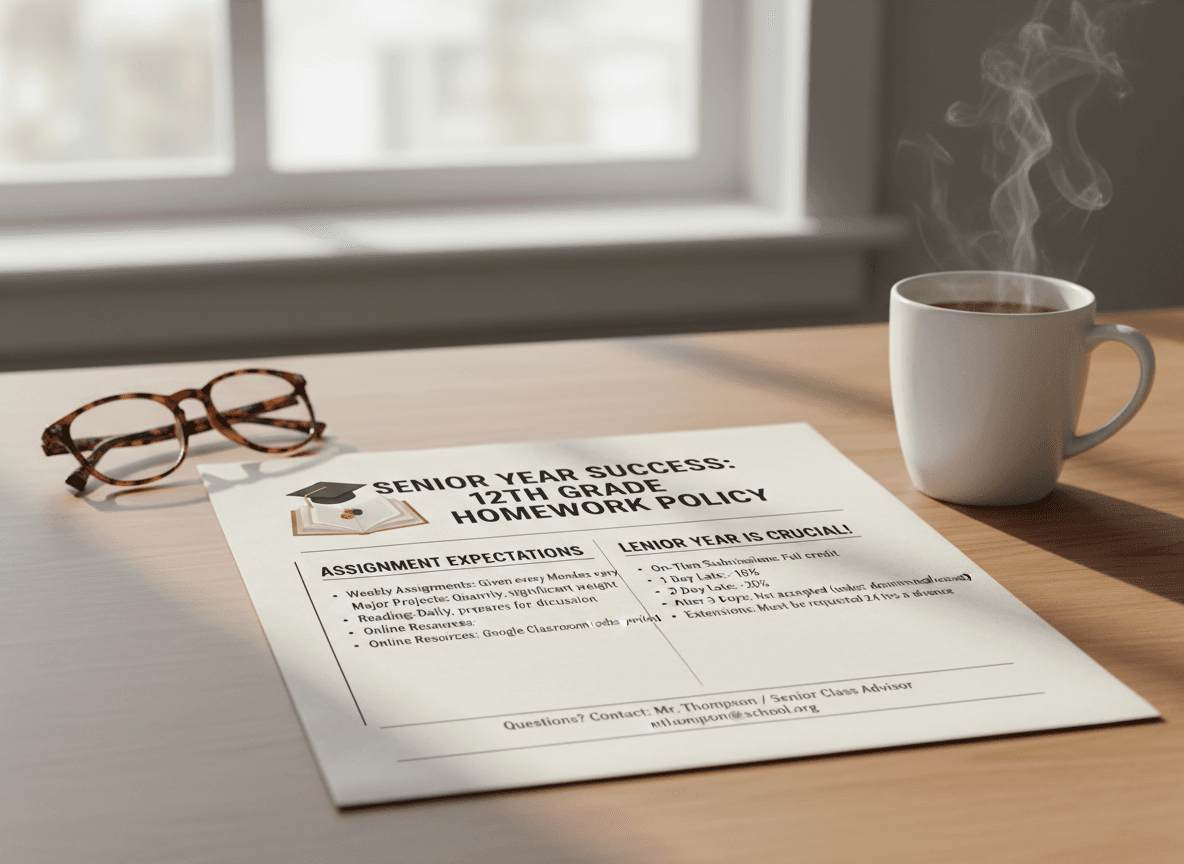
Homework policy communication in 12th grade sits at the intersection of academic standards and the practical reality of what senior year actually demands. Students are completing a full academic course load while simultaneously writing personal statements, gathering letters of recommendation, completing the FAFSA, and meeting college application deadlines. A homework policy newsletter that ignores this context will not be received well. One that acknowledges it while still holding clear expectations will.
This guide covers how to communicate your 12th grade homework expectations to families in a way that is honest about the year, firm about the standards, and useful as a reference document all the way through graduation.
Why Homework Policy Communication Matters More in Senior Year
In most years, a homework policy newsletter is a routine administrative document. In senior year, it is a meaningful piece of communication because the stakes of academic performance are higher and the competing demands on students' time are more significant than in any previous year.
Senior students who understand the homework policy from the beginning of the year are more likely to plan their time well and less likely to be caught off guard by consequences. Families who understand the policy are better positioned to support their student's time management rather than inadvertently undermining it by encouraging shortcuts.
Acknowledge the Competing Demands Without Lowering the Bar
A homework policy newsletter that pretends senior year is identical to junior year will not resonate. Students and families both know the year is more complex. The better approach is to name that complexity directly: this is a demanding year for a specific set of reasons, and the homework expectations in this class are designed with that reality in mind.
What that means in practice depends on your course. An AP class has external exam preparation built into its structure. A non-AP senior elective may have more flexibility in the volume and timing of assignments. Either way, explaining how you designed the homework load relative to the full senior year context shows families that you are thinking about their student's whole situation, not just your individual course.
The Late Work Policy: Be Specific and Explain the Why
Ambiguous late work policies create conflict. A policy that says "late work will be penalized" leaves open questions that become disputes in January. What is the penalty? How many days late is too late? What happens if a student has a legitimate emergency?
Write the policy in plain language: work submitted after the due date loses X points per day, is not accepted after X days, and is eligible for full credit only if an extension was requested before the deadline. Then explain why this structure exists. College professors do not typically accept late work without prior communication. The late work policy in your class is modeling a skill students will need immediately in whatever comes next.
AP Exam Season and Homework Adjustments
For AP courses, the weeks leading up to and including AP exams in May are a unique period. In-class content shifts toward review and practice. Outside assignments often shift accordingly. If you plan to modify homework expectations during this window, say so in your policy newsletter at the start of the year.
Students and families managing five or six AP courses simultaneously need to know what the homework burden will look like in April and May. If your plan is to reduce written homework and increase focused practice problems, that is information that helps families plan. If the full homework load continues through exam week, families need to know that too so they can support their student in managing it.
College Application Season and Homework Conflicts
The first semester of senior year is when college application workload peaks. November, in particular, is the month when early decision and early action deadlines arrive, FAFSA is due for many state aid programs, and classroom midterms are approaching simultaneously. Students in this period are genuinely managing more than students in any previous semester.
Your homework policy newsletter is a reasonable place to address this. Some teachers build in a modest extension policy specifically for the November crunch. Some maintain standard expectations and encourage students to plan ahead. Whatever your approach, communicating it explicitly prevents families from assuming an accommodation exists when it does not, or from not knowing to ask for one when it does.
Second Semester Expectations Are Especially Important to State Early
If there is one thing most families do not anticipate about 12th grade homework policy, it is that second semester expectations remain in effect. After acceptances arrive in March and April, many seniors assume the academic pressure is over. The homework policy newsletter you send in August is your best opportunity to state clearly that second semester assignments matter, grades matter, and a course grade that drops significantly in the spring can have real consequences.
This is not fearmongering. Colleges do rescind acceptances for academic decline in the final semester. The communication that prevents that outcome is the communication that happens early, not the panicked call to a family in May.
How Families Can Support the Homework Habit
Senior year is a phase when many families are either over-involved in their student's academic work or completely checked out. The homework policy newsletter is a good place to clarify the appropriate role. Families are not responsible for completing or checking homework. They are responsible for ensuring their student has the time and space to do it, and for reaching out if they notice their student consistently struggling to meet expectations.
Including a short section on what productive family support looks like, and what the teacher's preferred communication channel is when concerns arise, rounds out a homework policy newsletter that families can actually use all year.
Get one newsletter idea every week.
Free. For teachers. No spam.
Frequently asked questions
What should a 12th grade homework policy newsletter cover that earlier grades do not need?
Senior year homework policy newsletters need to address the reality that students are managing a second full workload in parallel with academics: college applications, FAFSA, scholarship essays, and potentially a job or significant extracurricular commitments. Acknowledging that context while still communicating clear expectations builds credibility with both students and families. The newsletter should also address what happens to homework in the weeks around AP exams and how the policy applies to second-semester seniors who may be coasting.
How much homework is appropriate to assign in 12th grade?
There is no universal standard, but most educational researchers and college counselors suggest that senior year homework loads should be meaningful rather than high-volume. Assignments that build AP exam readiness, reinforce complex content, or develop skills students need post-graduation are time well spent. Homework assigned out of routine rather than purpose is harder to defend to seniors who are evaluating every time commitment against their college application calendar. Your newsletter is a good place to explain the rationale for what you assign.
How should a late work policy be communicated to 12th grade families?
Be specific and explicit. State the penalty for late work, the maximum number of days late work is accepted, and whether any assignments are ineligible for late submission. Then explain why: seniors need to manage competing deadlines, and the homework policy models the kind of time management they will need in college. Framing the late work policy as preparation for what comes next is more persuasive to senior families than framing it as a disciplinary measure.
What should a 12th grade homework policy say about the second semester?
Second semester homework expectations should be stated clearly in August, not announced in March when senioritis is already a problem. If the homework load shifts as AP exam prep intensifies, say so. If expectations remain constant through May regardless of what students have done with their college decisions, say that too. The families and students who struggle most in the second semester are usually the ones who assumed the rules would change after acceptances came in.
What newsletter tool works best for communicating 12th grade homework policy to families?
Daystage makes it simple to send a well-formatted homework policy newsletter at the start of senior year with clear sections covering expectations, late work policy, and how to communicate with the teacher if a student needs an extension. Having that policy documented in an email families received in August is also useful later in the year if there are ever disputes about what was communicated and when.

Adi Ackerman
Author
Adi Ackerman is a former classroom teacher and curriculum writer with 8 years in K-8 schools. She writes about school communication, parent engagement, and what actually works in real classrooms.
More for High School
12th Grade Classroom Rules Newsletter: Setting Expectations for the Final Year Without Condescending to Seniors
High School · 5 min read
12th Grade Curriculum Overview Newsletter: Helping Senior Families Understand the Final Year Coursework
High School · 6 min read
Eleventh Grade Homework Policy Newsletter: Setting Clear Expectations for Junior Year Families
High School · 6 min read
Ready to send your first newsletter?
3 newsletters free. No credit card. First one ready in under 5 minutes.
Get started free