
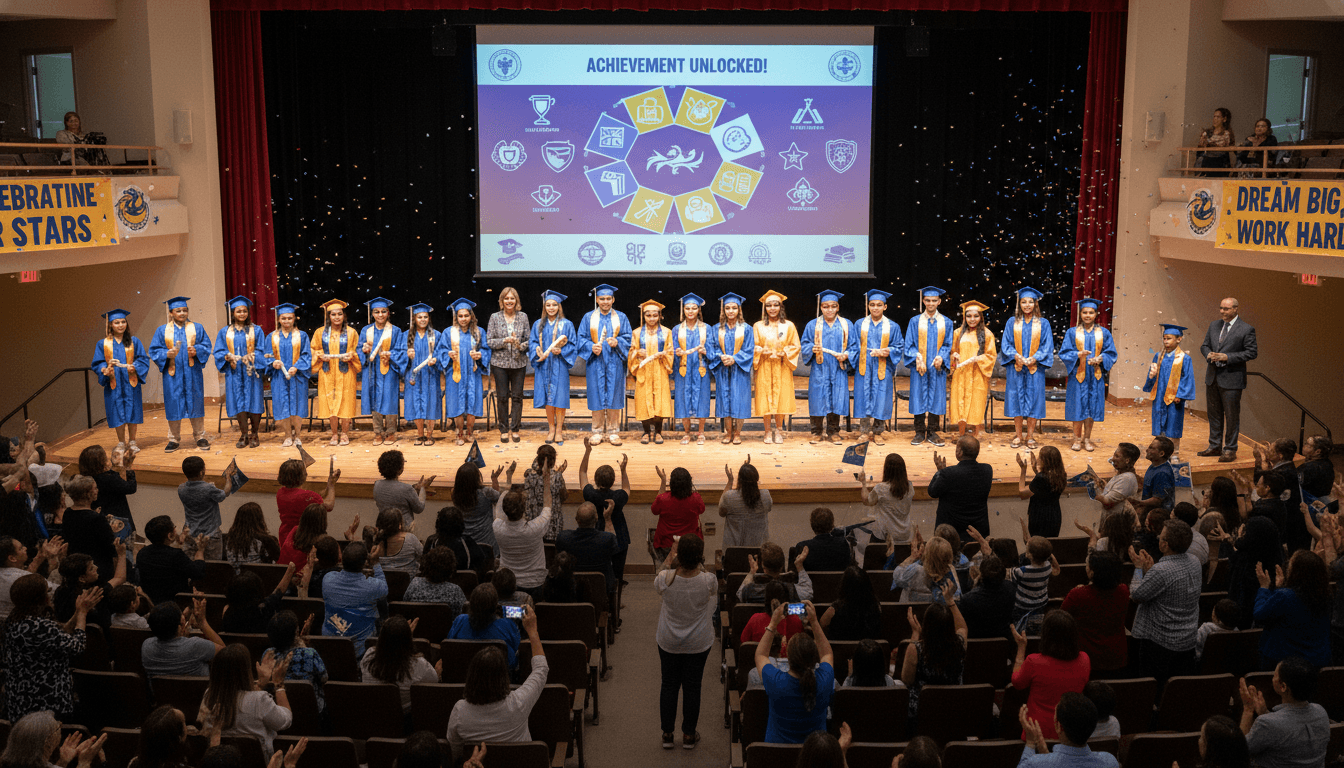
School Math Competition Newsletter: Building Number Sense and School Pride

Math competitions occupy an unusual position in most schools. They are academically prestigious but often invisible to the broader school community. Athletes get pep rallies. Math competitors get a quiet departure to a Saturday tournament. A newsletter that covers a math competition the way a school covers an athletic event, with a roster, a format description, and a post-event result, signals that mathematical achievement is valued just as highly as performance on a field.
Explaining the competition being entered
Name the specific competition and explain it briefly. MATHCOUNTS is different from the AMC, which is different from a Math Olympiad. Families who have never heard of these competitions do not have a frame for them. A two-sentence description of each one, what it tests and what level of competition it involves, gives families the context they need.
If the competition has multiple rounds, from school to regional to national, explain the structure. Families whose student has qualified for a regional competition are prouder of the achievement when they understand what qualifying represents.
Who can participate and how to prepare
Eligibility requirements vary by competition. Some are open to all students in specific grade levels. Others require a qualifying score. State the criteria plainly and, if registration is still open, include the deadline and the process.
Describe how the school is preparing participants: practice sessions, problem sets, and the types of problem categories that will appear. Families who know what preparation looks like can support it at home rather than wondering why their student is spending time on math problems that do not look like homework.
What the competition day looks like
For in-school competitions, describe the format: individual rounds, team rounds, timing, and scoring. For away competitions, include logistics. For both, describe the overall experience so families and students know what to expect.
Nervousness before a competition is normal and often beneficial. A newsletter that normalizes this and frames the competition as an opportunity to challenge yourself against a hard problem set is more supportive than one that emphasizes winning.
Celebrating the results
Post-competition communication is as important as pre-competition communication. Share the school's results, individual scores where appropriate, and what students learned from the experience. A brief note from the coach or a participating student on a problem that was particularly interesting or challenging gives the newsletter a personal and educational dimension.
Building a math culture beyond competition season
A math competition newsletter is also an opportunity to communicate what the school values in terms of mathematical thinking. End with a note on why competitions matter beyond the scores: they develop persistence, creative problem-solving, and the willingness to sit with a hard problem rather than immediately reaching for a procedure. These are skills that matter in every academic subject and in professional life long after the competition is over.
Get one newsletter idea every week.
Free. For teachers. No spam.
Frequently asked questions
What should a math competition newsletter include?
Cover the specific competition being entered (MATHCOUNTS, AMC, Math Olympiad, or a local tournament), who is eligible to participate, what the format and problem types look like, how students prepare, the competition schedule, and how results will be shared. For families unfamiliar with math competitions, a brief explanation of how math competition problems differ from standard classroom math is worth including.
How do math competition problems differ from regular classroom math?
Competition math typically involves problems that require multi-step reasoning, creative approaches, and mathematical thinking that goes beyond applying a formula. Problems are often novel, meaning students cannot solve them by recognizing a type they have practiced. This is why preparation for math competitions involves developing problem-solving strategies and mathematical intuition, not just reviewing procedures. A newsletter that explains this helps families understand why preparation takes time and why the competition is a genuine intellectual challenge.
How do you encourage more students to participate in math competitions?
Frame participation as an opportunity to explore math that is more interesting than classroom math, not as a high-stakes test for math prodigies. Many students who are strong in classroom math have never been exposed to competition math and find it challenging and engaging once they try it. A newsletter that explicitly invites any student who enjoys math to try participating, and that describes competition math as a new kind of challenge rather than a confirmation of mathematical talent, broadens the participant pool.
How can families help students prepare for math competitions at home?
Practice problems from prior competitions are publicly available for most national math competitions. Families can find these problems and work through them together with their students, or simply encourage their student to attempt problems independently and discuss the approach. Logic puzzles, strategy games, and number games also build the mathematical intuition that competition math requires.
How does Daystage support math teachers in communicating competition information to families?
Daystage lets math teachers and coaches send competition newsletters to all school families, so math achievements receive the broad community recognition they deserve.

Adi Ackerman
Author
Adi Ackerman is a former classroom teacher and curriculum writer with 8 years in K-8 schools. She writes about school communication, parent engagement, and what actually works in real classrooms.
More for School Events
Ready to send your first newsletter?
3 newsletters free. No credit card. First one ready in under 5 minutes.
Get started free