
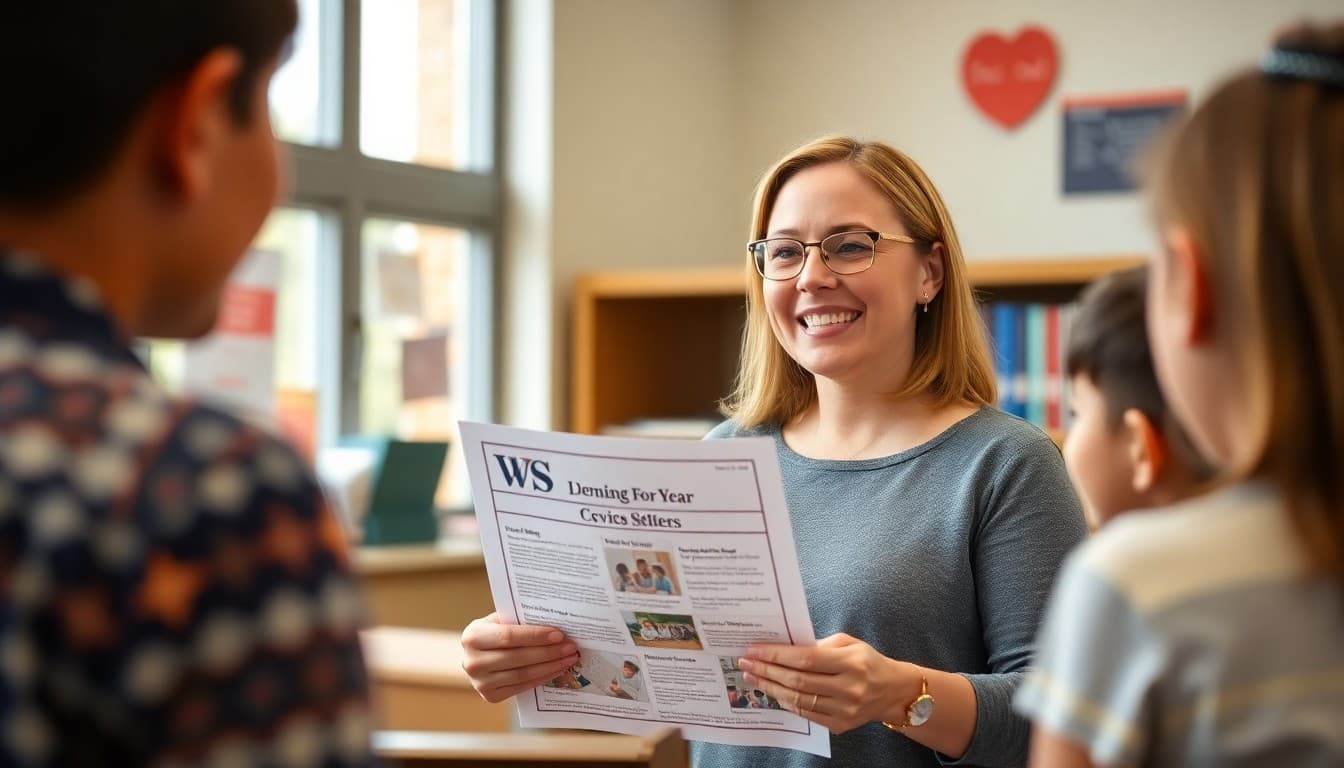
Civics Beginning of Year Newsletter: Elementary School Guide
The beginning of year civics newsletter does something more than share curriculum information. It introduces families to a subject they may have conflicted feelings about and invites them to engage with their student's civic education from day one. Done well, this newsletter builds excitement for a subject that can shape how students see themselves in the world.
Reframing What Elementary Civics Means
Many parents hear "civics" and picture their own high school experience: memorizing the Preamble, studying the branches of government, or debating electoral systems. Elementary civics is different. It starts where students are: in their community, their school, and their daily life.
Your newsletter can make this reframe directly: "Elementary civics isn't about memorizing the three branches of government. It's about understanding the community your student already lives in: why rules exist, what community helpers do, how groups make decisions together, and what it means to be a responsible member of the communities you belong to." That framing usually generates interest rather than resistance.
What the Year Looks Like
Give parents a brief unit map. For a typical elementary civics curriculum:
"Here's what we'll cover this year. We'll start with Our Classroom Community and explore how rules and responsibilities work in a small group. From there, we'll expand to Our Neighborhood and Community, looking at the roles different people play and what services communities provide. In the spring, we'll move into Local Government Basics, how town and city decisions get made, and what voting means. We'll close the year with a unit on Rights and Responsibilities, connecting all the earlier concepts to what it means to be an active community member."
Template Excerpt: Welcome and Overview
"Welcome to [Grade] Social Studies. I'm [name], and this year we're going to spend a lot of time on civics: understanding the communities your student belongs to and their place in them.
We'll start close to home and expand outward. First, our classroom and school community. Then our neighborhood and town. Then the bigger questions about how communities make decisions, why rules exist, and what each of us can contribute.
You'll hear from me at the start of each unit with a short newsletter and a couple of ideas for continuing the conversation at home. Civics is one of those subjects where your everyday life offers dozens of teaching moments every week. I'll help you spot them."
How to Engage With Civics at Home Right Now
Give parents one or two things to do before the first full unit begins. Ask their student what they think a "community" is. Walk through the neighborhood and identify three community helpers they see (mail carrier, trash collector, crossing guard). Ask why their school has rules and what would happen if there weren't any.
These simple pre-unit conversations prime students for what's coming and signal to them that civic thinking is something their family cares about.
Building Civic Identity From the Start
One of the most important goals of elementary civics is helping students see themselves as community members with both rights and responsibilities, not just as recipients of what their community provides. Your newsletter can name that goal explicitly: "By June, my goal is for your student to feel like an active participant in the communities they belong to, not just someone who lives in them."
That's a compelling vision for a parent. It's also a vision that extends well beyond any particular test or unit, which is what makes civics worth teaching in the first place.
Communication Throughout the Year
Close with a brief description of how you'll communicate for the rest of the year and how parents can reach you with questions. Setting those expectations in the first newsletter makes every subsequent newsletter feel like a continuation of an established relationship rather than a cold update from a teacher they barely know.
Get one newsletter idea every week.
Free. For teachers. No spam.
Frequently asked questions
What should an elementary civics beginning of year newsletter include?
Cover four things: a brief introduction to you and your teaching approach, an overview of what civics means at the elementary level (since many parents picture high school government class), a unit map for the year, and two or three simple ways parents can engage with the subject at home from the start. Keep the total to one page and use plain, welcoming language.
How do I explain elementary civics to parents who expect it to be boring or irrelevant?
Lead with what kids actually do in elementary civics: explore community roles, practice fair decision-making, learn what rules are and why communities make them, and connect to the world they see every day. That description is immediately more engaging than 'study the three branches of government.' Parents who understand that the content is hands-on and community-focused are more likely to engage.
Should the beginning of year newsletter mention specific standards or frameworks?
A brief reference is helpful for parents who want context: 'This year's civics curriculum aligns with [state] social studies standards for [grade].' But don't lead with standards language, which rarely means anything to parents. Lead with what students will do and experience, then mention the standards as brief supporting information at the end.
What's the right tone for an elementary civics beginning of year newsletter?
Warm, enthusiastic, and accessible. Civics is a subject where teacher passion is genuinely contagious. If you love teaching students that they're already civic actors in their community, say that. The newsletter that sounds like it was written by someone who cares about the subject gets read differently than one that sounds like a form letter.
Is Daystage useful for beginning of year newsletters?
Yes, especially because you can save the beginning of year newsletter as a template and adjust it slightly each year. The structure stays consistent while the specific details update. Teachers who use Daystage for the first newsletter of the year tend to maintain consistent communication all year because the system is already set up.

Adi Ackerman
Author
Adi Ackerman is a former classroom teacher and curriculum writer with 8 years in K-8 schools. She writes about school communication, parent engagement, and what actually works in real classrooms.
More for Elementary
Elementary Teacher Back-to-School Newsletter: What to Send Before and During Week One
Elementary · 7 min read
Elementary Art Teacher Newsletter: How to Share Visual Learning With Families
Elementary · 6 min read
Elementary Math Newsletter: How to Explain What Students Are Learning in Math
Elementary · 7 min read
Ready to send your first newsletter?
3 newsletters free. No credit card. First one ready in under 5 minutes.
Get started free