
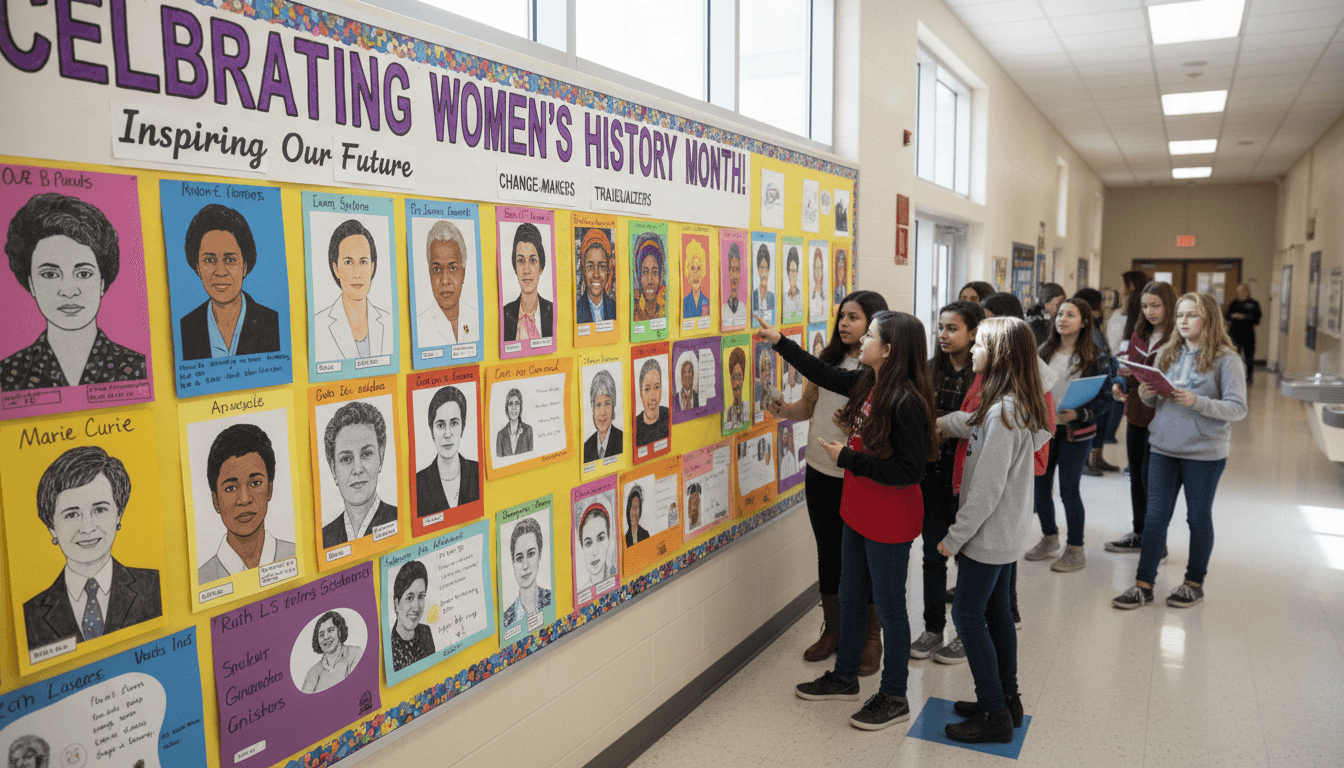
Women's History Month School Newsletter: Celebrating Women Leaders

A Women's History Month school newsletter that features Susan B. Anthony and Amelia Earhart, then closes with a clip-art rose and a generic statement about "strong women," is not doing Women's History Month. It is performing it. Students who read this newsletter, especially students who are women and girls, receive a message about how seriously the school takes their history and their ambitions. A newsletter that goes beyond the familiar roster of figures and connects to real curriculum, real student identity, and real possibility communicates something different.
This guide covers how to write a Women's History Month newsletter that reflects genuine curriculum engagement, represents the full breadth of women's contributions, and connects to the students whose futures this month is ultimately about.
Going beyond the ten names everyone already knows
The strongest Women's History Month newsletters introduce students and families to women they have not already encountered. Alongside the well-known figures, highlight women who are less commonly featured in school curricula: Katherine Johnson and the Black women mathematicians who made NASA's early missions possible. Sylvia Mendez, whose family's lawsuit desegregated California schools before Brown v. Board. Chien-Shiung Wu, one of the most accomplished experimental physicists of the twentieth century. Rigoberta Menchu, Guatemalan Indigenous rights activist and Nobel laureate. Ruth Bader Ginsburg is a fine choice. So is Constance Baker Motley, the civil rights attorney who argued more cases before the Supreme Court than any other Black woman.
Specificity about who is being highlighted, and why they matter in the curriculum context, is the difference between a newsletter that teaches and a newsletter that decorates.
Women's contributions across every discipline
Women's History Month newsletters that only feature women in politics and social activism imply that women's contributions to science, mathematics, technology, literature, music, athletics, and business are not equally worth celebrating. They are. A newsletter that deliberately covers women across disciplines reflects the full curriculum and sends students the message that women have contributed to every field they might pursue.
Describe what students are reading and studying this month across subject areas. What women authors are the English classes examining? What women scientists are the STEM teachers highlighting? What women composers or visual artists are the arts teachers featuring? Cross-disciplinary coverage makes the newsletter feel like a whole-school commitment rather than a single teacher's March project.
Connecting historical achievements to present possibility
The most effective Women's History Month curriculum connects what women achieved in the past, often against significant institutional resistance, to what students can pursue in the present. A newsletter that bridges this connection explicitly, that names women who broke into fields that were closed to them and connects their breakthroughs to the opportunities that exist for students today, gives students something more than historical information. It gives them a lineage.
Feature women who are active today in fields students might pursue. Name women who are currently serving in positions of leadership in government, science, medicine, law, engineering, and the arts. The historical figures ground the present; the contemporary figures make the future concrete.
Student voices and writing in the newsletter
Student writing about women they admire, women who have influenced them, or women they are studying this month is some of the most powerful content a Women's History Month newsletter can feature. With student permission, share writing samples, project descriptions, or student-created profiles of women leaders. When students see their own intellectual engagement reflected in the newsletter, they understand that their thinking matters. When families see their students' writing, they understand that Women's History Month is producing real learning, not just institutional acknowledgment.
Women in the local community and school history
National and international women's history matters. So does the local version. A newsletter that features women who have made contributions in your specific community, city, or region, including women who have attended your school, taught at your school, or served in leadership roles in your district, connects the history to something students can see and touch. Local history is often more diverse and more surprising than the national curriculum implies.
Family engagement and home extension activities
Women's History Month is an opportunity to extend learning into homes through specific, accessible family activities. A newsletter that suggests families watch a documentary together about a woman leader, visit a local museum exhibition, read a picture book or young adult novel featuring a girl protagonist, or simply have a dinner conversation about the women in their own family history connects the school curriculum to family life. These activities work across a wide range of family backgrounds and resources.
Addressing gender equity in the school itself
A Women's History Month newsletter is an appropriate moment to describe what the school is doing to address gender equity within its own walls. Are there gender gaps in advanced STEM course enrollment? Are women represented in leadership positions across the school? Are curriculum materials balanced in their representation of women and men? A school that uses Women's History Month to reflect on its own practices as well as celebrating historical figures is doing more than commemoration. It is doing the institutional self-examination that Women's History Month was designed to prompt.
The year-round curriculum question
Women's History Month newsletters land more credibly when they are explicitly connected to year-round curriculum representation. A newsletter that can reference women authors studied in September, women scientists highlighted in October, and women historical figures covered in the fall term is describing a curriculum that values women's contributions year-round. A newsletter that only features women in March signals that women's history is a March exercise rather than a permanent feature of how the school understands history, science, and literature.
Get one newsletter idea every week.
Free. For teachers. No spam.
Frequently asked questions
What should a Women's History Month school newsletter include?
Specific curriculum content covering women's contributions across multiple disciplines, not only politics and activism. Book recommendations by and about women. Student work that connects to Women's History Month curriculum. Events families can attend. And a clear description of how the school's Women's History Month programming connects to year-round curriculum representation for women and girls.
How do we represent diverse women in a Women's History Month newsletter?
Women's History Month curriculum that only highlights a handful of the same well-known figures, usually white American women, misses the breadth of women's contributions across cultures, disciplines, and eras. A newsletter that names women from different racial and ethnic backgrounds, different countries and eras, different fields including science, mathematics, art, literature, athletics, and activism, and different historical periods demonstrates curriculum breadth that benefits all students.
How do we connect Women's History Month to contemporary students' lives and ambitions?
Connect historical figures to current fields and careers that students may be considering. Highlight contemporary women leaders who are active right now. Share stories of women who defied expectations in fields that are traditionally underrepresented by women, including STEM, athletics, military service, and political leadership. Ask students to identify women whose work they find inspiring and feature their responses in the newsletter.
How do we write a Women's History Month newsletter that is inclusive of gender-diverse students?
Acknowledge that Women's History Month honors the contributions of women and girls throughout history, while using language that does not exclude gender-diverse students who may identify differently. Avoid framing the month as exclusively binary. Students who identify as non-binary or transgender may have complex relationships with Women's History Month, and inclusive language that acknowledges the breadth of the month's significance is more welcoming.
How does Daystage support Women's History Month newsletters?
Daystage makes it simple to send a monthly newsletter that consistently honors different communities and heritage months throughout the year. Schools that use Daystage for their March Women's History Month newsletter maintain the same consistent communication quality for Black History Month in February, AAPI Heritage Month in May, and every other month in the school calendar.

Adi Ackerman
Author
Adi Ackerman is a former classroom teacher and curriculum writer with 8 years in K-8 schools. She writes about school communication, parent engagement, and what actually works in real classrooms.
More for Diversity & Equity
Ready to send your first newsletter?
3 newsletters free. No credit card. First one ready in under 5 minutes.
Get started free