
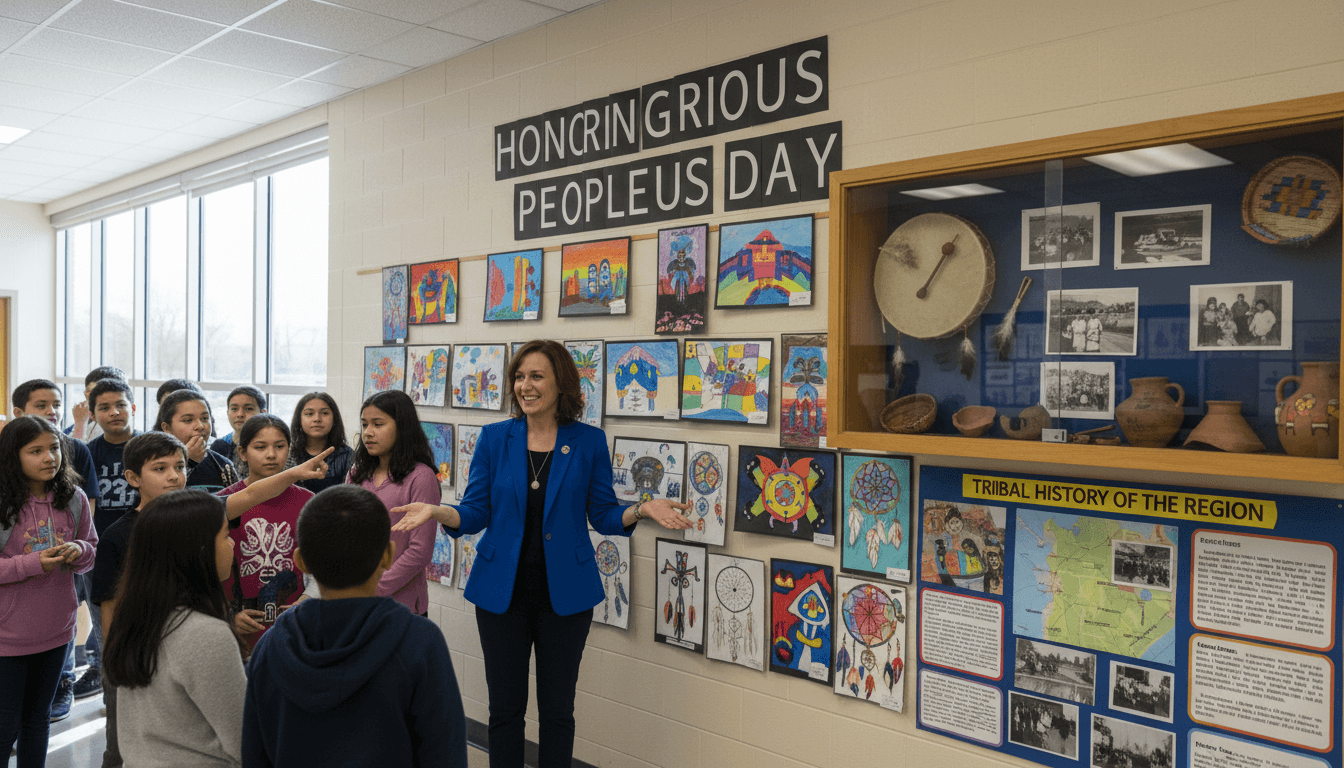
Indigenous Peoples Day School Newsletter: Honoring Native Communities

Indigenous Peoples Day newsletters that feature generic imagery of teepees and dreamcatchers, written in past tense about cultures that are fully alive today, do more harm than saying nothing. They reinforce the erasure of contemporary Native communities while performing the appearance of recognition. A newsletter that honors Indigenous communities meaningfully requires different choices: specific nations named by their actual names, living communities acknowledged as such, and curriculum content that reflects genuine historical engagement rather than surface-level celebration.
This guide covers how to write an Indigenous Peoples Day school newsletter that demonstrates real institutional commitment and respects the communities being honored.
Naming the specific tribal nations on your land
The first element of an Indigenous Peoples Day newsletter that signals genuine engagement is specificity about place. Most schools sit on the traditional territory of specific tribal nations. Name those nations by their own names, not by the anglicized or colonial names that appear in older texts. The Lenape, not the Delaware. The Anishinaabe, not the Chippewa. The Duwamish, the Muscogee, the Tongva. Learning these names and using them correctly is a basic act of respect.
The Native Land Digital map at native-land.ca provides a starting point for identifying whose territory your school occupies. Cross-reference with local tribal nation websites or cultural organizations for confirmation and preferred naming conventions.
Connecting acknowledgment to curriculum
A land acknowledgment that stands alone in a newsletter, disconnected from any curriculum content or institutional relationship, is a ritual rather than a commitment. The newsletter is more powerful when the acknowledgment connects to something real: a unit the school is teaching this month about Native history, a relationship with a local tribal cultural center, a speaker who came to campus, or a change to curriculum materials that removes inaccurate or stereotypical depictions. Acknowledgment plus action is what makes this month's newsletter credible.
Teaching Native history without freezing it in the past
Most K-12 curriculum places Native peoples firmly in the historical past, as if Native communities ceased to exist after European colonization. An Indigenous Peoples Day newsletter that reflects an updated curriculum acknowledges that Native nations are sovereign governments operating today, that Native languages and cultures are living and evolving, and that Native peoples are active contributors to contemporary science, art, politics, literature, and every other field. Describe specific contemporary Native figures and their contributions alongside the historical content students are studying.
Avoiding stereotypes in newsletter imagery and language
The imagery choice for an Indigenous Peoples Day newsletter communicates as much as the words do. Avoid generic imagery that collapses hundreds of distinct Indigenous nations into a single visual stereotype. Do not use feathered headdresses, tomahawks, or tipis as default representations. Seek out photography and artwork by Native artists, or use abstract imagery that does not misrepresent any specific community. If you cannot find appropriate imagery, text-only design is preferable to stereotyping.
Language choices matter equally. Avoid "Native American" as the only term if tribal nations in your area prefer specific names or use "Indigenous" or "American Indian" as preferred terms. Use the present tense when discussing living cultures. Avoid "ancient" or "traditional" as code words that imply Native cultures belong to the past.
Resources by Native authors and organizations
The newsletter is an effective vehicle for connecting families to resources created by Native people rather than about them. Share book recommendations by Native authors: Tommy Orange, Louise Erdrich, Robin Wall Kimmerer, Terese Marie Mailhot, Angeline Boulley. Share resources from tribal nation websites, the Smithsonian National Museum of the American Indian, and local Indigenous cultural organizations. These resources extend learning beyond the school and signal that the school is directing community attention toward Native voices rather than presenting itself as the authority on Native history.
Addressing the Columbus Day conversation directly
In school communities where Indigenous Peoples Day is a recent change from Columbus Day, the newsletter should address this directly. Some families will have questions or objections. A newsletter that explains the historical reasoning for the shift, the growing adoption of Indigenous Peoples Day across states and municipalities, and the school's commitment to historical accuracy gives families the context to understand the change rather than leaving them to fill in the gaps from elsewhere.
Building relationships with local tribal communities
The most powerful content an Indigenous Peoples Day newsletter can carry is a description of real institutional relationships with local tribal communities. If the school partners with a tribal cultural center for educational programming, describe that partnership. If tribal educators have spoken to students, share what they covered. If the school is in conversation with local tribal nations about curriculum review, describe that process. Real relationships are what distinguish a school that is doing this work from a school that is commemorating a day on a calendar.
What meaningful engagement looks like the rest of the year
An Indigenous Peoples Day newsletter sent in October is only meaningful if it connects to what happens in November, March, and throughout the year. Native American Heritage Month in November is an immediate next opportunity. Beyond designated months, the newsletter can signal year-round commitment by describing how Native history is integrated into the standard curriculum in history, social studies, literature, science, and art. Schools that teach Native content only in October are commemorating a day. Schools that teach it all year are building educated citizens.
Get one newsletter idea every week.
Free. For teachers. No spam.
Frequently asked questions
Should a school newsletter explain the shift from Columbus Day to Indigenous Peoples Day?
Yes, if your school or district observes Indigenous Peoples Day rather than Columbus Day, the newsletter should address this directly and explain the reasoning clearly. Families who receive a newsletter that acknowledges Indigenous Peoples Day without any context will have questions. A clear, factual explanation of why the school marks this day as Indigenous Peoples Day is more respectful than silence and more accurate than treating the change as self-evident.
How do we acknowledge local tribal nations in the newsletter without it feeling like a performative land acknowledgment?
Acknowledgment of the tribal nations on whose land the school sits becomes meaningful when it connects to real curriculum content and real relationships. If the school has a relationship with local tribal educators or cultural organizations, describe that relationship. If students are studying the history of the tribal nations whose territory they occupy, describe that curriculum. A land acknowledgment connected to action is different from a land acknowledgment that stands alone as a symbolic statement.
What should a school newsletter include for Indigenous Peoples Day?
Specific curriculum content covering Native history and cultures. The name of the tribal nations on whose land the school is located. Book recommendations by Native authors. Events or resources from local tribal nations or Native organizations. A clear statement of why Indigenous Peoples Day matters to the school community. Avoid generic imagery of feathers, tipis, or drums that conflate hundreds of distinct Indigenous nations into a single stereotype.
How do we write about Native history in a way that honors living communities, not just historical ones?
Frame Indigenous peoples as living, contemporary communities rather than historical subjects. Reference contemporary Native authors, artists, scientists, and political leaders. Describe how tribal nations are active and sovereign today. Avoid language that speaks of Native peoples in the past tense or implies that Native cultures are historical artifacts rather than living realities.
How does Daystage help schools manage Indigenous Peoples Day newsletters?
Daystage makes it simple to build an annual newsletter calendar that includes consistent Indigenous Peoples Day communication each October. Schools that use Daystage for year-round community newsletters find it easier to maintain the consistent voice and scheduling that makes heritage month communication feel like part of an ongoing commitment rather than an isolated event.

Adi Ackerman
Author
Adi Ackerman is a former classroom teacher and curriculum writer with 8 years in K-8 schools. She writes about school communication, parent engagement, and what actually works in real classrooms.
More for Diversity & Equity
Ready to send your first newsletter?
3 newsletters free. No credit card. First one ready in under 5 minutes.
Get started free