

How to Share Sentence Starters With Families in Your Teacher Newsletter
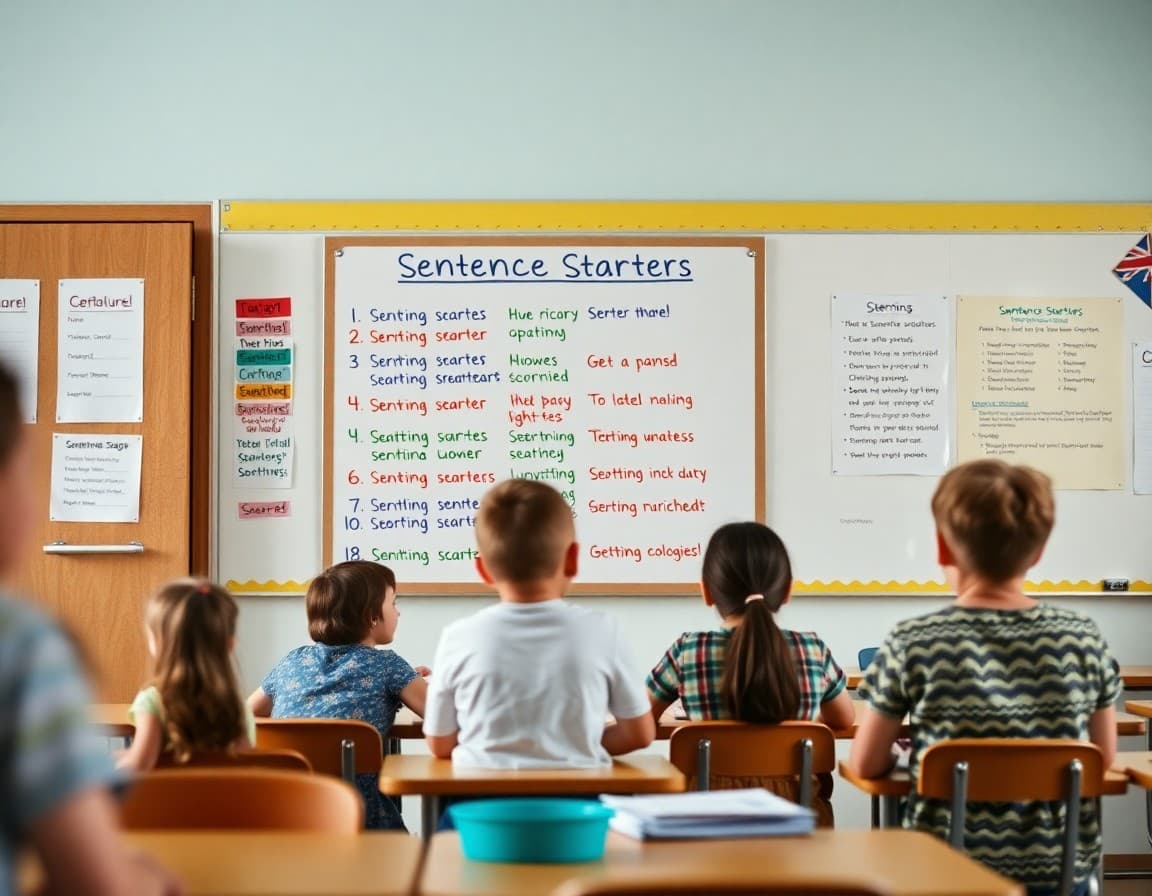
The blank page is the single most common reason writing assignments go unstarted at the kitchen table. Students who know what they want to say often do not know how to begin saying it in academic language. Sentence starters solve this problem by giving students a syntactic entry point. A newsletter that shares the sentence starters your class uses gives families a homework tool they can reach for immediately when a student is stuck.
Explain what sentence starters are and why they help
"Sentence starters are partial phrases that give students a way into an academic sentence. 'The evidence suggests...' 'This is important because...' 'Unlike the first example, this one...' They reduce the effort of getting started by providing the language structure so the student can focus entirely on the content. Students who use sentence starters produce more complex, more academic sentences than students who start from a blank page, especially when working in a genre that is new to them."
Share the specific sentence starters used in your class right now
"This month we are focused on argumentative writing. The sentence starters we are using include: 'I claim that...' 'The evidence supports this because...' 'A counterargument might be...' 'However, this does not account for...' 'In conclusion, the strongest argument is...' If your student is working on an argument essay at home, these starters are the same ones they are using in class."
Tell families when to offer a sentence starter
"If your student has been staring at a blank page for more than three minutes, ask: 'Can I give you a starter?' If they say yes, say: 'Try starting with: The most important reason is...' That is all. They fill in the rest. Most students who get the first four words going find that the next sentence comes more easily. The starter is the ignition, not the engine."
Explain when starters are used in class versus when students write without them
"In class, I use sentence starters during the introductory phase of a new writing type. Once students have practiced the structure five to ten times, I expect them to write without the starters. At that point the syntax is internalized and the starter becomes a hindrance rather than a scaffold. If your student says their teacher wants them to write without starters now, that is a sign of progress, not a removal of support."
Include a reference list of starters organized by purpose
A short reference list organized by writing purpose is more useful than a random collection. "Starters for evidence: 'This is supported by...' 'According to the text...' Starters for comparison: 'Similarly...' 'In contrast...' Starters for conclusion: 'Taken together, these examples show...' 'The most compelling evidence is...' A list like this at the kitchen table is a writing support families can reach for on any night of the year."
Note the relationship to academic vocabulary
"Sentence starters teach academic vocabulary in context. A student who uses 'The evidence suggests' twenty times over the course of a unit is learning that phrase as a functional tool. Academic language is acquired through repeated use in meaningful contexts, not through memorizing vocabulary lists."
Daystage newsletters with a linked sentence starter reference card are among the highest-value writing resources a teacher can send home. The barrier to use is minimal and the payoff at homework time is immediate.
Get one newsletter idea every week.
Free. For teachers. No spam.
Frequently asked questions
What are sentence starters and why do teachers use them?
Sentence starters are partial phrases that give students a syntactic frame to complete. 'The evidence shows...' 'This is significant because...' 'In contrast to...' 'The author's purpose is...' They reduce cognitive load by giving students the opening of a sentence so they can focus on the content rather than the language structure. They are especially helpful for English language learners and reluctant writers.
Do sentence starters crutch students and prevent them from developing independent writing?
Only if overused beyond the scaffolding stage. Sentence starters are intended as scaffolding that fades as students internalize the syntax. Most teachers use them for new genres or new types of academic language and expect students to write without them once the structure is familiar. The newsletter should clarify how and when they are used.
Should families use sentence starters at home during homework help?
Yes, when a student is stuck. 'Start with this: The most important thing about... and see if you can finish it.' The starter removes the blank page block without telling the student what to say. The content still comes from the student.
How do sentence starters differ from sentence frames?
Sentence starters provide the beginning of a sentence: 'The evidence suggests...' Sentence frames provide a more complete template with blanks: 'The evidence suggests ___ because ___.' Frames are more scaffolded. Starters are less scaffolded. Most teachers use frames for younger students and starters for older ones.
Can Daystage help teachers share sentence starter lists with families in newsletters?
Yes. A Daystage newsletter with a linked or embedded sentence starter reference card is a highly actionable resource for families supporting writing at home.

Adi Ackerman
Author
Adi Ackerman is a former classroom teacher and curriculum writer with 8 years in K-8 schools. She writes about school communication, parent engagement, and what actually works in real classrooms.
More for Classroom Teachers
Ready to send your first newsletter?
3 newsletters free. No credit card. First one ready in under 5 minutes.
Get started free