

Explaining Accountable Talk to Families in Your Teacher Newsletter
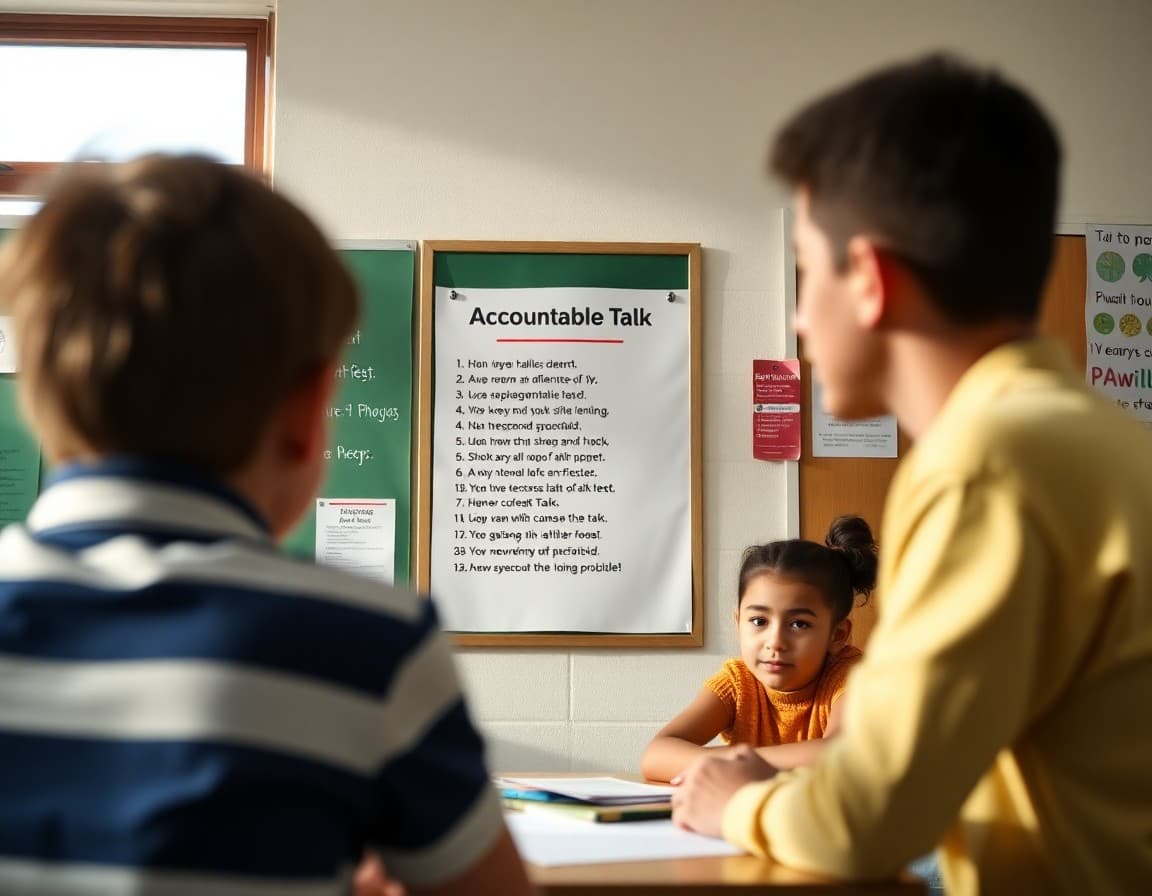
Accountable Talk is one of those classroom practices whose impact is visible in how students discuss ideas. Students who use it consistently say "I want to add to what Marcus said" instead of simply stating an unconnected opinion. They say "I disagree because the text says" rather than "I disagree." The difference is not just politeness. It is the structure of academic reasoning. A newsletter that introduces Accountable Talk to families creates an opportunity to extend the practice to where it can have the greatest additional impact: the dinner table.
Explain the purpose in plain language
"Accountable Talk is a set of discussion norms and language structures that teach students to engage with each other's ideas rather than simply stating their own. When students are accountable in discussion, they cite evidence for their claims, build on what others have said, and challenge ideas respectfully rather than dismissing them. The language structures make these habits explicit until they become natural."
Share the specific stems you are using in class
"This month we are practicing the following Accountable Talk stems. For building on ideas: 'I want to add to what ___ said...' For evidence: 'The text supports this when it says...' For respectful disagreement: 'I see it differently because...' For clarification: 'Can you say more about your reasoning?' These are the same stems posted on our classroom wall. Families who use them at home will hear their student recognize the language."
Tell families how to use the stems at the dinner table
"Try introducing one Accountable Talk stem at dinner this week. When your student shares an opinion about anything: 'What is your evidence for that?' When someone disagrees: 'Can you say that as I see it differently because...' It will feel artificial at first. That is normal. The structure is the point. After a few times it becomes a habit that shows up in other conversations."
Connect Accountable Talk to academic outcomes
"Students who practice Accountable Talk regularly produce more evidence-based writing because the same reasoning structure applies: make a claim, support it with evidence, consider the counterargument. Discussion is a rehearsal for writing and writing is a record of discussion. The two reinforce each other when the same norms apply to both."
Share an example from a recent classroom discussion
"In our science discussion this week, one student said 'I want to add to what Jordan said, but I think the evidence actually points in a different direction, because the graph shows a decrease, not an increase.' That sentence contains a claim, a direct response to a peer, and a specific piece of evidence. That is Accountable Talk in a real classroom moment."
Note what you observe in discussion quality over time
"By November, most students in my class stop needing the stems. The language becomes natural. At that point, the thinking is the focus rather than the language structure. Families who reinforce the stems at home accelerate that internalization."
Daystage newsletters with a short Accountable Talk stem card are one of the most transferable family engagement tools a teacher can send home. The stems are useful in family conversation immediately and reinforce classroom learning over time.
Get one newsletter idea every week.
Free. For teachers. No spam.
Frequently asked questions
What is Accountable Talk?
Accountable Talk is a structured approach to academic discussion that requires students to use specific language structures to make claims, support them with evidence, build on others' ideas, and respectfully disagree. The 'accountable' refers to three commitments: to the learning community, to rigorous thinking, and to knowledge.
Why do teachers use structured discussion language instead of letting students talk naturally?
Natural student discussion often devolves into sequential opinion-sharing without evidence or connection between ideas. Accountable Talk structures train students to respond to each other's ideas rather than simply taking turns. The structures become natural over time and transfer to all subject-area discussions.
What are common Accountable Talk stems?
For agreement: 'I agree with ___ because...' For disagreement: 'I respectfully disagree because...' For building on ideas: 'I want to add to what ___ said...' For evidence: 'According to the text...' For clarification: 'Can you say more about...?' These stems are posted in most classrooms that use the approach.
How can families use Accountable Talk stems at home?
Use them at the dinner table during conversations about anything. 'I want to add to what you just said...' 'I respectfully disagree because...' The language is appropriate for family conversation and reinforces the same habits the classroom is building. Students who hear the language at home internalize it faster.
Can Daystage newsletters include Accountable Talk stems for families to try at home?
Yes. Including a short list of stems in the newsletter with a suggestion for using them at dinner turns a classroom strategy into a family communication practice.

Adi Ackerman
Author
Adi Ackerman is a former classroom teacher and curriculum writer with 8 years in K-8 schools. She writes about school communication, parent engagement, and what actually works in real classrooms.
More for Classroom Teachers
Ready to send your first newsletter?
3 newsletters free. No credit card. First one ready in under 5 minutes.
Get started free