

Multilingual School Newsletter Guide: Reaching Every Family
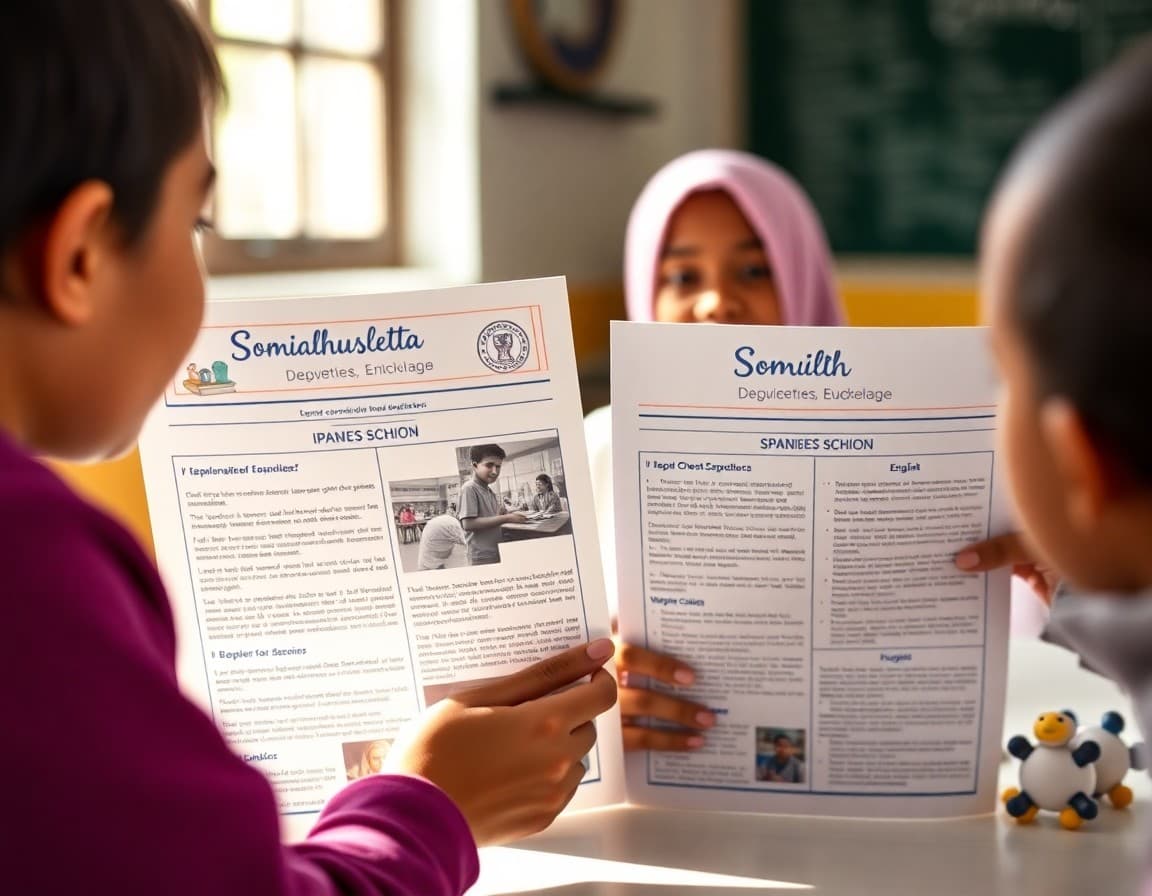
Schools with linguistically diverse families face a communication challenge that no single bilingual solution fully addresses. A Spanish-English newsletter leaves out Somali families. A Spanish-Somali-English newsletter leaves out Vietnamese families. The practical question is not whether to offer multilingual communication but how to build a system that scales beyond two languages without collapsing under its own complexity. This guide addresses exactly that.
Map Your Language Community First
Before designing anything, get the actual language data from your school. The home language survey collected at enrollment is your primary source. Ask your ELL coordinator for the most current language frequency breakdown. List every language spoken by more than 3 families and rank them by frequency. Most linguistically diverse schools have a long tail of 10 to 20 languages, but the top 3 to 5 languages typically account for 80 to 90 percent of non-English-speaking families. Start there. A newsletter in your top 3 languages reaches far more families than a newsletter that attempts 15 languages and is produced inconsistently.
Write Once, Translate Multiple Times
The foundation of a manageable multilingual newsletter system is a single source document that gets translated rather than multiple newsletters written independently. Write your master version in the language your editorial team is most comfortable in. Structure it for translatability: short sentences, no idioms that do not cross languages well, numbered lists rather than complex paragraphs for critical information. A newsletter written with translation in mind takes the same time to write but translates faster and more accurately than one written without that consideration.
Building Your Translation Workflow
Define the process before you need it. For each language you serve regularly, identify your translator or translation source. This might be a district staff member, a contracted translation service, a community volunteer with a formal review process, or a combination. Assign a review step for every language so no version goes out unreviewed. Set a production timeline: the master version is complete by Tuesday, translations are returned by Thursday, review is complete by Friday, send happens Monday morning. A timeline that exists on paper prevents every monthly newsletter from becoming a last-minute scramble.
Technical Setup for Multi-Script Languages
Languages like Arabic, Somali, Amharic, Chinese, Korean, and Vietnamese each have technical requirements for rendering correctly in email. Arabic and Urdu require right-to-left text alignment. Chinese, Japanese, and Korean character sets need Unicode font support. Amharic uses the Ge'ez script which is supported in most modern email clients but should be tested on both Android and iOS before your first send. Create a test email account for each language group and send yourself a test before distributing to families. A newsletter that arrives as garbled characters is worse than no newsletter because it actively undermines trust in your communication.
A Sample Newsletter Structure That Translates Well
Here is a structure designed for clean translation across multiple languages:
School Name - [Month] Family Newsletter
1. What students are learning this month: [2-3 sentences maximum]
2. Important dates:
- [Date]: [Event name] - [one-line description]
- [Date]: [Event name] - [Action required from family: yes/no]
3. One thing you can do at home: [specific, single activity]
4. How to reach us: [name, phone, email]
This structure produces a newsletter that translates in under 15 minutes per language and is accessible at a basic literacy level in any language.
Managing Quality Across Multiple Language Versions
Quality consistency is the hardest part of multilingual newsletter production. A school that sends excellent Spanish and English but inconsistent Somali or Vietnamese is creating a two-tier communication system for its families. Set the same quality standard for every language. This means every version is reviewed by a fluent community speaker before sending, every version contains identical information, and every version reaches families on the same day. Families who receive their newsletter two days later than other families because of a translation delay notice that difference.
Tracking Engagement Across Language Groups
Once you have a multilingual newsletter system running, use open rate data to evaluate whether it is working. If your Somali-language newsletter has a 15 percent open rate while your English version has a 60 percent open rate, investigate why. It might be a technical delivery issue, a formatting problem on the devices that community uses most, or a content relevance gap. Open rate tracking by language group is not about judging families. It is about making sure the system is actually working for everyone, not just the families whose engagement is easy to measure.
Get one newsletter idea every week.
Free. For teachers. No spam.
Frequently asked questions
How do schools manage newsletters in multiple languages without doubling the workload?
The key is writing once and translating rather than writing separately for each language group. Create a master English or primary-language version first, then send it to translation. Use a translation memory tool or glossary to ensure consistent terms across issues, which reduces translator time and costs. Establish a review workflow where each language version is checked by a community speaker before sending. The system should feel like one newsletter with multiple outputs, not three newsletters produced separately.
What tools work best for multilingual newsletter management?
Professional translation services like ALTA Language Services or Transperfect can turn around educational newsletter translation in 24 to 48 hours at per-word rates. For schools with tight budgets, bilingual staff or community volunteers with a consistent review process can work well for major languages. The newsletter platform you use should support multiple language versions without requiring you to rebuild the layout for each one. Daystage handles multi-language formatting so you focus on content.
How do I decide which languages to offer in the school newsletter?
Start with the languages spoken by families representing at least 5 percent of your school population, or any language spoken by enough families to constitute a meaningful community. Check your enrollment data, the home language survey from enrollment, and ELL service records. Your district's Title III coordinator can usually provide language frequency data. Add additional languages when a significant group is not currently reached in their home language, even if they represent a smaller percentage.
How do I handle languages that use non-Latin scripts like Arabic, Chinese, or Amharic?
Email and PDF formats support non-Latin scripts in most modern email clients. The main technical requirement is using a Unicode-compatible font and testing the output before sending. Arabic and Hebrew require right-to-left text formatting, which most email platforms now support but which needs testing. Chinese, Japanese, and Korean character sets render correctly in most modern email clients. Test each new language version on a phone and a desktop before your first send to catch any rendering issues.
Does Daystage support multilingual newsletter delivery to different family groups?
Yes. Daystage lets you build separate family lists by language preference and send each group the appropriate newsletter version. You manage it as one newsletter project with multiple language outputs. Open rate tracking across language groups shows you whether your multilingual outreach is actually working, which families are engaging, and which groups might need a phone follow-up when engagement drops. It takes the administrative complexity out of what would otherwise be a logistical challenge.

Adi Ackerman
Author
Adi Ackerman is a former classroom teacher and curriculum writer with 8 years in K-8 schools. She writes about school communication, parent engagement, and what actually works in real classrooms.
More for Bilingual
Ready to send your first newsletter?
3 newsletters free. No credit card. First one ready in under 5 minutes.
Get started free