
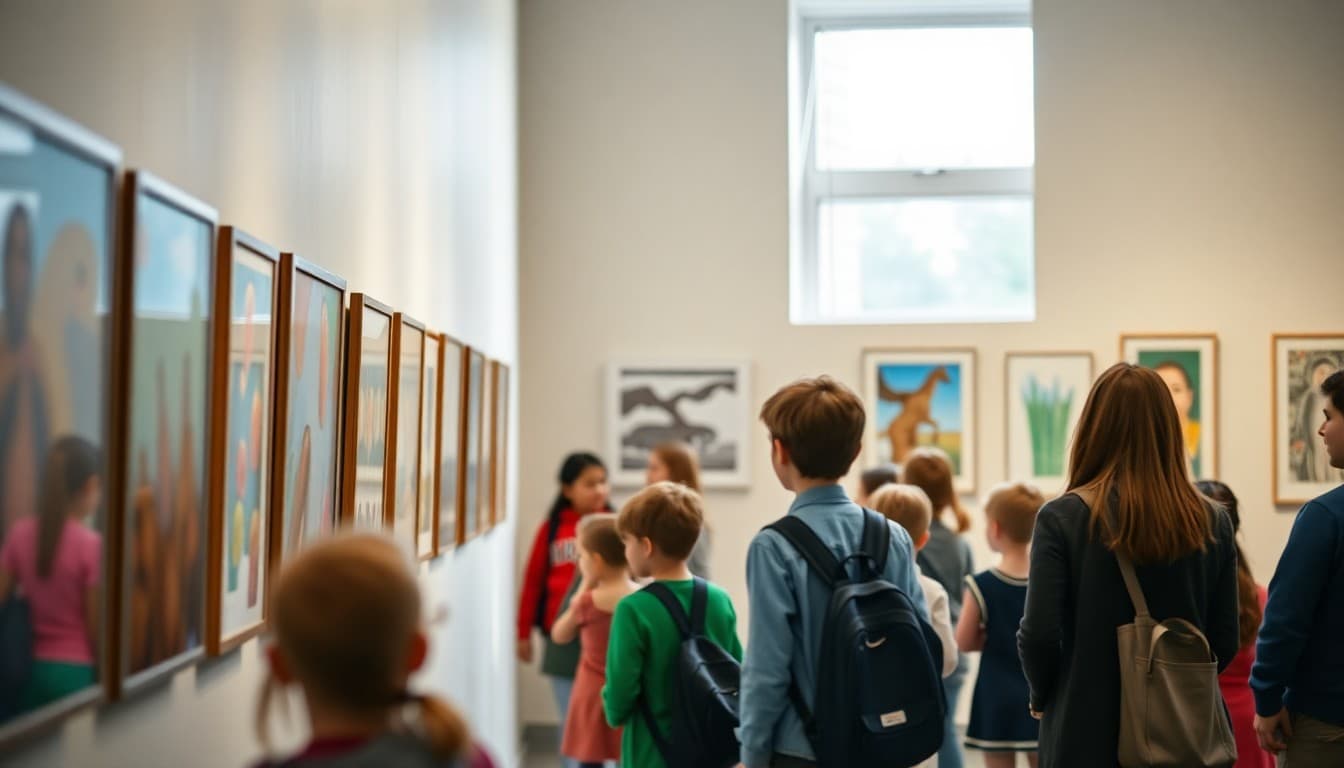
School Art Gallery Newsletter: Opening and Exhibition Guide

A gallery exhibition newsletter is doing something most school communications do not do: inviting families into a curated experience of their child's creative work. The quality of that experience depends on how well you prepare families to engage with what they are about to see.
Describe the exhibition theme and curatorial concept
If the exhibition has a unifying theme, describe it in the newsletter. Families who understand the conceptual thread through the show look at individual pieces differently than families who see a collection of unrelated student work.
"This year's spring exhibition is titled 'Place.' Every piece was made in response to a specific place that has personal significance to the student who made it: a childhood bedroom, a grandmother's kitchen, a vacant lot near school, a view from a bus window. The medium and approach vary widely. The connecting thread is specificity: every piece is about a real place, not an imagined one."
Coach families on how to engage with the work
Many families feel uncertain about how to respond to visual art. A newsletter that gives them specific questions to ask and specific things to look for transforms the gallery visit from a polite obligation to a genuine conversation.
"When you find your student's piece in the gallery, start by looking at it for 30 seconds without saying anything. Then ask: what is the first thing I notice? Then ask your student: what did you want me to notice? Those two questions often produce the most honest and interesting gallery conversations. There are no wrong answers to either question."
Provide the full exhibition logistics with every detail
Opening receptions generate the highest attendance, but the exhibition typically runs for weeks afterward. Give families both the opening night details and the full exhibition run so families who cannot attend the reception can visit during school hours.
"Opening reception: Friday, April 25th, 5 to 7 PM, in the main building lobby and adjacent hallways. Light refreshments provided. Students are expected to be present at their work during the reception. Exhibition runs through May 16th. Open to visitors Monday through Friday, 8 AM to 4 PM. All work returns home the week of May 19th."
Prepare students to write and speak their artist statements
Artist statements beside each piece give visitors context that the work alone cannot provide. A newsletter that explains what an artist statement is and gives families a way to help their child practice one prepares students for the conversations they will have on opening night.
"Each piece in the exhibition has a three-sentence artist statement written by the student. The statement answers: what did I make, what materials did I use, and what was I trying to communicate or explore. Ask your student to read you their statement at home before the opening. If it makes sense to you when you have not seen the piece, it will make even more sense when you are standing in front of it."
Sample newsletter template excerpt
Spring Art Exhibition opening is April 25th. Here is everything your family needs to know:
The theme is Place. Seventy-two student pieces across painting, drawing, ceramics, and mixed media. Every student in grades 6, 7, and 8 has at least one piece on display. Work spans graphite portraits and acrylic paintings to ceramic vessels and collages.
Reception is Friday, April 25th, 5 to 7 PM. Students should arrive at 4:45 PM to stand beside their work before families arrive. Families enter through the main building front doors. The gallery wraps through four hallways; maps will be posted at the entrance.
Acknowledge the teacher's curatorial and instructional work
A gallery exhibition represents months of instruction, feedback, and curation. A brief acknowledgment in the newsletter of what went into mounting the show, hanging work, writing labels, setting up lighting, builds community appreciation for the art department's work.
Follow up with a post-exhibition newsletter
After the exhibition closes, a brief newsletter with photos from the opening, attendance numbers, and a few words about what the class accomplished in the year serves as both documentation and celebration. It also primes families to attend the following year's exhibition before the invitation even arrives.
Get one newsletter idea every week.
Free. For teachers. No spam.
Frequently asked questions
What should a school art gallery newsletter include before an exhibition?
A pre-exhibition newsletter should describe the exhibition theme or concept, which classes or grade levels are represented, the opening reception details including date, time, and location, how long the exhibition runs before work is returned, and whether there are artist statements beside each piece. Including a brief description of the types of work on display and the media used helps families know what to look for and how to engage with the work. If the exhibition has a theme connecting it to a class curriculum, describe that connection so families understand the academic context.
How do you help students prepare to talk about their artwork with family visitors?
Students who can talk about their own work with visitors have a much richer gallery experience than students who stand silently beside their piece. Preparation involves two things: knowing the answers to the most common visitor questions (what is this made of, how long did it take, what were you trying to show or say) and practicing an artist statement that is specific and personal rather than vague. A newsletter that coaches families on how to ask productive questions, rather than just reacting, helps create the conditions for those conversations.
How should a school art gallery handle work that is fragile or cannot be touched?
Gallery etiquette guidelines should be communicated in the newsletter before the exhibition opens so families arrive knowing what to expect. Typical school gallery rules include not touching artwork, not photographing student work without the student's or school's permission, keeping food and drinks outside the gallery space, and accompanying young children. If specific pieces are particularly fragile or have special viewing instructions, note them in the newsletter. Students who know their work will be properly protected are more willing to invest in high-quality pieces.
How does a student art exhibition differ from other school events in terms of parent engagement?
An art exhibition is self-paced and personal in a way that concerts and performances are not. Families move through the gallery at their own speed, stop at pieces that interest them, and have individual conversations with students. This format allows for deeper one-on-one engagement between family members and their student but requires more preparation: families who arrive without any context for what they are seeing often do not know how to engage. A newsletter that provides context before the event produces far richer gallery interactions than a simple event announcement.
How does Daystage help art teachers communicate about gallery exhibitions?
Daystage lets art teachers send gallery preview newsletters with photos of the exhibition space being set up, descriptions of the work on display, and invitations that families can add directly to their calendar. When families receive a Daystage newsletter with a teaser photo of three student pieces alongside the gallery opening details, attendance at the reception increases and families arrive already curious about specific works they want to find.

Adi Ackerman
Author
Adi Ackerman is a former classroom teacher and curriculum writer with 8 years in K-8 schools. She writes about school communication, parent engagement, and what actually works in real classrooms.
More for Arts & Music
Ready to send your first newsletter?
3 newsletters free. No credit card. First one ready in under 5 minutes.
Get started free