

Art Class Newsletter: Projects and Exhibition Updates
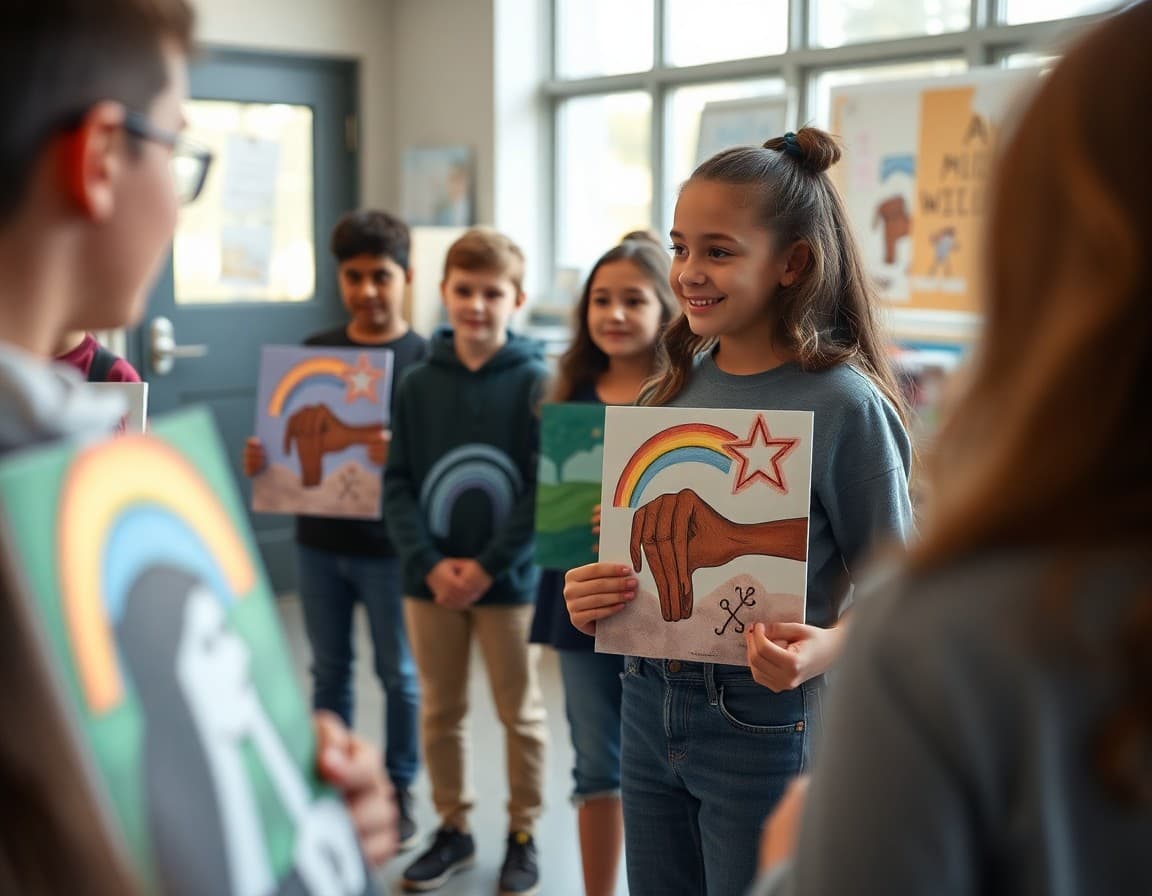
Art class newsletters make visible a kind of learning that is otherwise easy to misread as play. The moment you describe the specific technique, the visual principle, and the thinking behind the project, families understand that art class is doing something rigorous that no other subject does in the same way.
Name the medium and the specific technique being taught
Every unit in art class teaches specific technical skills. Name them in the newsletter just as a math teacher would name the mathematical concept being covered. Families who know that students are learning contour line drawing, or atmospheric perspective, or value scale rendering understand that art class has a curriculum, not just open project time.
"We began the watercolor unit this week with a focus on wet-on-wet technique: applying wet paint to a wet surface to create soft, blended edges rather than crisp lines. Students practiced controlling water ratio before beginning their project, because too much water washes out color and too little creates hard edges where softness is needed. Getting that ratio right took most students three practice sheets."
Explain the visual concept or principle behind the project
Every project in art class teaches something beyond the technique: a visual principle like contrast, balance, rhythm, or focal point. Naming that principle connects the technical work to a larger visual language families can notice in the world around them.
"This month's project teaches compositional balance. Students are learning that a visually satisfying composition does not need to be symmetrical, but every element needs to feel like it belongs where it is. A large dark shape on one side needs something else in the composition to balance its visual weight. Students are making these decisions deliberately rather than by instinct, and then evaluating whether their choices worked."
Describe what the finished project should look like and when it comes home
Families appreciate a heads-up before artwork arrives home so they can respond with informed questions rather than just "that's nice." A brief preview in the newsletter of what the project is, what the learning objective was, and when it is coming home gives families the context to have a real conversation about it.
Prepare families for exhibition events
Art exhibitions are the concert equivalent for visual art students. Families need the same logistical detail: when the exhibition opens, where work is displayed, whether there is a reception, and how long the exhibition runs. A newsletter that treats the exhibition as a significant event generates attendance; one that mentions it in passing does not.
"Our spring art exhibition opens April 22nd with a family reception from 5 to 7 PM. Every student in grades 6 through 8 will have at least one piece on display. The exhibition runs through May 10th. Families who cannot attend the reception can visit during school hours through May 10th. All work returns home on May 11th."
Sample newsletter template excerpt
Art class update for October:
This month, students are completing their first major project of the year: a self-portrait using graphite pencil. The project teaches proportion, value (the range from light to dark), and observational accuracy. Students are working from mirrors, not photographs, because working from life teaches different observational skills than working from a flat image.
Ask your student to show you their value scale, the strip of squares ranging from white to black that they completed before starting the portrait. The range of values they achieved in that scale is the same range they will use to model the forms in the face. That scale took most students an entire class period to get right.
Share the connection between art and other subjects
Art class overlaps with science through observational drawing, with math through proportion and geometry, with history through periods and movements, and with language arts through interpretation and analysis. Naming these overlaps when they appear in the curriculum shows families that art class is reinforcing and deepening what students are learning across all of their subjects.
Acknowledge the range of work being produced
Art produces a wider visible range of student outcomes than most subjects. A newsletter that acknowledges this range, and explains that artistic development is not a race, helps families support their child's growth without comparing to classmates. "Students are at different stages in their drawing development, and that is expected and appropriate. The goal for every student is that their October portrait shows things they could not do in September."
Get one newsletter idea every week.
Free. For teachers. No spam.
Frequently asked questions
What should an art class newsletter cover throughout the school year?
An art class newsletter should cover what medium or technique is being introduced, what concept or visual principle the unit teaches, what project students are currently working on, when work will come home or go on display, any materials families need to provide, and upcoming exhibition dates. A newsletter that describes both the process and the concept being taught helps families understand that art class is teaching observational thinking, design principles, and visual communication alongside the hands-on craft.
How do you explain art class learning goals to families who see art as a break from academics?
Art class develops observational precision, spatial reasoning, iterative refinement, and visual communication skills. When a student draws from observation, they are practicing the same precise attention to detail that scientists use in field sketching and that architects use in documentation. When a student learns color theory, they are learning physics of light and human perception. Naming these connections in the newsletter repositions art class from enrichment to rigorous visual thinking training. Families who see these connections support art programs more actively than families who see them as extras.
How do art teachers handle the critique process and communicate it to families?
Critique is one of the most educationally valuable practices in art class and one of the least understood by families. A newsletter that explains how critiques work, that students share their work and receive specific feedback about what is working and what could be stronger, and why that process is valuable rather than harsh, helps families prepare their child to receive and give critique constructively. Students whose families understand and value critique are more open to it than students who go home to parents who dismiss critical feedback as mean.
How do you communicate about art supplies that need to be provided by families?
Art supply requests should be specific, affordable, and given with enough lead time. Instead of 'students may need supplies,' write 'by October 7th, each student needs one sketch pad at least 9 by 12 inches, one set of colored pencils with at least 24 colors, and a kneaded eraser.' Include price range if possible. Offer a list of stores where supplies are available locally. Offer to supply materials for families who indicate a need. Vague supply requests create anxiety; specific lists with prices and timelines create action.
How does Daystage help art teachers communicate with families?
Daystage lets art teachers share photos of student work in progress and finished pieces directly in the newsletter, so families see what students are creating before it comes home or goes on display. When a family sees a photo of their child's watercolor alongside a description of the technique and concept being practiced, they engage with the artwork differently when it arrives home. That engagement reinforces the learning and shows the student that their work is valued.

Adi Ackerman
Author
Adi Ackerman is a former classroom teacher and curriculum writer with 8 years in K-8 schools. She writes about school communication, parent engagement, and what actually works in real classrooms.
More for Arts & Music
Ready to send your first newsletter?
3 newsletters free. No credit card. First one ready in under 5 minutes.
Get started free