

Social Studies Teacher Newsletter: Summer Work Newsletter
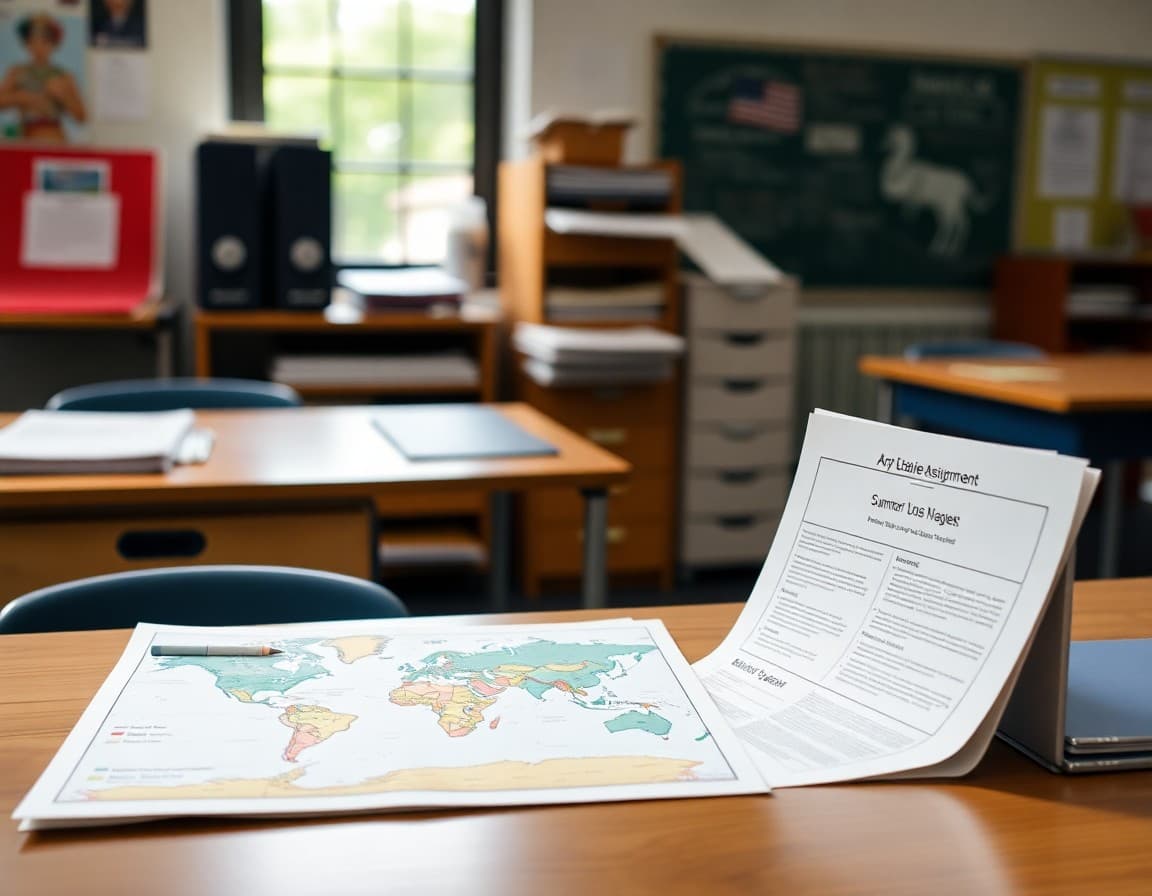
Summer work for social studies can be more engaging than summer work in most other subjects if it is designed well. The discipline is about the world students live in, and a well-designed summer assignment gives them a genuine reason to pay attention to that world between June and September. A clear newsletter makes the difference between students who arrive in September with real background knowledge and students who did the minimum because they did not understand the point.
Start with the connection to fall instruction
The most important thing a summer work newsletter can communicate is why the assignment is worth doing. "Our first unit in September examines contemporary geopolitics through case studies in three active conflict regions. Students who spent the summer following one international news story will arrive with a level of background knowledge that makes the first unit's primary source analysis far more accessible. This is not busywork. It is the foundation we will build on for the first three weeks of school."
This framing works for any course level. An AP US History summer reading assignment should connect directly to the first DBQ students will write. A geography summer map exercise should connect directly to the first unit's geographic analysis.
Give the complete assignment with specific requirements
Every ambiguous instruction generates an individual family email in August. Be specific. "Summer Assignment for AP Human Geography: Part 1 (required reading): Read Chapter 1 and Chapter 2 of Harm de Blij's Why Geography Matters. These chapters are available as free PDFs through the school's digital library, linked below. As you read, complete the reading guide attached to this newsletter. Part 2 (current events log): Select one international story that is developing over the summer. Track it weekly from June 15 through August 15. Each entry should include the date, the source, a two to three sentence summary, and one question the article raised. Log format attached. Both parts are due September 8."
Explain how to access materials for free
Social studies summer reading often involves books that families are not sure they can afford. Name every free option. "The required text is available in three ways: (1) print copy from the school library (pick up May 30 to June 7), (2) free PDF through the school's digital library at [link], (3) physical copy at the public library (check availability at [link]). You do not need to purchase this book."
For current events tracking: "Reputable free news sources for the current events log include: BBC News, NPR, Reuters, and AP News. All are available without a subscription. If students want to go deeper, the school provides free digital access to the New York Times through [school portal link]."
What the current events log actually looks like
Here is a newsletter excerpt that gives students and families a concrete model:
"Current Events Log Entry Example: Date: July 7. Story: South Sudan peace negotiations. Source: BBC News. Summary: The South Sudan transitional government and two armed opposition groups signed a preliminary ceasefire agreement, the third such agreement in five years. The previous two agreements collapsed within months. International observers expressed cautious optimism but noted that previous agreements failed due to unresolved disputes over military integration. My question: What would make this agreement more durable than the previous ones? This is the level of engagement we are looking for. You do not need to be an expert. You need to read carefully, summarize accurately, and think about what you do not yet understand."
Address the most likely family concerns upfront
The three questions social studies summer work generates most often: Can my student choose any news story? What counts as a reputable source? Can they write the log in a different format? "Any ongoing international news story counts for the current events log. Choose something your student is genuinely curious about, not just the first story they find. Reputable sources are those with named reporters, editorial standards, and corrections policies. Social media posts do not count. Blogs do not count. The log format can be handwritten, typed, or in a notes app, as long as each entry has the four required elements."
Give a recommended pacing guide for longer assignments
For AP summer reading with 50 to 80 pages of content: "If you want to finish the reading before July 15 and leave yourself time to revisit the reading guide questions: read 15 pages per week starting the first week of June. The chapters are dense but not long. One sitting of 90 minutes per week is enough. Do not save the reading for August."
Send the newsletter twice and make it easy to find later
Send the summer work newsletter two weeks before school ends and again on the last day of school. Families who receive it in May plan better. Families who receive it in June act on it sooner. A final-day reminder catches everyone who forgot to look at the first email. Keeping both sends in Daystage means you can resend the newsletter to families who contact you in August saying they never received it, without having to find it in your sent mail.
Get one newsletter idea every week.
Free. For teachers. No spam.
Frequently asked questions
What types of summer work do social studies teachers typically assign?
The most common are: a required reading book tied to the fall unit, a current events tracking log where students follow a specific type of news story over the summer, a primary source preview packet with questions to complete before school starts, and a geographic literacy exercise like labeling a world map from memory. AP Human Geography and AP US History teachers often have more intensive summer assignments that include multiple readings and written responses. The assignment should be proportional to the course level and give students a genuine head start on September skills.
How do I explain a current events tracking assignment to families?
Be specific about what students should track and how. 'For this assignment, students will follow one ongoing international news story over the summer. They should choose a story that started before June 1 and is still developing (examples: an ongoing conflict, a major election cycle, an international economic dispute). Each week they read at least one article about the story, write two to three sentences summarizing what happened, and note one question the article raised for them. They will bring this log to class in September and it will be the starting point for our fall unit on contemporary geopolitics.' Without this level of detail, 'follow a current event' produces 50 different interpretations.
How do I handle summer work for incoming students who were not in my class last year?
Send the summer work newsletter to all incoming students, not just returning ones. For AP courses where the summer work assumes prior knowledge, include a one-page review sheet of foundational concepts students should be familiar with before starting the assignment. 'If you are new to this school or are taking social studies at this level for the first time, here is a brief review of the primary source analysis skills we will use in the summer assignment. If any of this is unfamiliar, email me before July 15 and I can help you get started.'
Should summer work be graded, and should I say that in the newsletter?
Yes, if it is graded, say so clearly. 'The summer reading and current events log are graded and are due September 8, the first full week of school. Together they count for one assignment grade in the first unit. Students who complete both earn full credit. Students who complete one earn partial credit. Students who complete neither will start the year behind on the first unit grade.' Being direct about grading is more respectful than pretending summer work is optional when it is not.
What is the best way to send a social studies summer work newsletter?
Daystage lets you send the newsletter twice without drafting it twice: once two weeks before school ends and again on the last day of school as a reminder. You can include links to any online resources or free ebook versions of required reading directly in the newsletter. Families receive it in their regular inbox, which means they are likely to save it rather than losing it in a classroom app they stop checking in June.

Adi Ackerman
Author
Adi Ackerman is a former classroom teacher and curriculum writer with 8 years in K-8 schools. She writes about school communication, parent engagement, and what actually works in real classrooms.
More for Subject Teachers
Ready to send your first newsletter?
3 newsletters free. No credit card. First one ready in under 5 minutes.
Get started free