
Physics Teacher Newsletter: Setting Up the Year the Right Way

Physics has a reputation that precedes it. Students hear that it is the hardest science. Parents who took it remember the math. Your beginning-of-year newsletter has a specific job: replace that reputation with accurate expectations, concrete information about what the course involves, and a genuine argument for why studying physics is worth the work. Here is how to write one that does all three.
What Physics Parents Actually Want to Know
Parents of physics students have four main concerns. How hard is it, really? What math does it require? What happens in the lab? And is there support available when students struggle? A newsletter that addresses all four directly, without minimizing the challenge or amplifying it, builds the trust that makes the rest of the year more productive.
The math question is the one most likely to be inadequately addressed in a first newsletter. Parents who do not know that their student will need to solve trigonometric equations in the first unit are surprised and sometimes alarmed when it happens. Front-loading that information prevents the perception that you are making the course harder than advertised.
The Math Component
Be specific about what math is required and when. For algebra-based physics: "This course uses algebra throughout: solving equations for unknown variables, working with ratios and proportions, and applying trigonometric functions to vector problems. Calculus is not required. Students who are comfortable with algebra and basic trigonometry will find the mathematical component manageable. I will review the key mathematical techniques in the first week."
For AP Physics 1 or 2: "This course is algebra-based. All calculations use algebra and trigonometry. Calculus is not required but is taken by many students simultaneously. Students who are strong in precalculus will find the math accessible."
For AP Physics C: "This course requires calculus. Derivatives and integrals are used throughout the mechanics and electromagnetism units. Students should be enrolled in or have completed BC Calculus."
What Physics Lab Looks Like
Physics labs are different from chemistry or biology labs in character: they tend to involve measurement, motion analysis, and mechanical systems rather than chemicals or specimens. Give families a sense of what the first few labs involve. "Our first lab is a kinematics experiment: students release a cart down an inclined track, measure its position at regular time intervals using a motion sensor, and analyze the velocity versus time graph to determine acceleration. This is the same technique used to analyze the motion of spacecraft and racing vehicles. The equipment is safe and students work in pairs throughout."
Framing the Course
Lead with what makes physics genuinely interesting. "Physics is the foundation of all other sciences and all modern technology. This year, your student will understand why objects fall, how electrical circuits work, what makes light behave like both a wave and a particle, and why Einstein's theory of relativity is not just philosophical speculation but a practical requirement for GPS to function accurately. These are not abstract concepts; they are the explanations behind technology students interact with every day." That framing motivates students before they open a textbook.
Sample Newsletter Opener
Here is a template:
"Welcome to AP Physics 1. This is a challenging course that will give your student one of the most valuable analytical tools available: the ability to model how systems behave using mathematics and physical principles. By May, your student will have analyzed motion, forces, energy, waves, and basic circuits at a level that typically appears in the first semester of college physics. It is difficult and it is worth it. Here is what your family needs to know before we begin."
Lab Safety and Materials
Physics labs involve less chemical hazard than chemistry labs but do involve electrical equipment, mechanical systems, and occasionally heat sources. A brief safety section tells families that you manage these responsibly: "All electrical experiments use low-voltage DC supplies. Students wear eye protection during any spring, elastic, or projectile motion lab. Lab safety rules are reviewed at the start of each lab session."
List required materials specifically: a scientific or graphing calculator (specify if graphing is required or recommended), a dedicated notebook, a ruler and protractor for geometry-based problems. Note any graphing software students will access through school accounts.
Using Daystage for Consistent Communication
Physics communication goes best when families hear from you regularly rather than only when something is wrong. Setting up a consistent newsletter cadence with Daystage, one per unit or one per month, turns you from a voice that surfaces at grade time into a teacher families feel genuinely connected to throughout the year. That relationship makes every difficult conversation easier when it eventually comes.
Get one newsletter idea every week.
Free. For teachers. No spam.
Frequently asked questions
What should a physics beginning-of-year newsletter cover?
The course overview, major units, grading breakdown, math prerequisites, lab safety expectations, required materials, and how you will communicate throughout the year. For physics specifically, being explicit about the math component is essential: physics is inherently quantitative and families who are not prepared for trigonometry and algebra-based or calculus-based problem-solving are sometimes surprised mid-year when their strong student struggles with the mathematical demands.
How do I explain the math requirement in a physics newsletter?
Be specific about what math is required and at what point in the year it appears. For algebra-based physics: 'This course requires fluency with algebra, especially solving multi-variable equations and working with ratios and proportions. Trigonometry is introduced in the first unit. Students who are uncomfortable with algebra should plan additional review time in September.' For AP Physics: 'AP Physics C requires calculus. Students should be taking or have completed BC Calculus. The derivative and integral operations used in class are covered in parallel with your calculus course.'
Should I describe lab activities in the first newsletter?
Yes, briefly. Physics labs range from motion analysis (kinematics) to electrical circuits to optics. Giving families a sense of the hands-on component helps them understand what their student will actually do in class. A brief description of the first lab connects the newsletter to the physical world rather than keeping it purely logistical.
How do I frame physics as relevant in a beginning-of-year newsletter?
Connect the course to phenomena students already experience and technologies they use. 'Physics explains why your phone can detect movement, how GPS knows where you are, why bridges do not collapse under traffic, and what happens inside a nuclear reactor. Every engineering achievement students read about in the news is built on physics principles they will learn this year.' This framing motivates students and tells families why the course matters beyond the grade.
What tool helps physics teachers send beginning-of-year newsletters effectively?
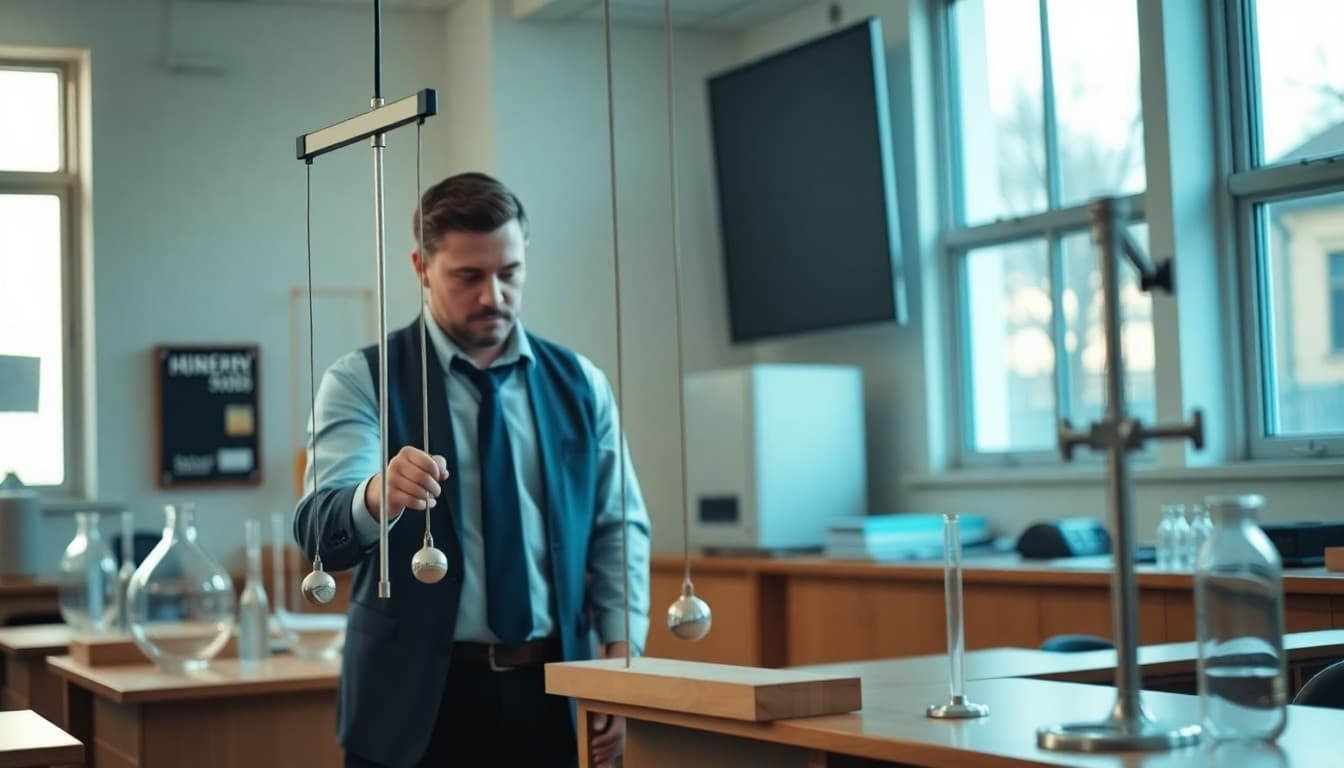
Daystage lets you design a polished newsletter with a course overview, lab preview, and math requirement section in a clean professional format. You can include a photo from a previous year's lab, like a pendulum timing experiment or an electrical circuit activity, to give families a concrete sense of what physics class looks like in practice.

Adi Ackerman
Author
Adi Ackerman is a former classroom teacher and curriculum writer with 8 years in K-8 schools. She writes about school communication, parent engagement, and what actually works in real classrooms.
More for Subject Teachers
Ready to send your first newsletter?
3 newsletters free. No credit card. First one ready in under 5 minutes.
Get started free