
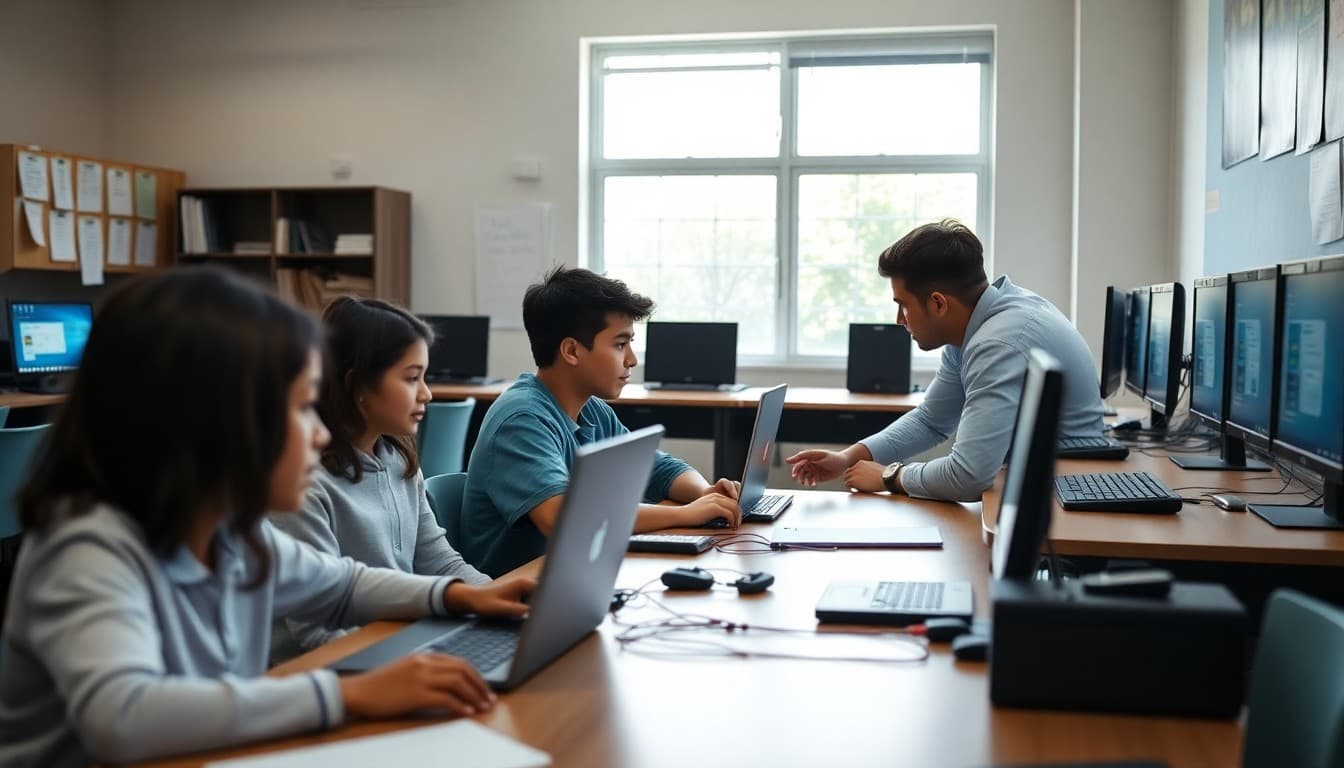
Computer Science Teacher Newsletter: Communicating Differentiation

Differentiation in a CS classroom is both more necessary and more visible than in many other subjects. Students arrive with coding experience ranging from zero to "built their first app at age 12," and a single pacing or assignment structure cannot serve both ends of that range. When families see their student working on a different project than a classmate, or finishing assignments faster or slower than expected, questions arise.
A differentiation newsletter that explains your approach clearly prevents the misunderstandings that come from leaving families to interpret what they see from the outside. This guide covers how to explain differentiated CS instruction in family-friendly language, what to include, and how to frame both support and extension honestly.
Explain why CS classes often have wide skill ranges
Start by helping families understand the landscape. Unlike math, where students enter a given grade level with roughly predictable prior knowledge, CS courses draw students with dramatically different backgrounds. A student who attended a coding camp every summer since fourth grade, a student who discovered Scratch last year, and a student with no coding background at all can all land in the same Introduction to Computer Science class. Families who understand this context immediately understand why differentiation is necessary rather than a sign of curriculum problems.
Describe your differentiation approach specifically
Name the actual strategy you use rather than speaking about differentiation in abstract terms. Do you use tiered assignments where all students complete the same core task but extension students add additional features? Do you use a workshop model where students who need support work with you in a small group while others work independently on extension problems? Do you use a pace-based model where students move through the same content at different speeds?
The more specific you are, the less mysterious the classroom looks to families. "Students who master the core project early are working on a bonus challenge that adds a search feature to the app. Students who need more time with the core concepts are working with me directly in small groups on Tuesdays and Thursdays during the last 20 minutes of class."

Clarify that different work does not mean different standards
Some families worry that a student doing "easier" work is being prepared for lower outcomes. Address this directly. "All students in this class are working toward the same core competencies in the course: writing programs that solve problems, understanding how code is structured, and developing the debugging skills that every programmer uses. The difference in assignments is in the pathway, not the destination." Families who see the same endpoint for all students are reassured that differentiation is a service rather than a sorting mechanism.
Tell families how they can ask about their student's specific level
Be clear that families can reach out to learn more about where their student is working and why. "If you would like to know specifically which challenges your student is working on and how that maps to their progress in the course, please email me and I will set up a brief call." This invitation signals that differentiation is transparent and that you are not hiding anything about how students are grouped or assigned work.
Give families a way to support their student at home
For students receiving additional support: encourage families to ask their student to explain what they are working on in plain terms. If the student can explain what a variable does or why a loop repeats, they understand the concept at the level needed for the next step. For students in extension work: suggest families ask what the harder challenge involves and what their student did to solve it. Both conversations reinforce learning without requiring any coding knowledge from the parent.
Include a brief template section families can reference
Here is how a differentiation explanation might read in a CS newsletter:
"In our current Python unit, students are working on the same foundational project: a program that takes user input and produces a personalized output. Students who complete the core project with time to spare are adding features like input validation, error handling, and a loop that lets the user run the program multiple times without restarting. Students who need more practice with the core concepts are working in a small group with me to trace through the logic step by step before coding. Both groups will complete the unit with the same core skills. The difference is pace and depth, not destination."
Address the most common family concern directly
The concern families rarely say out loud but often think is: "Is my student behind?" Address it head-on. "Learning to code involves a normal period of confusion before things click, and the speed at which that happens varies widely by student. Students who are receiving support right now are not on a different track; they are on the same track with more scaffolding for this part of the journey." This kind of direct acknowledgment does more to relieve family anxiety than any amount of positive framing around it.
Close with your contact information and a note on upcoming progress updates
End by telling families when they will hear more about their student's specific progress and how to reach you in the meantime. Families who know a progress update is coming in three weeks are more patient than families who do not know when they will next hear from you.
Get one newsletter idea every week.
Free. For teachers. No spam.
Frequently asked questions
Why does differentiation in CS class look different from other subjects?
CS students often arrive in the same course with wildly different prior experience. One student has been coding in Python since age 10; another has never written a line of code. In most academic subjects, prior knowledge gaps are smaller. In CS, you can have students in the same Introduction to Computer Science class who range from total beginner to someone who has completed online college-level coursework. Differentiation in CS is about meeting students where they are so both groups are challenged and neither is bored or overwhelmed.
How do you explain to a parent why their student is doing different work than a classmate?
Frame it as matching the work to the student's current level rather than separating students into tracks. 'Your student has a strong foundation in Python and is working on an extension challenge that pushes further into functions and file handling, while students who are earlier in their coding journey are building the same core skills at a pace that works for them. Both paths complete the same unit's learning goals.' This framing protects the student's dignity and reassures families that differentiation is a service, not a label.
Should a CS teacher tell parents their child is in an extension or support group?
Be careful with language here. Avoid group labels in family communications. Instead of 'your student is in the advanced group,' write 'your student is working on extension challenges this unit.' Instead of 'your student is in the intervention group,' write 'your student is getting additional support with the fundamentals this unit, which will strengthen their project work before we move to the next topic.' The behavior is the same; the framing makes a significant difference.
How do you communicate support without making families feel their student is struggling?
Lead with what the student is doing well before naming the area of support. 'Your student demonstrates strong logical thinking and persistence when debugging, which are the most important qualities in CS. Right now, they are getting extra practice with Python syntax, which is a common point where new programmers need repetition before it becomes automatic.' Contextualize the support as a normal part of learning to code, because it is.
How does Daystage support CS teachers sending differentiation newsletters?
Daystage allows you to send a general differentiation newsletter to the full class explaining your approach, and then use the same tool to send targeted follow-ups to specific families whose students are receiving extra support or extension challenges. The ability to segment your audience means families get the context that is relevant to their student without receiving information that is not meant for them.

Adi Ackerman
Author
Adi Ackerman is a former classroom teacher and curriculum writer with 8 years in K-8 schools. She writes about school communication, parent engagement, and what actually works in real classrooms.
More for Subject Teachers
Ready to send your first newsletter?
3 newsletters free. No credit card. First one ready in under 5 minutes.
Get started free