

Art Teacher Newsletter: Summer Work Newsletter
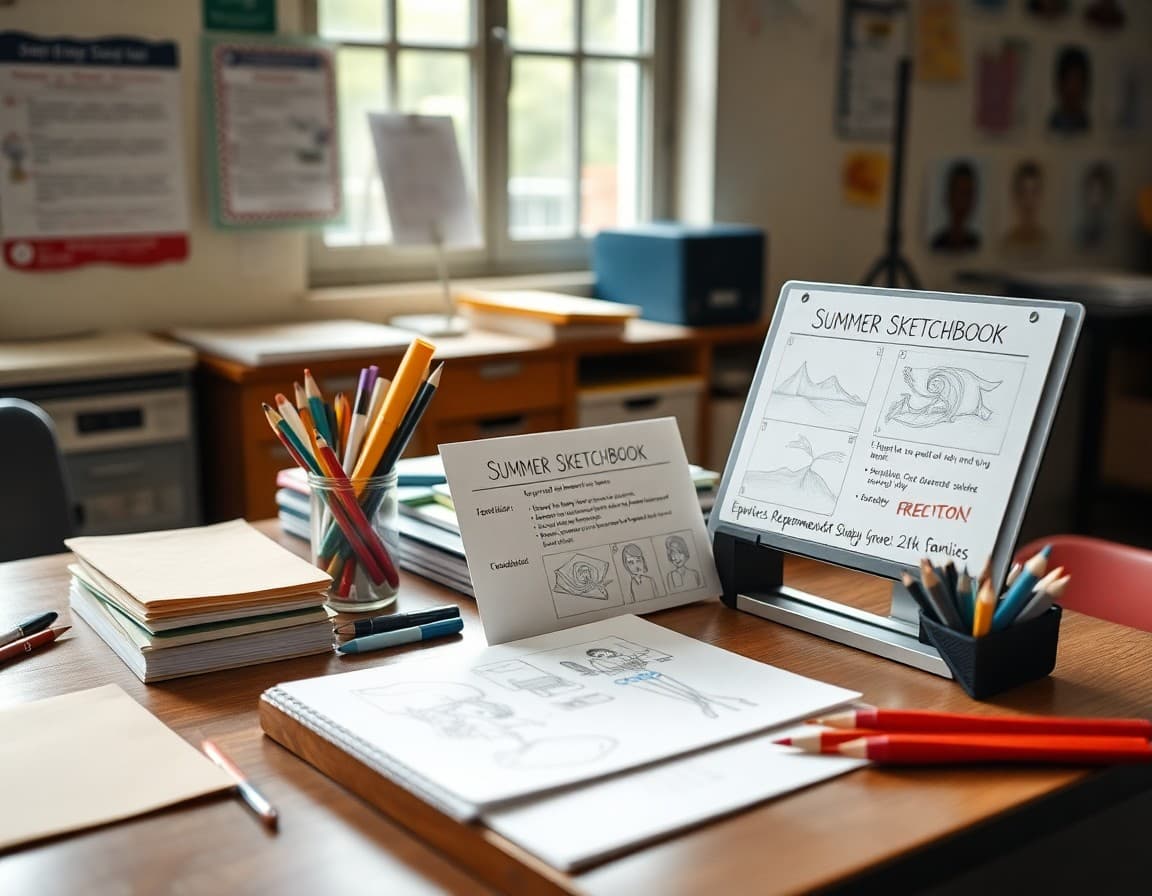
Summer art work is most effective when it asks students to build a specific habit, not to produce a portfolio of finished pieces. The habit that matters most for studio art is looking carefully. A summer assignment that keeps students looking, sketching, and noticing arrives at September with real results. A summer assignment that asks students to produce 20 polished drawings with no guidance usually produces 20 rushed copies of internet images.
Connect the summer assignment to the fall curriculum
"Our fall semester opens with an intensive observational drawing unit. Students who spent the summer practicing looking at real objects and drawing what they actually see arrive significantly better prepared for that unit than students who spent the summer drawing from imagination or copying references. The summer sketchbook is not extra credit or a busywork assignment. It is the preparation that makes the first unit accessible." That framing converts the assignment from an imposition into a head start.
Describe exactly what a good sketchbook entry looks like
Families and students who receive the assignment without a model produce a wide range of interpretations. Give them a concrete description. "A strong summer sketchbook entry looks like this: 15 minutes or more spent drawing one specific object or scene from direct observation. The drawing fills most of the page. It shows different values, some areas darker and some lighter. The student did not trace, did not copy from a photo, and did not draw a cartoon or a character from memory. The drawing shows that the student actually looked at the real thing."
If you can include one or two example photos of entries from previous years (with student permission), do so. Seeing what a real entry looks like is far more useful than reading a description.
Keep the supply requirements minimal and accessible
The supply list for a summer sketchbook assignment should be short and cheap. "For the summer sketchbook, your student needs: any sketchbook with plain paper (a $5 to $8 spiral sketchbook from any art or office supply store works fine), and any drawing tool they have at home: a pencil, a pen, a marker, a ballpoint. The medium does not matter. The observation habit does." When the supply requirement is this simple, there is no barrier to starting.
For families who want to invest in better materials: "If your student is enthusiastic and wants better materials, a medium-grade graphite set ($10 to $15) and a 9x6-inch sketchbook are a worthwhile upgrade. But they are not required."
Summer work for AP Art and Design students
Here is a newsletter section that handles AP-specific summer requirements:
"AP Art and Design students have a more specific summer task: developing the concept for their Sustained Investigation. A sustained investigation is a series of at least 12 artworks that develop one idea, question, or theme over the year. Before September 8, each AP student should: write one paragraph describing the idea they want to investigate (not the subject of their drawings, but the question or concept they want to explore), collect three to five reference images that relate to their concept (artists who have inspired them, visual examples of the direction they want to go), and complete at least five sketchbook entries that explore different approaches to their concept. Students who arrive in September with this work done hit the ground running. Students who arrive without it spend the first unit catching up while also trying to make new work."
Give students a pacing guide for the sketchbook entries
Ten weeks of summer feels like a long time in June. Give students a structure they can follow if they need one. "If you want to complete 15 entries by September 8 without saving them all for August: two entries per week from June 15 through August 15. Each entry is 15 to 30 minutes. That is 30 to 60 minutes of drawing per week, roughly one Sunday afternoon, for ten weeks." Concrete numbers and a concrete schedule remove the inertia of not knowing where to start.
Address parents who are worried about whether their student will do it
"If your student has never kept a sketchbook before, starting can feel awkward. The most useful thing you can do as a family is sit with them for the first entry. Draw alongside them with whatever you have. You do not need to be an artist. You just need to look at something together and try to draw it. That shared experience often gets the sketchbook habit started in a way that an assignment prompt alone does not." Family engagement at the start of the summer sets the habit. After two or three entries, most students are self-sustaining.
Send twice and make it easy to find later
Send the summer work newsletter two weeks before school ends and again on the last day. Include your email address prominently and offer to answer questions over the summer. "I check email on weekdays through August 20 and respond within 48 hours. If your student has a question about whether a specific entry counts, send me a photo and I will give them feedback." Families and students who can ask questions in July produce better work in September than those who guess and hope.
Get one newsletter idea every week.
Free. For teachers. No spam.
Frequently asked questions
What types of summer work do art teachers typically assign?
The most common are: a sketchbook practice assignment where students complete a set number of observational drawings over the summer, a reference image collection for AP portfolio students who need to start their sustained investigation, a color mixing exercise using any available medium, or a structured visual journal that combines drawing and written reflection. The best summer art assignments are low-barrier, require supplies students probably already have or can find cheaply, and connect directly to what the class will do in the fall. AP Art and Design students often have more intensive summer requirements tied to their portfolio concept development.
How do I explain a sketchbook assignment to families who are not familiar with visual art?
Be concrete about what an entry looks like. 'A sketchbook entry for this assignment is a drawing made from direct observation, meaning your student looked at a real object or scene, not a photo, and drew what they actually saw. Each entry should take at least 15 minutes. Entries do not need to be finished or polished. They should show that the student looked carefully. A drawing of a coffee mug, a plant, a pile of shoes, or the view from a window all count. A drawing copied from a photo or screen does not.'
How many entries should I require for a summer sketchbook assignment?
Between 12 and 20 entries over a 10-week summer is a reasonable range. For introductory or regular studio art: 12 to 15 entries. For advanced or AP students: 18 to 25 entries with written annotations. Be realistic: students who are required to draw 50 times over the summer either comply at a low quality level or do not comply at all. 12 to 20 entries with genuine engagement produces better artists than 50 rushed entries.
How do I handle AP Art and Design summer work expectations?
AP students need to begin their sustained investigation concept before September. The summer newsletter should explain what a sustained investigation is, give students a framework for developing their concept, and provide a clear deliverable: 'By September 8, bring a one-page written concept statement explaining your sustained investigation idea and three reference images (printed or digital) that influenced your direction.' Students who arrive in September without a concept statement spend the first two weeks of class catching up rather than making work.
What platform makes sending art summer work newsletters simple?
Daystage is a good choice because it lets you include example photos of sketchbook entries, a supply list with links, and the full assignment description in one clean email. Sending it twice, once two weeks before school ends and again on the last day, ensures families have the information when they are ready to act on it. For AP students whose summer work is more intensive, a separate targeted send through Daystage lets you give them more detail without overwhelming families of regular studio students with AP-level requirements.

Adi Ackerman
Author
Adi Ackerman is a former classroom teacher and curriculum writer with 8 years in K-8 schools. She writes about school communication, parent engagement, and what actually works in real classrooms.
More for Subject Teachers
Art Teacher Newsletter Guide: Communicating with Families About Visual Arts
Arts & Music · 6 min read
AP Teacher Newsletter Guide: Communicating Expectations, Exam Prep, and Support to Families
Subject Teachers · 6 min read
Art Teacher Newsletter: Setting Up the Year for Studio Success
Subject Teachers · 6 min read
Ready to send your first newsletter?
3 newsletters free. No credit card. First one ready in under 5 minutes.
Get started free