

Newsletter Guide for Stem School Families
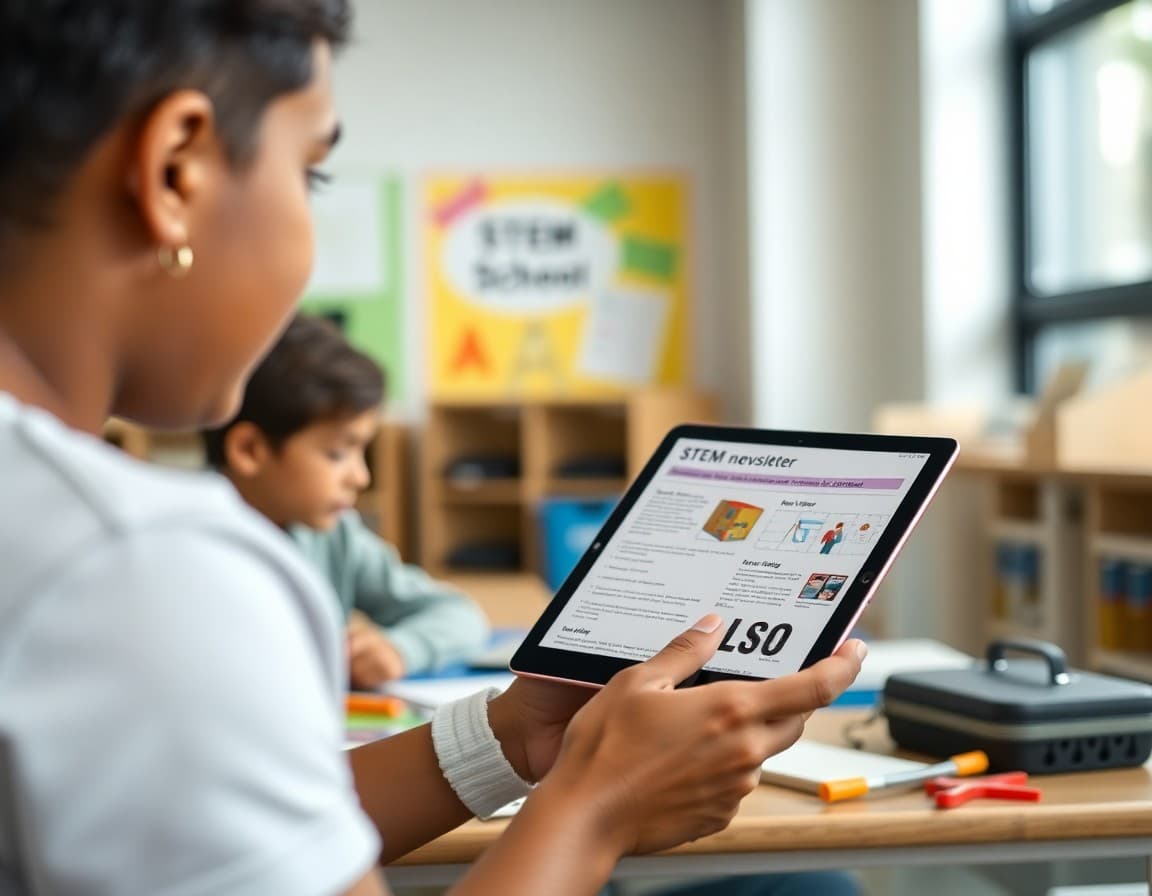
STEM school newsletters carry a specific challenge: they need to make specialized, technical work accessible to a general audience without oversimplifying it. Families who enrolled their children in a STEM school are curious and invested. A newsletter that gives them real insight into what their child is learning and building earns consistent readership and builds the community that STEM schools need to thrive.
Who Is Reading a STEM School Newsletter
STEM school parent communities tend to skew toward families with higher educational attainment and stronger interest in technology, engineering, and science. But even in schools with a high concentration of engineers and scientists among parents, there will be families who chose the school for other reasons: a strong academic reputation, a particular program, proximity, or a recommendation from a neighbor. A newsletter that assumes deep technical knowledge will lose part of its audience. One that condescends will alienate another part.
The target register is: thoughtful, curious adult who wants to understand what their child is actually doing in this school, and who appreciates specific information delivered without jargon.
Translating Technical Work Into Readable Content
The most common failure in STEM school newsletters is describing programs in terms that only make sense to practitioners. "Students are implementing sensor fusion algorithms in Python to improve localization accuracy for the robotics team's autonomous navigation system" is accurate but useless for most parents.
Better: "Our robotics team is teaching their robot to know where it is on the field using data from multiple sensors at once. This is the same technology that helps self-driving cars navigate safely, and it is genuinely difficult to build. Ask your student to show you how it works."
The revision uses analogy, explains the significance, and invites family engagement. It takes the same information and makes it accessible without dumbing it down.
A Template Excerpt for a STEM School Monthly Newsletter
Here is a section from a STEM high school in Austin:
"This month, junior engineering students completed their bridge load-testing projects. Each team designed and built a balsa wood bridge, then added weight until it failed. The goal was to optimize for both strength and weight efficiency. The winning design held 18.4 kilograms while weighing only 47 grams, a ratio that would be impressive in professional structural engineering. Students presented their design decisions and failure analysis to a panel that included two engineers from our industry partner, Halcyon Structures. Their feedback was incorporated into end-of-unit reflections. Bridge photos are posted on our school website."
This section gives specific numbers, explains what they mean, names the real-world connection, and includes a link to more content. It respects the family's intelligence without requiring a technical background.
Covering Competition Schedules and What They Involve
STEM school families often need advance notice of competitions, demonstrations, and showcases that require family attendance or after-school transportation arrangements. A newsletter that gives dates, locations, and brief descriptions of what each competition involves helps families plan. For families who have not attended a FIRST Robotics event or a science olympiad before, a sentence of context makes them more likely to show up.
"Our robotics team competes at the regional qualifier on November 14 at Central High School in Portland. Spectators are welcome from 9 AM to 5 PM. Admission is free. The competition involves 40 teams building robots to complete the same challenge task. It is loud, fast, and genuinely exciting to watch." That description turns an event on a calendar into something a family wants to attend.
Showcasing Student Projects and Achievements
STEM school students often complete projects that are genuinely impressive and would interest any family, not just those of the students directly involved. A monthly newsletter that highlights one student project or team achievement, with a brief description of what students built, what problem they solved, and what skills they developed, gives the whole community a window into the school's work.
Include student quotes when possible. A sentence from a 9th grader explaining what they were trying to do and what they learned when it did not work is more engaging than a description of the same project written by a teacher.
Connecting STEM Programs to Career and College Outcomes
STEM school families chose the school partly because of the pathway it opens for students. A newsletter that periodically highlights career connections, alumni outcomes, dual enrollment opportunities, and industry partnerships reinforces that the school is delivering on its promise. A brief alumni spotlight once per semester, a paragraph about a university research partnership, or a mention of a certification program students can complete before graduation all serve this purpose.
Lab Safety, Equipment Policies, and Permission Structures
STEM schools often have lab safety requirements, equipment use policies, and permission structures that families need to understand. The newsletter is an efficient way to communicate these without requiring individual conversations. A brief section on lab safety expectations at the start of the year, with a note about where the full policy lives, sets appropriate expectations and helps families talk to their students about responsibility in specialized learning environments.
Making Technical Achievements Feel Personal
The most effective STEM school newsletters connect technical achievement to individual students and families. A description of a robotics competition that names specific students and their roles, or a photo essay of a chemistry lab that shows individual students at work, makes the newsletter feel like it is about real people rather than a program. That personal connection is what drives families to share the newsletter, attend events, and stay invested in the school's work throughout the year.
Get one newsletter idea every week.
Free. For teachers. No spam.
Frequently asked questions
What makes a STEM school newsletter different from a general school newsletter?
STEM school newsletters need to explain technical programs and projects in ways that families without engineering or science backgrounds can understand and get excited about. They also need to cover competition schedules, certification timelines, lab safety policies, and equipment-related permission structures that general school newsletters do not address. The goal is to make the school's specialized work legible and compelling to every family, not just those with technical expertise.
How often should a STEM school send newsletters?
A monthly school-wide newsletter combined with project-specific updates when major events occur works well. STEM programs often have irregular schedules around competitions, demonstrations, and project deadlines. Supplementing the regular newsletter with event-specific communications ensures families have advance notice of dates that may require them to attend or to arrange transportation for after-school programs.
How do I explain complex STEM projects to parents without technical backgrounds?
Use analogies, outcomes, and student quotes rather than technical specifications. Instead of 'students are learning to program microcontrollers using Python scripts,' write 'students are writing code that makes a small computer respond to light and temperature, the same technology used in smart home devices.' Connect the technical work to something familiar and name what students are learning to do, not just the technical tools they are using.
Should STEM school newsletters cover career and college pathways?
Yes. One of the strongest draws of a STEM school is its connection to real career pathways. A newsletter that mentions an alumna who is now a software engineer, a partnership with a local engineering firm, or a college credit course available to juniors and seniors connects the school's daily work to the future outcomes families care about. These connections are worth highlighting several times per year.
What platform works well for STEM school newsletters?
Daystage is a strong option for STEM schools because it handles both the visual design and the sending in one place, without requiring technical expertise to produce a polished newsletter. You can include photos of lab work, embed competition results, and send to your full family list without needing a separate email platform or design tool.

Adi Ackerman
Author
Adi Ackerman is a former classroom teacher and curriculum writer with 8 years in K-8 schools. She writes about school communication, parent engagement, and what actually works in real classrooms.
More for STEM
Ready to send your first newsletter?
3 newsletters free. No credit card. First one ready in under 5 minutes.
Get started free