
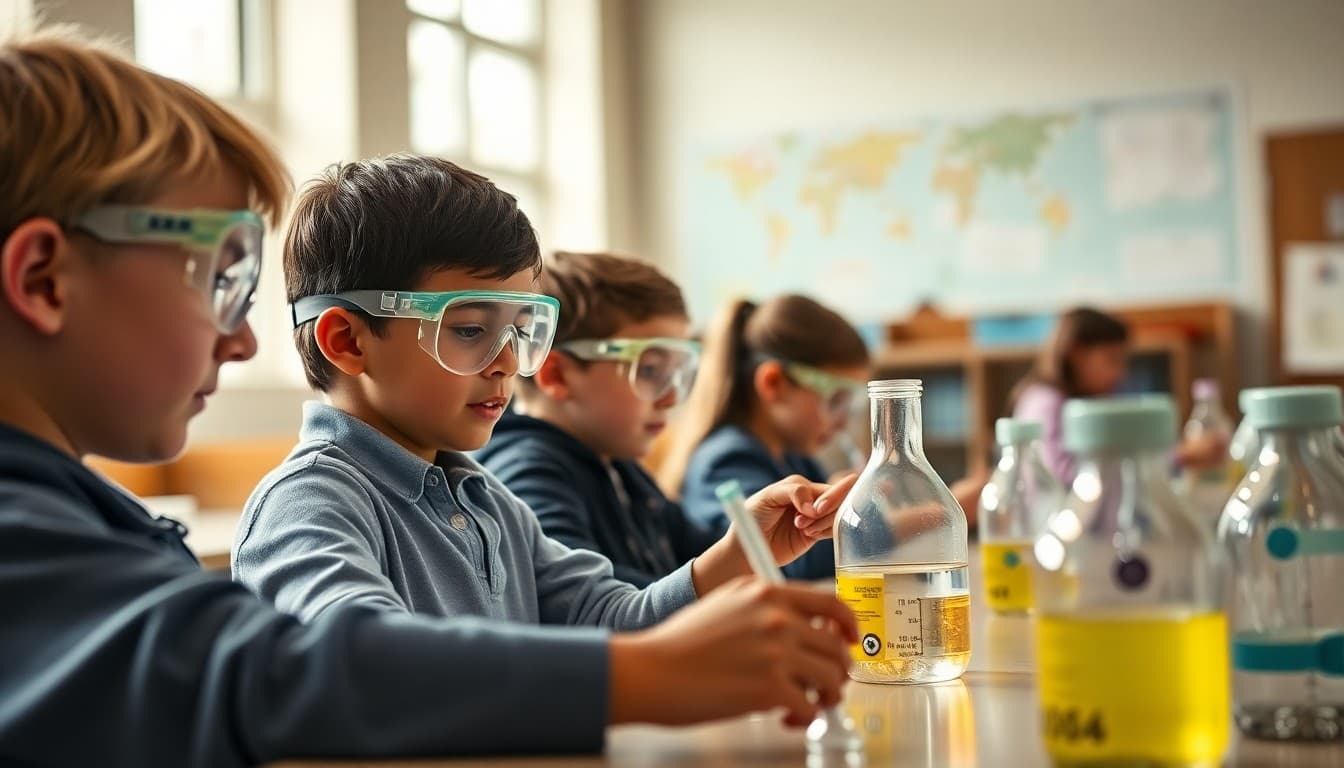
School Newsletter for National Science Month: Ideas and Template
April is National Science Month, and for classroom teachers it falls at a moment when spring science units are in full swing. Whether your class is studying ecosystems, chemistry, physics, or life science, a newsletter during National Science Month gives families a window into the work students are doing, builds science enthusiasm at home, and positions the school as a place where curiosity is valued. It does not need to be elaborate to be effective.
Why a Science-Focused Newsletter Is Worth the Effort
Family involvement in STEM subjects is one of the most reliable predictors of student persistence in science. Families who talk about science at home, ask their students about experiments, and engage with science concepts themselves raise students who are more likely to see themselves as scientists and more likely to pursue STEM pathways. A newsletter that gives families concrete conversation starters and activity ideas is not just communication -- it is a STEM engagement intervention that costs nothing beyond the 20 minutes it takes to write.
What Students Are Studying in Science Right Now
Be specific about the current unit. "We are studying ecosystems" is less engaging than "We spent this week building food webs using organisms found in our local watershed -- students discovered that removing one species from the web can collapse the entire system." The second version gives families a genuine point of entry: they can ask "which species did you choose and what happened when you removed it?" That question launches a real conversation rather than the usual "fine" response. Science units are full of interesting details that most teachers never share in newsletters because they assume parents will not find them interesting. They are wrong.
Upcoming Science Events Worth Noting
April is science fair season in many schools. If a science fair is coming up, the newsletter should cover the timeline, the project requirements, whether projects are individual or collaborative, and how families can support the process without doing the work for the student. Also note any science field trips, guest speaker visits (a local engineer, ecologist, or physician is a powerful classroom visitor), or external competitions like Science Olympiad or regional science bowl events. Families who know about these events can help students prepare and arrange schedule accommodations.
Template Section: This Month in Science
Here is a classroom science update section that is specific and engaging:
"This Month in Science -- April: We are finishing our ecosystems unit this week with a field study of the school's rain garden. Students will collect water and soil samples, identify native plants, and look for invertebrates that indicate ecosystem health. Next week we begin our chemistry unit with an introduction to states of matter and phase changes. By the end of April, students will build a solar-powered device as their final project. Ask your student: what lives in the rain garden, and what does that tell us about the health of the ecosystem?"
Three Family Science Activities for April
Give families three specific science activities they can do at home this month. First (K-5): plant a bean seed in a clear plastic bag attached to a window and watch it germinate -- record growth every two days in a journal. Second (grades 3-8): make a density column by layering corn syrup, dish soap, water, cooking oil, and rubbing alcohol in a tall glass -- objects placed at the top will sink to their "matching density" layer. Third (all ages): visit a local nature preserve and use a free app like iNaturalist to identify plants and animals you observe, contributing to real scientific research. Each of these is achievable with household materials and produces genuine scientific observations.
Connecting Science to Careers
Career connections help students see science as relevant to their futures, not just as required coursework. For an ecosystems unit: environmental scientists, wildlife biologists, conservation ecologists, environmental lawyers, and sustainable agriculture specialists. For a chemistry unit: pharmacists, chemists, materials scientists, food scientists, and chemical engineers. For a physics unit: civil engineers, aerospace engineers, architects, and physicists working in everything from renewable energy to medical imaging. A two-sentence career connection in the newsletter broadens what students imagine possible for themselves.
Science Fairs: How Families Can Help Without Taking Over
Science fair projects work best when students drive the design and families support the process. The newsletter can clarify what appropriate parent support looks like: help your student brainstorm a question they are genuinely curious about, drive them to the library or hardware store if needed, ask questions about their methodology rather than suggesting what they should do, and proofread the final report. The science fair results belong to the student. Families who understand this boundary produce better projects and better learning outcomes than families who design the project themselves.
Get one newsletter idea every week.
Free. For teachers. No spam.
Frequently asked questions
When is National Science Month?
April is National Science Month in the United States, aligned with Earth Day on April 22 and Science Literacy Week in some regions. April is also when many schools hold science fairs, making it a natural month for a science-focused newsletter. A newsletter sent in early April can preview both the science curriculum and any upcoming science events or competitions.
What should a National Science Month newsletter include?
Cover the current science unit and key concepts students are learning, any hands-on experiments or lab work happening this month, upcoming science events (science fair, field trips, guest speakers), career connections to science fields, and three family science activity ideas that do not require special equipment. The newsletter should feel like an invitation into the science classroom.
How do I connect science learning to future career opportunities in the newsletter?
Briefly note career pathways that connect to the current science unit. For an ecosystems unit: ecology, wildlife biology, environmental science, conservation policy. For a chemistry unit: pharmaceutical science, materials engineering, food science. For a physics unit: engineering, architecture, aerospace. These connections matter particularly for students who do not see themselves as 'science people' -- they may not know that science careers span far beyond lab coats.
What low-cost family science activities can I recommend in the newsletter?
Excellent low-cost options include: growing a plant from seed on a windowsill and tracking growth, building a simple water filtration system from household materials, making vinegar-and-baking-soda volcanoes (classic but effective for K-2), measuring the pH of household liquids with red cabbage indicator, tracking cloud types for a week using a weather journal, or dissecting a flower to identify its parts. Specific instructions or a link to a how-to guide are more useful than a general suggestion.
Can Daystage help science teachers send a National Science Month newsletter with experiment photos and lab previews?
Yes. Daystage supports photo inclusion in newsletters, making it easy to include pictures from classroom lab work alongside the text sections. Teachers use it to send science newsletters that give families a visual window into the lab -- which is often the section parents find most engaging.

Adi Ackerman
Author
Adi Ackerman is a former classroom teacher and curriculum writer with 8 years in K-8 schools. She writes about school communication, parent engagement, and what actually works in real classrooms.
More for STEM
Ready to send your first newsletter?
3 newsletters free. No credit card. First one ready in under 5 minutes.
Get started free