

Physics Club Newsletter: Experiments and Competitions
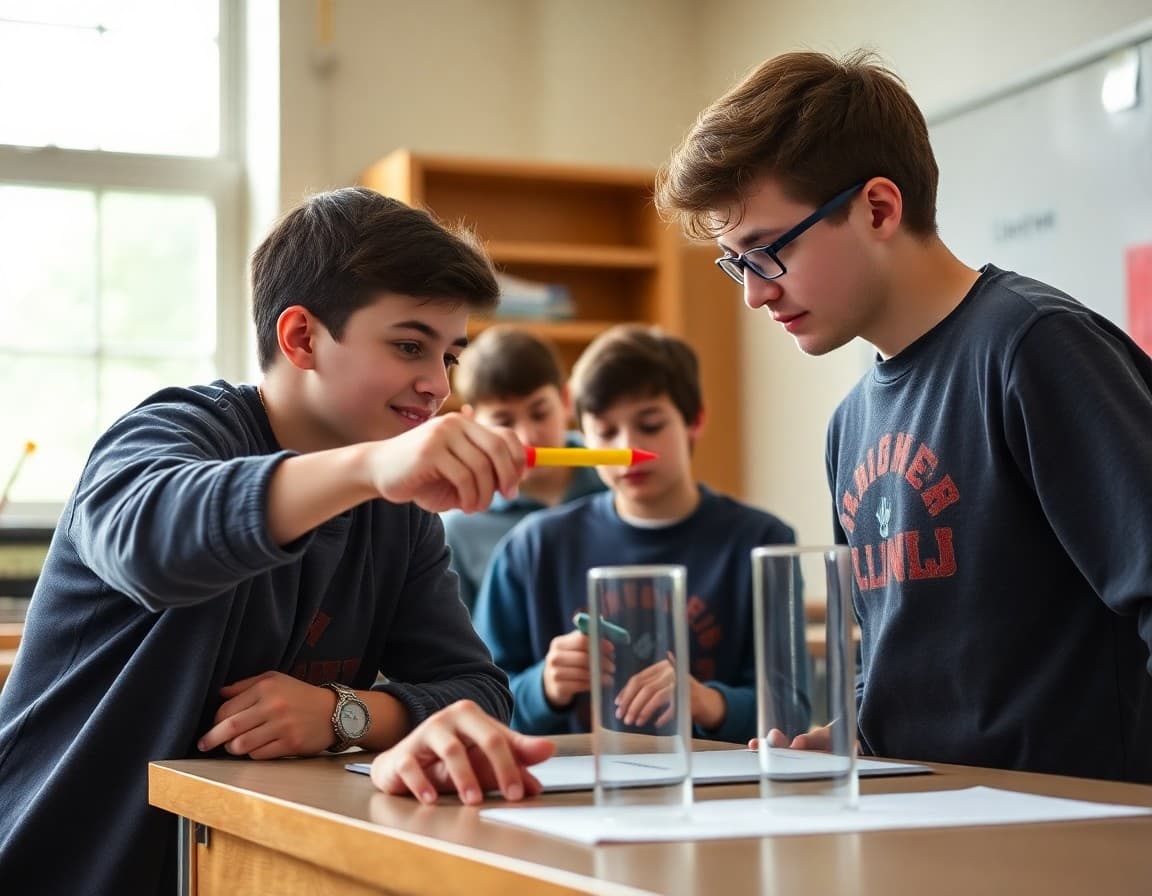
Physics club newsletters work best when they show families that the experiments students are doing connect to the world they live in. Gravity, electricity, waves, and motion are not abstract: they are operating in every car, building, phone, and body on earth. Make that connection in every update.
Start with what the club worked on and why it matters
Every newsletter should begin with a specific experiment or activity from the most recent session. Name the physics principle being studied, describe what students did, report what they measured, and connect it to something families encounter outside of school.
"This week, students studied centripetal force by spinning water in a bucket and measuring the minimum speed needed to keep the water from falling out at the top of the arc. The physics of that minimum speed is the same physics that engineers use to design roller coaster loops and spacecraft orbital maneuvers."
Explain experimental design and measurement precision
One of the most valuable skills physics club teaches is experimental design: choosing the right variable to measure, controlling other variables, and collecting data precisely enough to draw valid conclusions. When your newsletter describes these choices, families understand that the work is rigorous science, not just interesting demonstrations.
"Students designed their own experiment to measure the effect of angle on projectile range. Each group had to choose a consistent launch method, decide how many angle trials to run, choose a measurement tool accurate enough to detect differences, and handle data from a 10-trial run. Two groups had to re-run their entire data set because their launch mechanism was inconsistent. Recognizing that problem and re-running is a sign of good scientific thinking."
Cover competition preparation with specifics
Students preparing for the F=ma exam or Physics Olympiad need families to understand the commitment involved. The F=ma exam covers mechanics at a level above AP Physics, and serious preparation requires significant independent study time. Tell families what that preparation looks like and what resources students are using.
"Students preparing for the January F=ma exam are working through the past ten years of released exams. The exam has 25 problems in 75 minutes. A score in the top 400 nationally advances to the USA Physics Olympiad exam. We have had two students advance in the past five years. The students currently preparing are working at that level."
Describe the equipment students are using
Physics equipment is interesting. Families who learn that their child is using a photogate timer, a spectrometer, a force plate, or an oscilloscope in club sessions understand that the program has genuine laboratory depth. Name the specific equipment and what it measures.
"This month students used a photogate timer, which measures object velocity to within 0.01 milliseconds, to test whether two objects of different masses really do fall at the same rate in a vacuum. They compared drop times in air versus drop times using a vacuum tube and measured the difference that air resistance makes at different object sizes."
Sample newsletter template excerpt
Physics Club update: we completed the wave optics unit this month. Students used diffraction gratings to measure the wavelengths of different colors of light by shining a laser through the grating and measuring the distance between diffraction spots on a screen.
Results: Red laser measured at 648 nm (actual: 650 nm). Green laser measured at 531 nm (actual: 532 nm). Both measurements were within 0.5% of the actual values. This level of precision required students to measure angles carefully and understand the relationship between grating spacing, wavelength, and diffraction angle. They earned it.
Connect physics to technology careers
Physics underlies every technology field: semiconductor engineering, renewable energy, medical imaging, satellite communications, materials science. When a specific physics principle connects to a technology students use or hear about, name that connection in the newsletter.
"The electromagnetic induction experiment students ran this month is the principle behind every electric motor and generator on earth, from the generator in a wind turbine producing renewable electricity to the regenerative braking system in an electric car."
Invite families to ask physics questions
Families who engage with physics questions tend to produce students who retain physics concepts better. A newsletter that closes with a physics question for families to discuss at home extends the learning beyond the lab room. Keep the question approachable and connected to something familiar. "Ask your student: why do heavier objects not actually fall faster than lighter ones in a vacuum? The answer involves something Galileo figured out 400 years ago."
Get one newsletter idea every week.
Free. For teachers. No spam.
Frequently asked questions
What kinds of experiments do school physics clubs run?
Physics clubs run experiments that complement and extend the classroom curriculum, including projectile motion analysis with high-speed cameras, simple harmonic motion using pendulums and springs, electromagnetic induction using coils and magnets to generate voltage, optics experiments with prisms and diffraction gratings, fluid dynamics using pipe flow setups, and thermodynamics experiments measuring heat transfer rates. Clubs that compete prepare experiments aligned to specific competition events like Science Olympiad Experimental Design or the Physics Olympiad exam topics.
What physics competitions do school clubs participate in?
Major competitions include the Physics Olympiad (F=ma exam in January, followed by USAPhO in March), Science Olympiad Physics events, SkillsUSA Electronics Technology, and regional physics bowl competitions run by universities. The American Association of Physics Teachers also sponsors the Physics Bowl exam for high school students. Many regional universities run annual physics challenge days specifically for high school teams. Check with your state's physics teacher association for local options.
How does physics club work benefit students in their regular physics class?
Students who do extended experimental work in physics club consistently perform better in their formal physics classes because they have seen the concepts operate in multiple real contexts. A student who has measured projectile motion experimentally and compared it to the equations understands kinematic formulas at a deeper level than a student who has only solved textbook problems. The experimental troubleshooting skills built in club also improve lab performance in class.
What math background do students need for physics club?
Most physics club activities at the introductory level require algebra and basic trigonometry. Students in AP Physics 1 or 2 benefit from pre-calculus fluency. Students preparing for the Physics Olympiad or F=ma exam need calculus-based physics, which means either concurrent enrollment in calculus or self-study of calculus concepts. Clubs should accommodate different math backgrounds by offering multiple entry points rather than assuming all members are at the same level.
How does Daystage help physics club advisors communicate with families?
Daystage lets physics club advisors share experiment writeups, competition schedules, and student results in a newsletter format that families can follow throughout the year. When a student places in a regional physics competition, a Daystage newsletter announcement with context about what the competition tests and how difficult it is gives the achievement the recognition it deserves.

Adi Ackerman
Author
Adi Ackerman is a former classroom teacher and curriculum writer with 8 years in K-8 schools. She writes about school communication, parent engagement, and what actually works in real classrooms.
More for STEM
Ready to send your first newsletter?
3 newsletters free. No credit card. First one ready in under 5 minutes.
Get started free