

Twice-Exceptional (2e) Student Newsletter: Gifted and Special Needs
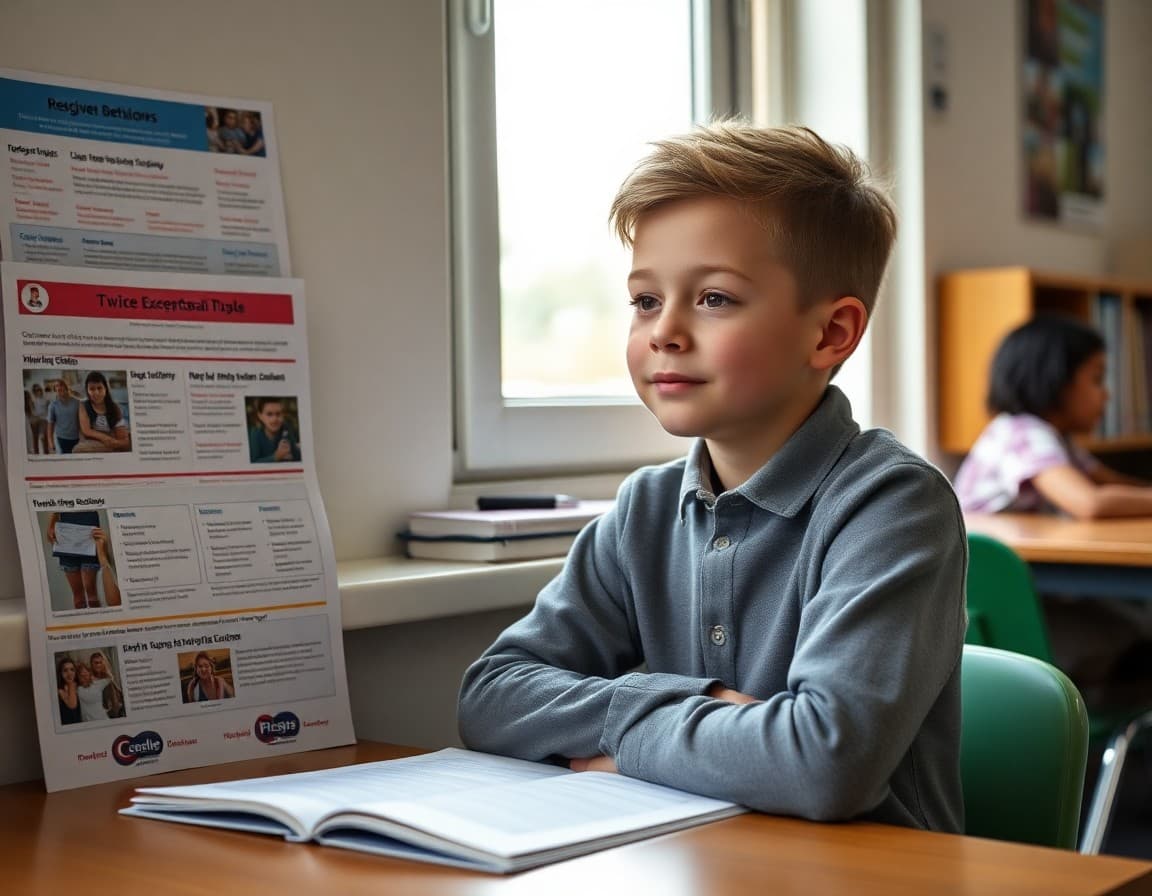
Twice-exceptional students are among the most misunderstood learners in any school. Their gifts hide their challenges. Their challenges obscure their gifts. Families often spend years watching their child struggle in areas while excelling in others before anyone puts a name to what they are seeing. A newsletter that addresses twice-exceptionality directly helps these families feel seen.
Why 2e Students Are Often Missed
Standard school assessments and benchmark tools are designed to identify students performing significantly above or below grade level norms. A 2e student whose gifts bring them to grade-level performance despite a significant learning disability may score in the average range on every measure. They never qualify for gifted services because they are not outperforming peers. They never get evaluated for a disability because they are meeting grade-level benchmarks. The offset creates an invisible profile.
Over time, these students exhaust themselves compensating. They use processing speed and verbal reasoning to memorize what they cannot decode. They use humor and social skill to avoid written output tasks. By middle school, many 2e students have developed anxiety, avoidance, and a fragile relationship with their own intelligence that takes years to rebuild.
What a 2e-Informed Newsletter Communicates
A newsletter for families of 2e students or a general newsletter section on twice-exceptionality communicates three things: the school recognizes this profile exists, the school has a plan for addressing it, and the family is a partner in that plan. That message alone changes how many 2e families experience their school relationship.
Cover what twice-exceptionality means in plain language. Describe how your school identifies and serves 2e students. Explain how gifted services and special education services can coexist in the same student's program. And provide resources families can use independently.
How Gifted and Special Education Services Coexist
A student can receive both gifted services and special education services simultaneously. The gifted program addresses their advanced learning needs. The IEP addresses their disability-related needs. These services are not in competition. A student with dyslexia and exceptional mathematical reasoning should receive reading instruction through their IEP and math enrichment through the gifted program at the same time.
In practice, schools sometimes treat these as either-or. A student who gets an IEP gets pulled from gifted math. A student who qualifies for gifted does not get referred for a disability evaluation. Your newsletter can explicitly name this as a problem and describe how your school approaches it differently.
Template: 2e Communication Section
"Some students combine exceptional abilities in one or more areas with learning or developmental challenges in others. These twice-exceptional students have both a giftedness identification and a disability that requires support. Both aspects of their profile deserve attention.
In our school, 2e students may receive both gifted services and special education or 504 accommodations. An IEP addresses the disability-related barriers to learning. Gifted services provide the enrichment and challenge that the student's abilities require. Neither cancels out the other.
If you believe your child may be twice-exceptional and is not currently receiving services that address both sides of their profile, please contact [gifted coordinator] or [special education case manager] for a conversation about next steps."
Social-Emotional Needs of 2e Students
Many 2e students experience significant social-emotional challenges alongside their academic profile. Intense frustration at the gap between what they understand and what they can produce. Social difficulty related to asynchronous development. Anxiety around evaluation and being seen as struggling. Perfectionism that masks avoidance.
A newsletter that acknowledges these challenges and names the school's supports for them, such as counseling, a school psychologist, or a student mentor program, completes the picture of a school that genuinely understands and addresses the full 2e experience.
The Importance of Strength-Based Language
In all communication about 2e students, lead with strengths. "Your child has exceptional capacity for [area] and is building skills in [challenging area]" positions the student's gifts as real and the challenges as developable. A newsletter that leads with disability language misrepresents the profile and can reinforce the family's fear that the school only sees the problem, not the whole child.
Get one newsletter idea every week.
Free. For teachers. No spam.
Frequently asked questions
What does twice-exceptional mean?
Twice-exceptional, or 2e, refers to students who are identified as gifted and also have one or more disabilities. Common co-occurring conditions include dyslexia, ADHD, autism spectrum disorder, sensory processing disorder, anxiety, and other learning or developmental differences. 2e students often mask one identity with the other: their giftedness can compensate for a learning disability, making the disability less visible, or their disability can mask their gifts, leading to underidentification for gifted services.
How do twice-exceptional students get identified for services?
Identification is often a challenge because 2e students can appear average when their gifts and disabilities offset each other. Gifted identification typically requires evidence of exceptional ability through testing, portfolio, or demonstrated performance. Disability identification requires evaluation data showing that the disability adversely affects educational performance. Many 2e students need separate evaluations to document both their gifts and their disabilities, and those two processes do not always happen at the same time or through the same team.
What should a 2e student's IEP include?
A 2e student's IEP must address their disability-related needs, not their gifted needs. The IEP is a special education document and is not the vehicle for documenting gifted services. However, IEP goals and accommodations should be designed with the student's full profile in mind, including their areas of strength. A 2e student with dyslexia and exceptional verbal reasoning might have IEP goals for written expression that are scaffolded in a way that allows them to demonstrate the complexity of their thinking even while building written language skills.
How do I communicate about a 2e student's profile to families without overpromising or underselling?
Be honest about both dimensions. 'Your child has exceptional strengths in [area] and is also working to develop skills in [area affected by disability]. Our goal is to address both, not to treat one as more important than the other.' Families of 2e students often feel that schools see only the disability or only the gift, not the whole child. A newsletter that explicitly names both validates their experience and builds trust.
What resources are most useful for 2e families?
The 2e Newsletter and the Davidson Institute are two well-regarded resources focused specifically on twice-exceptional learners. SENG (Supporting Emotional Needs of the Gifted) addresses the social-emotional dimensions that often accompany 2e profiles. Your local Parent Training and Information Center provides free consultation on disability rights and IEP processes. Daystage newsletters let you include curated resource links so families can access these without having to search independently.

Adi Ackerman
Author
Adi Ackerman is a former classroom teacher and curriculum writer with 8 years in K-8 schools. She writes about school communication, parent engagement, and what actually works in real classrooms.
More for Special Education
Ready to send your first newsletter?
3 newsletters free. No credit card. First one ready in under 5 minutes.
Get started free