
SEL Newsletter on Growth Mindset: A Working Template

Growth mindset became famous, then got watered down, then got misused. A newsletter that brings it back to the original idea and gives parents one concrete way to use it at home is more useful than a poster on the wall. The core idea is simple. Kids get better at things by working at them, not by being born good at them. That belief shapes how a kid responds when something gets hard.
What growth mindset actually means
It is the belief that abilities grow through effort and strategy. A kid with this belief sees a hard problem as something to work on. A kid with the opposite belief sees the same hard problem as proof that they are not good at the subject. Same problem, different next step. The belief is the variable that matters.
The power of YET
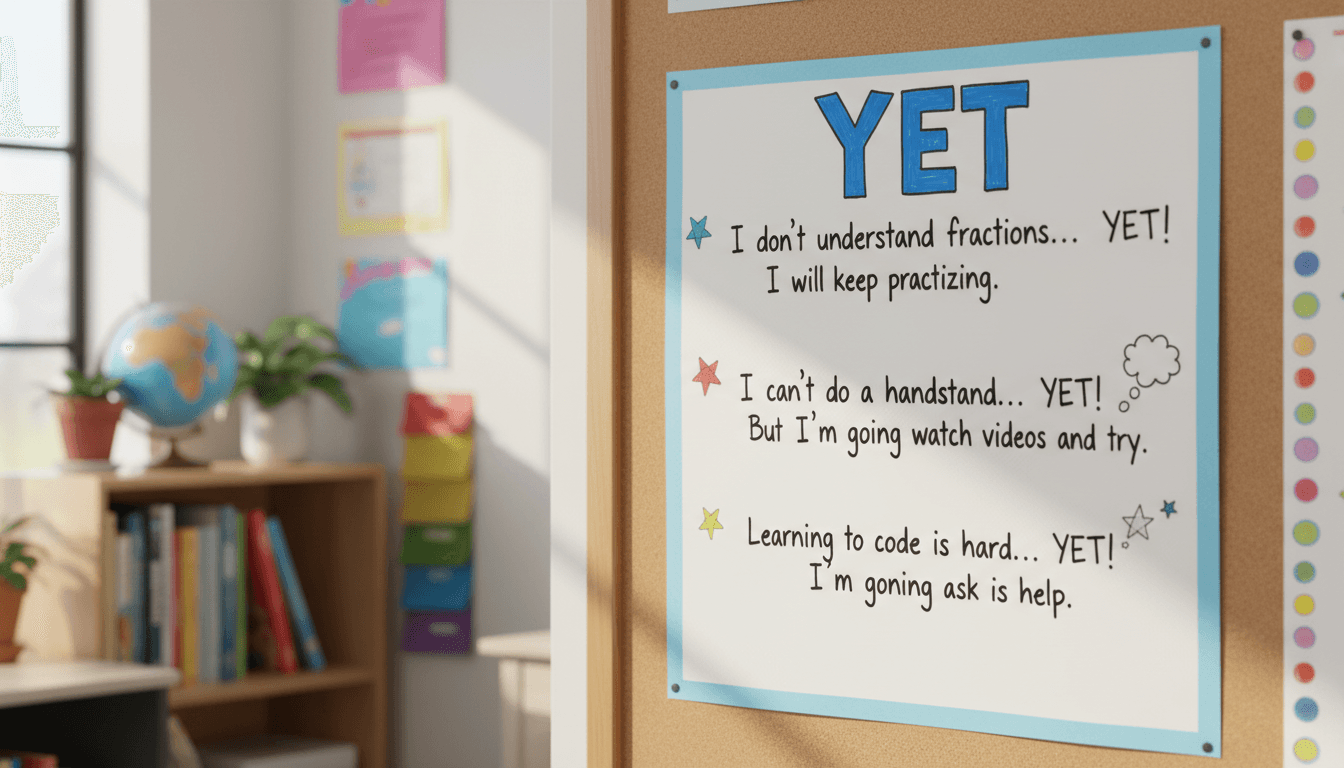
One small word. Drop it at the end of any "I cannot" sentence in class. "I cannot solve this." Add YET. "I cannot solve this yet." The sentence changes meaning. In Room 7, we have a bulletin board where kids post their "not yet" sticky notes. Last month a kid I will call J wrote "I cannot do long division YET." This month she scratched the sticky note out and wrote "Now I can." That is the whole frame in action.
Praise effort and strategy, not identity
Carol Dweck's research caveats are worth noting. Effort praise works when it is specific and tied to actual work. "You tried three different ways before that one worked" lands. "You worked so hard" can feel like a participation trophy if the kid did not actually work hard. The praise has to be true. Generic effort praise wears thin fast.
The "this is hard, and..." reframe
Kids sometimes hear "this is hard" as a stopping signal. We reframe it. "This is hard, and that means my brain is growing." "This is hard, and I have not tried strategy X yet." The "and" keeps the sentence going. The brain finds the next step instead of stopping.
A short section parents will actually read
On Monday, a kid in our class, a kid I will call M, was stuck on a multi-step word problem. Her first sentence was "I cannot do this." We added the word YET. Her face changed a little. She said, "I cannot do this yet." Then she asked, "Can I draw a picture to help?" Yes. She drew the problem out, then solved it. That whole loop took maybe four minutes.
The skill we have been practicing is called growth mindset. It is the belief that abilities grow through effort and strategy. At home, you can build this with one move tonight. When your child says "I cannot do this," add the word YET out loud. See what happens.
Watch the false growth mindset
Dweck has warned about a watered-down version. It is when adults praise effort without paying attention to whether the strategy is working. A kid who tries the same wrong approach for an hour does not need more praise. They need a new strategy. Growth mindset includes the willingness to switch approaches, not just the willingness to keep going.
What to skip in the newsletter
Skip slogans like "anything is possible if you just believe." That is not growth mindset, that is wishful thinking. Skip praising your child for being smart and adding a "growth mindset" hashtag. Skip turning YET into a class poster and never talking about it. The word only works when it lives in the daily conversation.
Common pitfalls in growth-mindset newsletters
The first pitfall is the watered-down version. Praising effort without checking the strategy. That is not growth mindset, that is empty encouragement. The second pitfall is ignoring real obstacles. A kid who is hungry, tired, or scared needs more than a YET poster. The third pitfall is making growth mindset the only frame. Some kids do not need more grit, they need more support. Hold both at once.
Subject lines that get opened
"The day M added the word YET to a sentence" gets opened. "Growth Mindset Update" does not. Try "One word that changed how a kid in our class thinks about hard work" or "What we praise and what we skip in Room 7." Specific over generic. Write the subject after the body is written.
Length, cadence, and visuals
Keep the body to 350 to 500 words. Two short sections. One photo of the YET bulletin board or a kid working through a hard problem, with permissions cleared. Send every two to three weeks. By the end of the year, families have heard the word YET enough times that it shows up at homework time without anyone planning for it.
How Daystage helps with growth mindset newsletters
Daystage drafts parent-friendly SEL newsletters from a few notes you type in. The growth mindset template includes the power of YET frame, a classroom moment, and one prompt for the dinner table. You read, edit, send. Most teachers finish in under ten minutes.
Get one newsletter idea every week.
Free. For teachers. No spam.
Frequently asked questions
What is a growth mindset?
The belief that abilities are built through effort and strategy, not fixed at birth. A kid who thinks math is something you get better at with practice has a growth mindset. A kid who thinks you are either a math person or not has a fixed one. The first kid keeps working. The second one quits sooner.
What is the power of YET?
A small word that changes the meaning of a sentence. 'I cannot read this' shuts the door. 'I cannot read this YET' opens it. We add 'yet' to the end of any 'I cannot' sentence in class. It sounds small. It is not.
Should I praise my child for being smart?
Better to praise effort and strategy than identity. 'You worked hard on that problem' or 'You tried a new way and it worked' lands differently than 'You are so smart.' Identity praise can backfire when the next task is hard. Effort praise keeps the door open.
How is growth mindset different from positive thinking?
Positive thinking is a feeling. Growth mindset is a strategy. A kid with a growth mindset can still feel frustrated and stuck. They just believe that effort and strategy can move them forward. The feeling is allowed. The next step is the skill.
Does Daystage have a growth mindset newsletter template?
Daystage has SEL templates for the five CASEL competencies and adjacent skills like growth mindset. The template includes a classroom moment, the power of YET frame, and one parent prompt. Type your notes, Daystage drafts, you send.

Adi Ackerman
Author
Adi Ackerman is a former classroom teacher and curriculum writer with 8 years in K-8 schools. She writes about school communication, parent engagement, and what actually works in real classrooms.
More for Social-Emotional Learning
Ready to send your first newsletter?
3 newsletters free. No credit card. First one ready in under 5 minutes.
Get started free