
SEL Newsletter Explaining the RULER Approach
The RULER approach, developed at the Yale Center for Emotional Intelligence, has spread through thousands of K-12 schools. Most parents in those schools have seen the Mood Meter come home on a piece of paper and not been entirely sure what to do with it. A short explainer newsletter at the start of the year gives families the vocabulary in plain language. It also gives them one specific thing to try at home that week. This is the template.
Open with what RULER stands for, briefly
Name the five letters once, in plain words. "Our school uses an approach called RULER, which stands for Recognizing, Understanding, Labeling, Expressing, and Regulating emotions. That is a mouthful. In practice it means we spend time helping your child notice what they feel, name it precisely, and pick what to do about it." That is the introduction. Move on.
The Mood Meter, explained without the chart
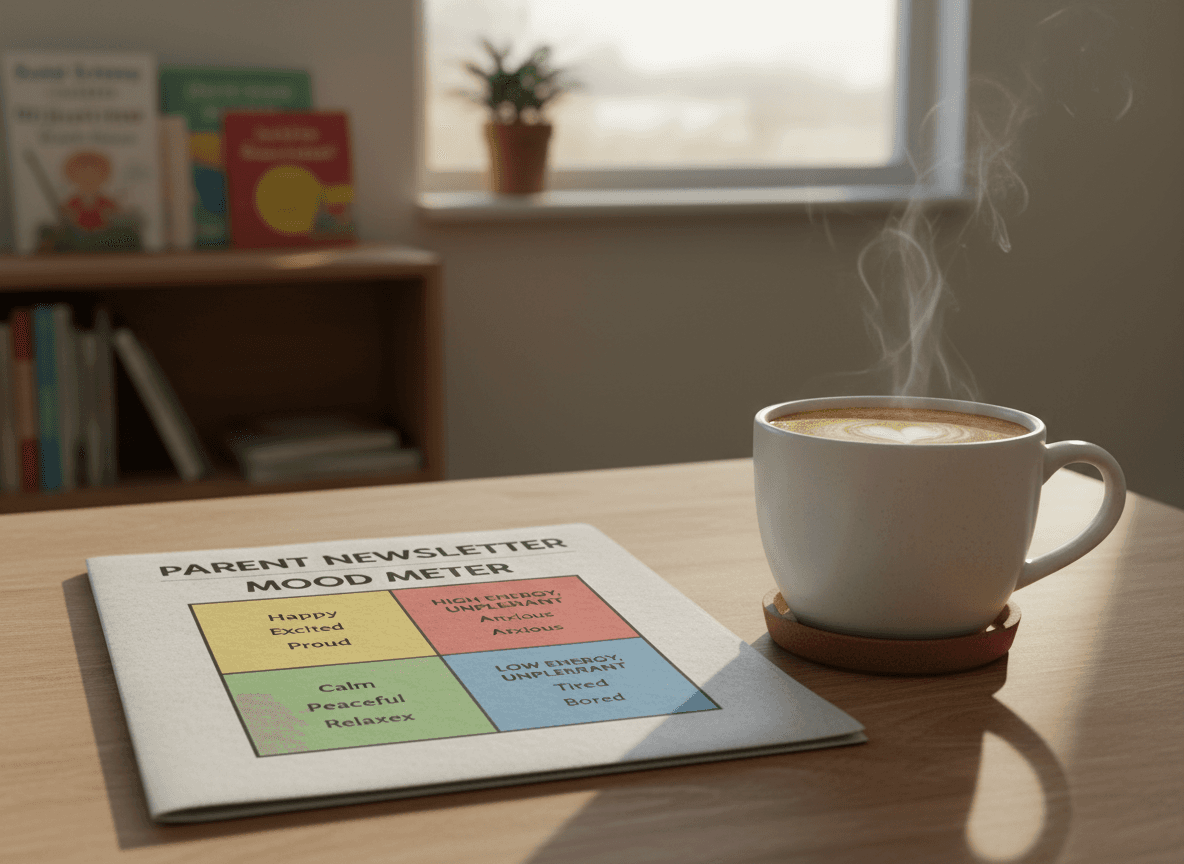
Describe the two axes. "Imagine a grid. The bottom-to-top line is how much energy you have, from low to high. The left-to-right line is how pleasant it feels, from unpleasant to pleasant. Every feeling lives somewhere on that grid. That is the Mood Meter."
The four quadrants in plain words
"Yellow is high energy, pleasant. Excited, joyful, hopeful. Green is low energy, pleasant. Calm, peaceful, content. Red is high energy, unpleasant. Angry, anxious, frustrated. Blue is low energy, unpleasant. Sad, tired, bored." Four lines. Each quadrant gets a feeling word a child would actually use. Skip the longer vocabulary list for now. Save it for the second newsletter.
Why naming a feeling changes it
The most useful single paragraph in any RULER explainer. "There is good research showing that putting a precise name on a feeling moves brain activity from the part that reacts to the part that thinks. A child who can say 'I am frustrated' instead of melting down is already part of the way to handling it. That is the whole reason RULER puts so much weight on naming."
What this looks like in the classroom
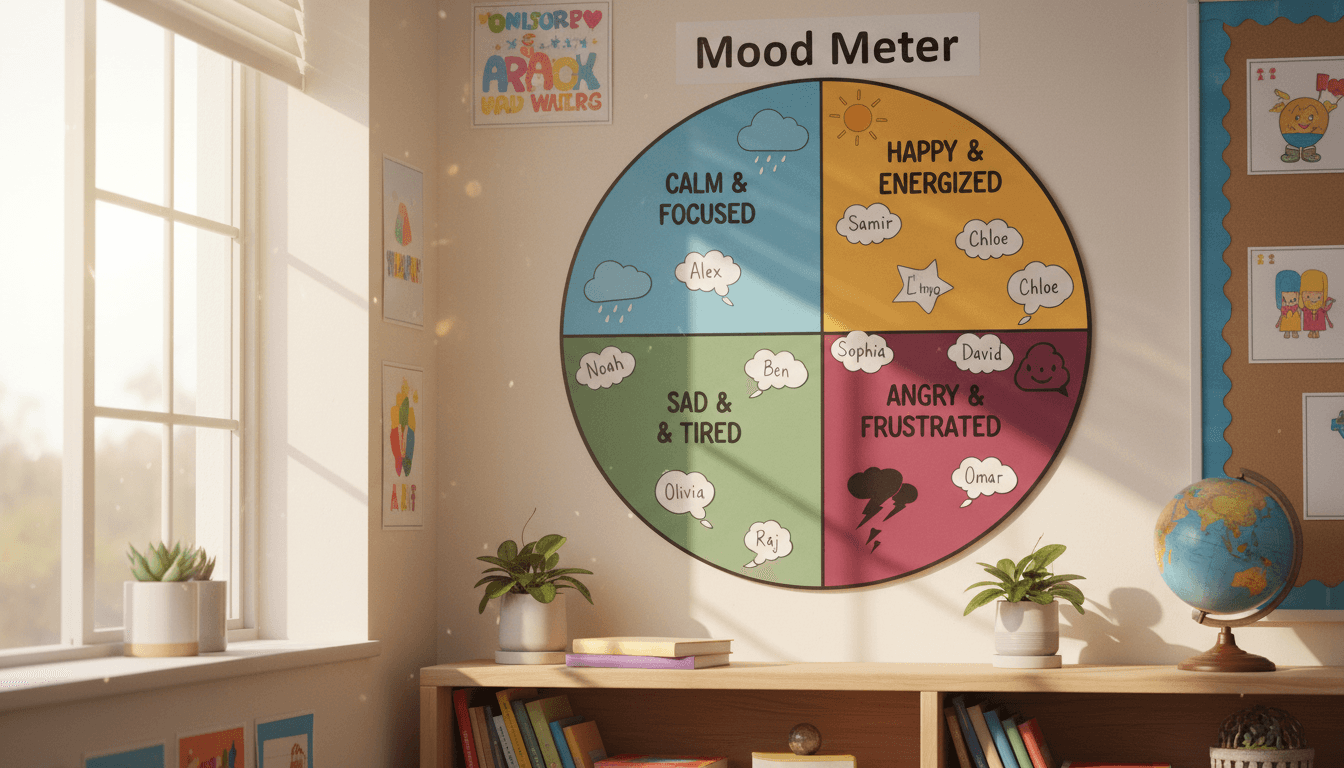
"Every morning our class checks in on the Mood Meter. Each student places their name in the quadrant that fits how they are feeling. We are not fixing anything in that moment. We are noticing. Over the year your child will pick up the words that fit their feelings most precisely. They will also start noticing when their quadrant changes during the day, which is the beginning of regulation."
A worked example
On Monday morning a second grader put her name tag in the blue quadrant. I asked if she wanted to tell me about it. She said her dog was at the vet. I said, 'That is a hard feeling. You named it. Do you want to do your morning work with a partner or by yourself today?' She picked a partner. By lunch her name tag was in green. She did the moving herself.
What to do at home this week
One specific prompt. "Before bed this week, ask your child what quadrant they ended the day in. Yellow, green, red, or blue. You do not need a chart. Just ask. If they tell you red, ask one more question: what color did they start the day in? You are teaching them to notice their own movement."
Common questions
"Is there a wrong quadrant? No. All four are real. Red and blue are not bad. They are information. Is green better than yellow? Not in general. The right answer depends on what you are about to do. Yellow is great for a birthday party. Green is better for falling asleep. The skill is matching your quadrant to what you need."
The five RULER skills, briefly
The Mood Meter is the most visible part of RULER but not the whole thing. The five skills are: Recognizing emotions in yourself and others, Understanding what causes them, Labeling them precisely, Expressing them appropriately, and Regulating them with strategies. The Mood Meter mostly works on Recognizing and Labeling. The other three skills get taught through classroom routines like the charter, the meta-moment, and the blueprint. Parents do not need to know those four tools by name. They need to know that the Mood Meter is part of a larger approach.
What to do when a child gets stuck in red or blue
Parents will ask. "She is in red all afternoon. What do I do?" The short answer: sit with it first, fix it second. Naming the quadrant is the work for the first two minutes. After that, your child has a strategy from class they can try. Deep breaths. A walk. Drawing. Asking for a break. Pick one. Try it for five minutes. Notice if the quadrant changed. This is the cycle the classroom is teaching.
How Daystage helps with RULER newsletters
Daystage has a RULER template with the Mood Meter explanation, the four quadrants in plain language, and a parent prompt slot. You add one classroom moment. Daystage drafts the parent newsletter in language families can use at dinner that night, with a subject line that earns opens. The once-a-year RULER intro takes about twenty minutes instead of two evenings of fighting with a Word doc.
Get one newsletter idea every week.
Free. For teachers. No spam.
Frequently asked questions
What are the four Mood Meter quadrants in plain language?
The Mood Meter splits feelings along two lines: how much energy you have and how pleasant it feels. Yellow is high energy and pleasant (excited, happy). Green is low energy and pleasant (calm, content). Red is high energy and unpleasant (angry, anxious). Blue is low energy and unpleasant (sad, tired). Every feeling lives somewhere on the grid.
Why does naming a feeling change it?
There is good research on this. Putting a precise name on a feeling moves activity from the part of the brain that reacts to the part that thinks. The kid who can say 'I am frustrated' instead of just feeling bad is already partway to handling it. This is why RULER puts naming front and center.
Do you have to use the actual Mood Meter chart at home?
No. The point is the vocabulary, not the poster. If your child knows the four quadrants and can name where they are, they have the tool. A printed Mood Meter on the fridge helps younger kids who like the visual, but the conversation is what matters.
What is the difference between RULER and other SEL frameworks?
RULER is built around five skills: Recognizing, Understanding, Labeling, Expressing, and Regulating emotions. CASEL is broader. Second Step is a specific curriculum. RULER is more of an approach that schools weave through everything. The Mood Meter is its best-known tool because it is the one kids and parents can use immediately.
Can Daystage explain RULER in a parent newsletter?
Daystage has a RULER template with the Mood Meter visual, plain-language definitions of the four quadrants, and a parent prompt slot. You add one classroom moment that fits. Daystage drafts the parent newsletter in language families can use at dinner that night.

Adi Ackerman
Author
Adi Ackerman is a former classroom teacher and curriculum writer with 8 years in K-8 schools. She writes about school communication, parent engagement, and what actually works in real classrooms.
More for Social-Emotional Learning
Ready to send your first newsletter?
3 newsletters free. No credit card. First one ready in under 5 minutes.
Get started free