
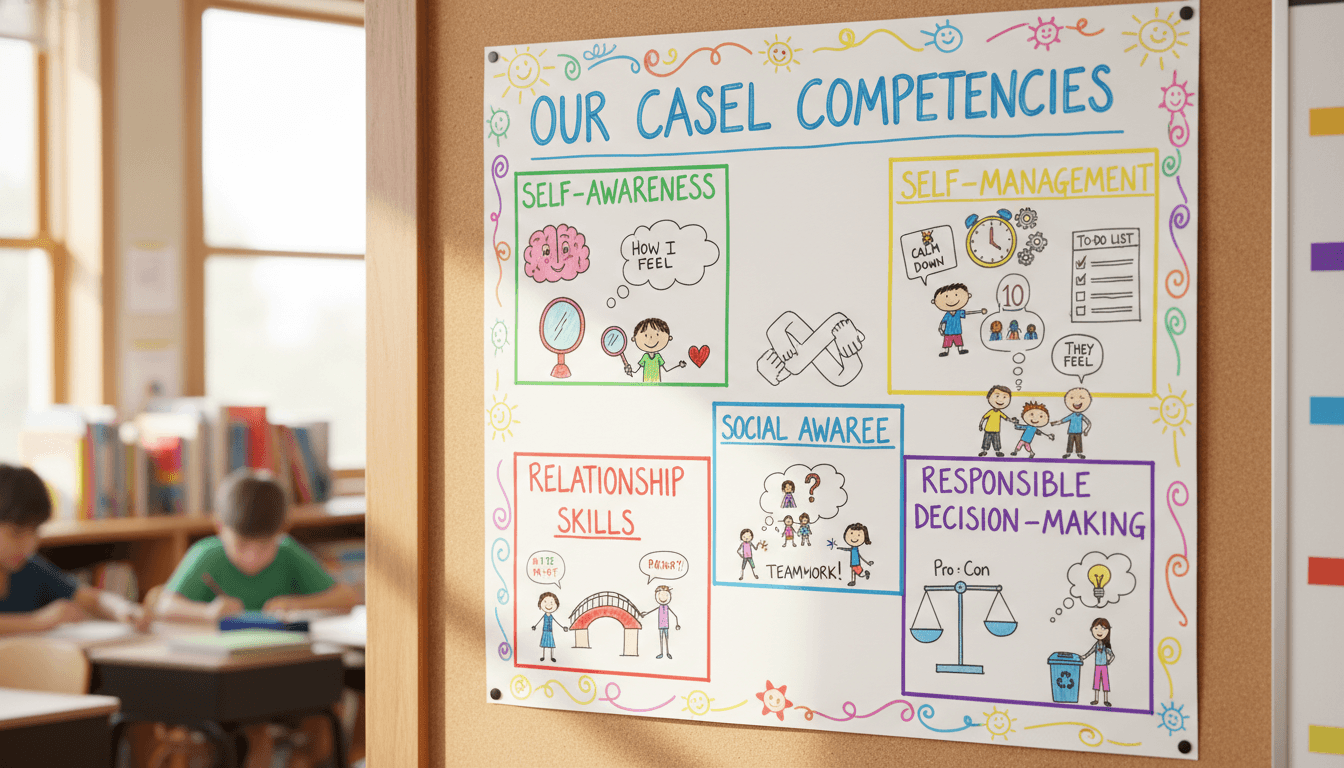
SEL Newsletter Explaining the CASEL Framework

Most parents have heard the term SEL. Many have heard the acronym CASEL. Far fewer can name what the five CASEL competencies actually are or how they show up in a Tuesday morning classroom. A single overview newsletter at the start of the year solves this. It gives families the map so the rest of your newsletters can describe specific stops without re-introducing the framework every time. This is the template.
Open with the headline parents understand
Skip the framework name in the first line. Start with the outcome. "By the end of this year, every student in our classroom should be better at five things: knowing what they feel, doing something about it, noticing what other people feel, working with other people, and making good choices when it is hard." That is the CASEL framework in 47 words. Parents get it immediately.
Self-awareness, with one example
Naming what you feel. "On Monday morning a third grader walked in, picked the word 'tired' off the feelings chart, and sat down. He did not need a hug. He needed to be left alone for ten minutes. He could only ask for that because he could name it." Self-awareness is the foundation. Without it, none of the other four work.
Self-management, with one example
Doing something about what you feel. "A fourth grader noticed she was getting frustrated with a math problem, took two deep breaths, asked for help, and went back to work. The whole cycle took two minutes." This is the competency parents most recognize from home life. It is also the one that tends to click last.
Social awareness, with one example
Noticing what other people feel. "At lunch a second grader saw a classmate sitting alone, walked over without being prompted, and sat down. She did not say much. She did not have to." Social awareness is harder to teach than the first two competencies because it requires looking outward. When you see it, name it out loud.
Relationship skills, with one example
Working with other people. "Three first graders were building a tower together. One of them said, 'Wait, let me finish this part first.' The other two waited. Then they kept building together. That is collaboration in first grade." Most of what parents call "playing nicely" is relationship skills in action.
Responsible decision-making, with one example
Choosing well in real situations. "A fifth grader saw a younger student pick up something that did not belong to them. Instead of telling on them, she walked over, said what she saw, and asked them to put it back. They did." Responsible decision-making is the competency that pulls in all the others. It is the last one to develop and the most important one to recognize when it shows up.
How they nest
You cannot manage a feeling you do not notice. You cannot respond to a friend's mood you cannot see. You cannot work with someone if you cannot notice them. You cannot decide well in a hard moment if you cannot do any of the first four. The CASEL framework is not a checklist. It is layers. Each one rests on the one before. Telling parents this once, clearly, changes how they read every newsletter that follows.
What to ask at home
One prompt per competency. Pick the one that fits your child this week. "What is one feeling you noticed today?" for self-awareness. "What did you do when you got frustrated?" for self-management. "Did you notice how anyone else was feeling today?" for social awareness. Parents do not need to ask all five every night. One a day is plenty.
What changes after parents have the map
Once families understand the five competencies in plain language, every newsletter that follows lands faster. You no longer have to re-introduce what self-management means. You can write "this week we are practicing self-management with the breathing strategy" and a parent who read the overview knows exactly what you are talking about. The overview newsletter is a one-time investment that pays back every issue for the rest of the year.
How to reference the framework after the intro
After the overview issue, mention the competency name once per newsletter and then describe the skill in plain language. "This week we focused on social awareness, which means noticing how someone else is feeling. Here is what that looked like in class." The framework name is the bookmark. The story is the content.
How Daystage helps with framework explainer newsletters
Daystage has a CASEL-introduction template with all five competencies preset and one example slot per competency. You add a real moment from your classroom for each one. Daystage formats the overview newsletter in plain parent-friendly language with a subject line that gets opened. The once-a-year explainer takes about twenty minutes instead of an evening at the dining room table.
Get one newsletter idea every week.
Free. For teachers. No spam.
Frequently asked questions
Do parents need to know what CASEL stands for?
No. They need to know the five competencies in plain language and what the classroom is doing about them. The acronym (Collaborative for Academic, Social, and Emotional Learning) can sit in a footer for the parents who want to search it. Lead with the skills, not the organization.
How do the five CASEL competencies relate to each other?
They nest, not stack. Self-awareness is the foundation (noticing what you feel). Self-management builds on it (doing something about what you feel). Social awareness extends outward (noticing what others feel). Relationship skills apply it (working with people). Responsible decision-making is the result (choosing well in real situations).
Is it worth introducing all five in one newsletter?
Yes, once, at the start of the year or unit. Then drop back to one competency per newsletter for the rest of the year. The overview issue gives parents the map. The rest of the year gives them the specific stops on it.
What if your district uses a different framework name?
Mention your district language once and bridge to the CASEL terms parents are most likely to encounter outside of school. 'Our district calls these social-emotional competencies. You may also hear them called the five CASEL competencies. The skills are the same.' Then move on.
Can Daystage produce a CASEL-framework explainer newsletter?
Daystage has a framework-introduction template with all five CASEL competencies preset in plain language, with example slots for each. You type one classroom moment per competency. Daystage drafts the full overview newsletter in under fifteen minutes.

Adi Ackerman
Author
Adi Ackerman is a former classroom teacher and curriculum writer with 8 years in K-8 schools. She writes about school communication, parent engagement, and what actually works in real classrooms.
More for Social-Emotional Learning
Ready to send your first newsletter?
3 newsletters free. No credit card. First one ready in under 5 minutes.
Get started free