
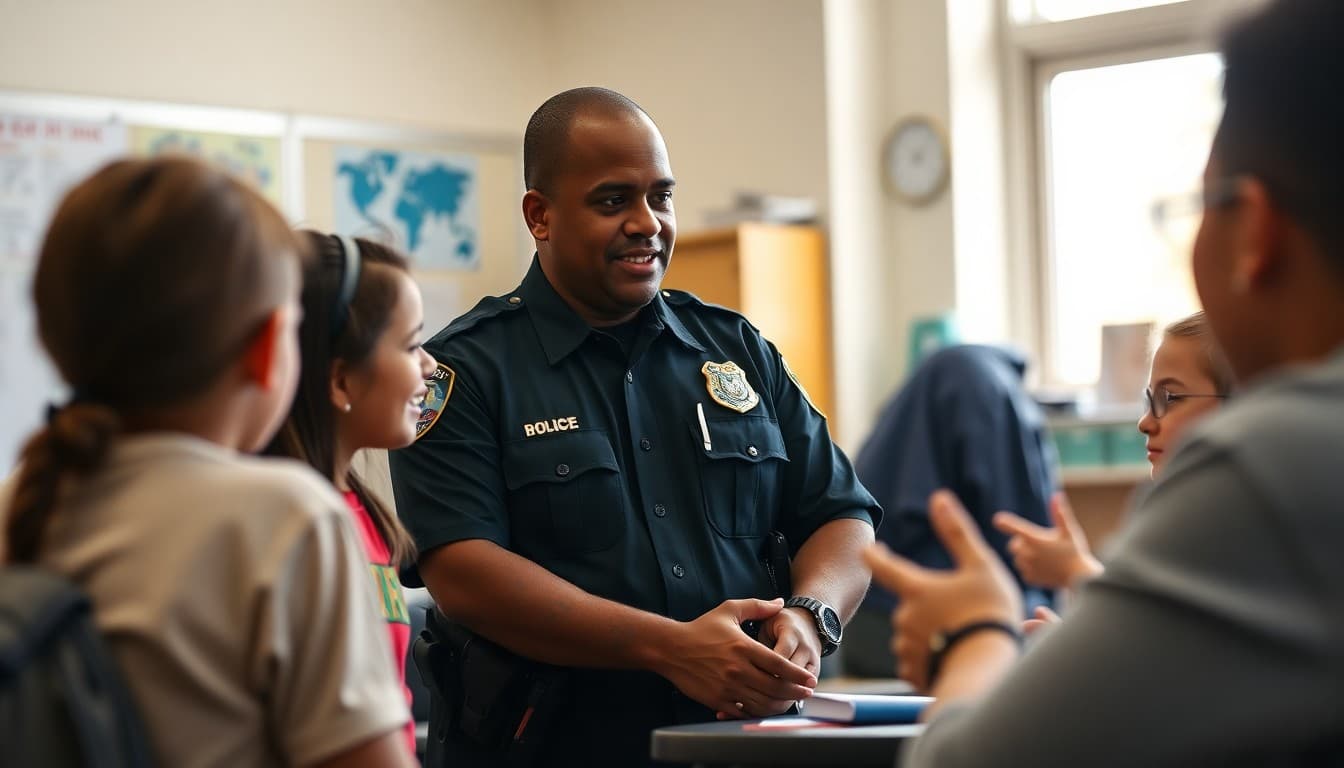
School Resource Officer Newsletter: Building Community Trust
Many families have complicated feelings about police in schools. The most effective way to address that is direct, transparent communication about who your SRO is, what they do, and how they approach their role on campus. A well-written introduction newsletter shifts the dynamic before it becomes defined by a specific incident.
Introduce Your SRO as a Person, Not Just a Title
Open the newsletter with a genuine introduction. Include the officer's name, the agency they're assigned from, how long they've been in law enforcement, and what brought them to school work. If they coach a sport, have children in the district, or grew up in the community, share that. "Officer Ramirez has been with the county sheriff's department for 11 years. He has two kids at Lincoln Elementary and coached youth soccer for four years. He chose school resource work because he believes in early relationship building." That's an introduction that humanizes. A badge number and title is not.
Define the SRO's Role Clearly
Families often don't know whether the SRO is primarily a disciplinary figure, an emergency responder, or a community presence. Define the role specifically. Your SRO is on campus to maintain physical safety, build relationships with students and staff, serve as a law enforcement resource for students who have questions about legal rights or community issues, coordinate with local agencies during emergencies, and provide mentorship and presence that makes students feel both safe and supported. Discipline referrals are handled through the school's administration, not the SRO, unless a behavior rises to the level of a criminal matter.
Explain What the SRO Does on a Typical Day
Help families visualize the role in practice. On a typical day, the SRO arrives before school to be visible during student arrival, makes rounds through hallways and common areas throughout the day, is available in their office for students who want to stop by, attends student events such as lunch periods and extracurricular activities when possible, and coordinates with the principal on any campus safety concerns. This description replaces the image of a uniformed officer sitting in a back room with a more accurate picture of an active community member.
Address How the SRO Works with the School's Discipline System
Families with concerns about school-to-prison pipeline issues need to understand how discipline is handled at your school. Be specific. The school's administration handles behavioral infractions under the student code of conduct. The SRO becomes involved when a behavior may constitute a criminal offense. Schools that have formalized diversion agreements, restorative justice programs, or memoranda of understanding with their law enforcement agency should describe those agreements. Transparency about when the SRO does and does not become involved in student discipline builds trust with families who are skeptical of police involvement in schools.
Use a Template Section for Student Contact Information
Here is a format you can include:
"Students can speak with Officer [Name] by: stopping by their office in [location] any school day between [hours], asking a teacher or counselor to make an introduction, or calling the main office at [number] to request a meeting. For emergencies, call 911 first. For non-emergency tips or concerns, use the school's anonymous tip line at [link or number]. Officer [Name]'s direct contact for families is [email or phone]."
Share Specific SRO Initiatives or Programs This Year
If your SRO runs any programs, name them. Law enforcement education class sessions, mentorship lunch groups for at-risk students, participation in student orientation, involvement in athletic programs, or coordination with community partners. Specific programs show that the SRO's role is actively positive, not merely reactive. A family who knows the SRO runs a weekly chess club has a very different perception than a family who has never heard anything about the officer except that they're "assigned to campus."
Acknowledge the Context Honestly
Families who have had negative experiences with law enforcement deserve acknowledgment, not dismissal. A single sentence can do this: "We know that families come to this relationship with different experiences and perspectives, and we take that seriously. If you have concerns about the SRO program or how it is implemented at our school, we welcome that conversation directly." That doesn't require defensiveness or lengthy justification. It just demonstrates that the school is listening.
Invite Families to Meet the SRO in Person
Close with an invitation for families to meet the officer at a school event, an open-door coffee hour, or during regular school visits. Name a specific event if possible. "Officer [Name] will be at our Back to School Family Night on October 15 from 5 to 7 PM and looks forward to meeting families." Personal contact removes the abstract and builds the individual relationship that makes community trust possible.
Get one newsletter idea every week.
Free. For teachers. No spam.
Frequently asked questions
What does a school resource officer do?
A school resource officer is a sworn law enforcement officer assigned to a school on a regular basis. Their primary responsibilities include ensuring campus safety, building relationships with students and staff, providing law enforcement education, serving as a resource for students dealing with legal questions or concerns, and coordinating with local law enforcement during emergencies. SROs are not primarily disciplinary figures. Their role is community-building as much as enforcement.
How is an SRO different from a school security guard?
A school resource officer is a sworn police officer with full law enforcement authority, typically assigned from the local police or sheriff's department. A security guard is typically a private employee without law enforcement powers, responsible for monitoring campus access and responding to internal security issues. Both roles contribute to campus safety but in different ways. Some schools have both; others have one or the other.
What should a student do if they want to talk to the SRO about something?
Most SROs have an open-door policy and welcome students stopping by to talk, whether about a safety concern, a legal question, or simply to connect. Students can also ask their teacher or counselor to facilitate a conversation with the SRO. For non-emergency concerns, the SRO can be reached through the school's main office. For emergencies, call 911 first.
How do SROs handle incidents involving students?
SROs follow both school district policy and law enforcement protocol. Minor incidents are often handled at the school level without formal law enforcement action. More serious incidents may result in formal charges, a referral to a diversion program, or coordination with the district attorney. The SRO uses judgment to determine which response is appropriate. Families who understand this graduated approach feel more confident about the SRO's role.
Can Daystage help schools introduce a new SRO to families at the start of the year?
Yes. An SRO introduction newsletter sent through Daystage at the start of the school year is one of the most effective ways to build early trust between the officer, families, and students. Including a photo, a brief personal introduction, and contact information makes the SRO a recognizable community member rather than an unfamiliar authority figure on campus.

Adi Ackerman
Author
Adi Ackerman is a former classroom teacher and curriculum writer with 8 years in K-8 schools. She writes about school communication, parent engagement, and what actually works in real classrooms.
More for School Safety
Ready to send your first newsletter?
3 newsletters free. No credit card. First one ready in under 5 minutes.
Get started free