
Library Newsletter Explaining the ISTE Standards
Parents see kids on screens and worry. The ISTE standards are the framework that turns screen time into curriculum, and the school librarian is one of the people in the building who actually teaches to them. A short parent-facing explainer once a year makes the case that the library does serious digital teaching, not just book checkout.
What ISTE actually is
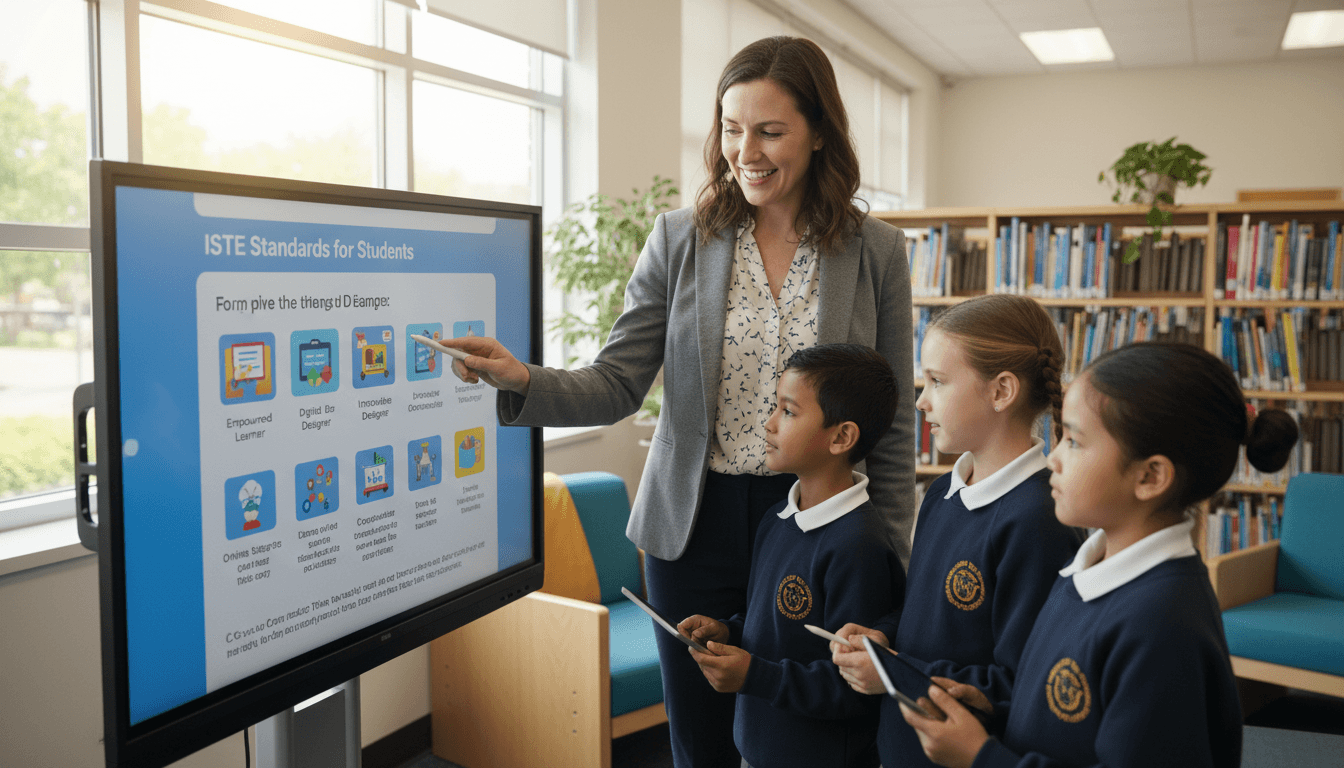
ISTE stands for the International Society for Technology in Education. Their student standards are the most widely used framework in U.S. schools for teaching kids how to use technology well. There are seven student standards. Library lessons hit most of them across the year.
Section 1: Empowered Learner
Plain words: kids set their own learning goals and use tech to reach them. Library example: "Fourth graders set a one-month independent reading goal in our library tracker, picked their own books, and logged minutes. The tool sent them a small confetti animation when they hit the goal. Tiny thing, big motivation."
Section 2: Digital Citizen
Plain words: kids learn to be safe, kind, and ethical online. Library example: "Third graders did a four-week unit on what counts as a real source online. They learned about clickbait, about why ads look like articles, and about why .gov sources are not always the final word. They also learned what to do if someone is unkind in a comment section, which came up because it always comes up."
Section 3: Knowledge Constructor
Plain words: kids find, evaluate, and build their own understanding from multiple sources. Library example: "Fifth graders ran a two-week research project on a person of their choice. They used at least three sources, evaluated each one with a rubric they helped write, and built a slide deck that cited every claim back to a source."
Section 4: Innovative Designer
Plain words: kids design solutions to real problems using technology. Library example: "Sixth graders in the makerspace designed and 3D-printed a solution to a real problem they identified in the school. One pair printed a small clip that keeps the morning announcement sign from falling off the front desk. It is still there."
Section 5: Computational Thinker
Plain words: kids learn to break problems down, see patterns, and use logic. Library example: "Second graders did a four-week unit with Bee-Bots, programming a robot to move through a story map. By the end, they could break down a four-step path into individual commands and predict where the bot would land before they pressed go."
Section 6: Creative Communicator
Plain words: kids learn to express ideas across different media. Library example: "Fourth graders made 90-second book trailers using Adobe Express. They wrote a hook, chose music, picked images that did not violate copyright, and added text overlays. The trailers played on the library screen for a month, and checkouts of those books jumped."
Section 7: Global Collaborator
Plain words: kids learn to work with people beyond their own classroom. Library example: "Third graders did a virtual pen-pal project with a partner classroom in another state. They wrote emails, made one shared slide deck, and met on Zoom three times across the year. Their final question was about the weather. They had not realized it could snow in May."
Section 8: why librarians teach to ISTE
Close with one paragraph that ties it together. The librarian is often the one teacher in the building who works with every grade on technology in a structured way. ISTE is the framework that keeps the work coherent across grades. Without it, library tech lessons would be one-off activities. With it, they are a curriculum that builds from kindergarten through eighth grade.
How Daystage helps with library ISTE explainer newsletters
Daystage lets you build the ISTE explainer template once with one section per standard and an example slot for each. You refresh the examples each year as your library lessons evolve and send the newsletter to the family list. Parents save it and reference it, which is rare for any school newsletter.
Get one newsletter idea every week.
Free. For teachers. No spam.
Frequently asked questions
What are the ISTE standards in plain language?
The ISTE student standards are the framework most school librarians and tech teachers use to teach kids how to use technology well. There are seven of them: Empowered Learner, Digital Citizen, Knowledge Constructor, Innovative Designer, Computational Thinker, Creative Communicator, and Global Collaborator. Library lessons map to almost all seven across the year.
Why send a parent newsletter about a tech standards framework?
Because parents see kids on screens and assume the screen time is mostly social media or games. They do not know the librarian teaches research, digital citizenship, and source evaluation as a real curriculum. An ISTE explainer shows them the structure behind the screen time. It also gives them language for the parent-teacher conference.
Which ISTE standard matters most for elementary parents to understand?
Digital Citizen, by a wide margin. It covers privacy, kindness online, evaluating information, and respecting others' work. Parents have direct questions about it every conference season. Lead the newsletter with that one and use the others to round out the picture. Empowered Learner and Knowledge Constructor are the next two most parent-relevant.
How do library lessons actually map to ISTE?
Source evaluation maps to Digital Citizen and Knowledge Constructor. Research projects map to Empowered Learner and Knowledge Constructor. Coding and makerspace work maps to Computational Thinker and Innovative Designer. Book trailer projects map to Creative Communicator. Virtual author visits and pen-pal projects map to Global Collaborator. Almost every library lesson hits at least one ISTE standard.
What tool makes an ISTE explainer newsletter easy to produce?
Daystage lets you build an ISTE explainer template with one section per standard and an example slot for each. You write it once and refresh the examples each year as your library lessons evolve. Parents read it, save it, and pull it up when their kid talks about something they did in library class.

Adi Ackerman
Author
Adi Ackerman is a former classroom teacher and curriculum writer with 8 years in K-8 schools. She writes about school communication, parent engagement, and what actually works in real classrooms.
More for School Librarian
Ready to send your first newsletter?
3 newsletters free. No credit card. First one ready in under 5 minutes.
Get started free