
Library Newsletter Explaining Information Literacy Frameworks
When a kid brings home a research project, most families do not know how to help. They jump to Google, panic about citations, and end up doing the work themselves. Information literacy frameworks are the tool that fixes this, and a one-time explainer newsletter to families pays back for years.
The two frameworks worth explaining
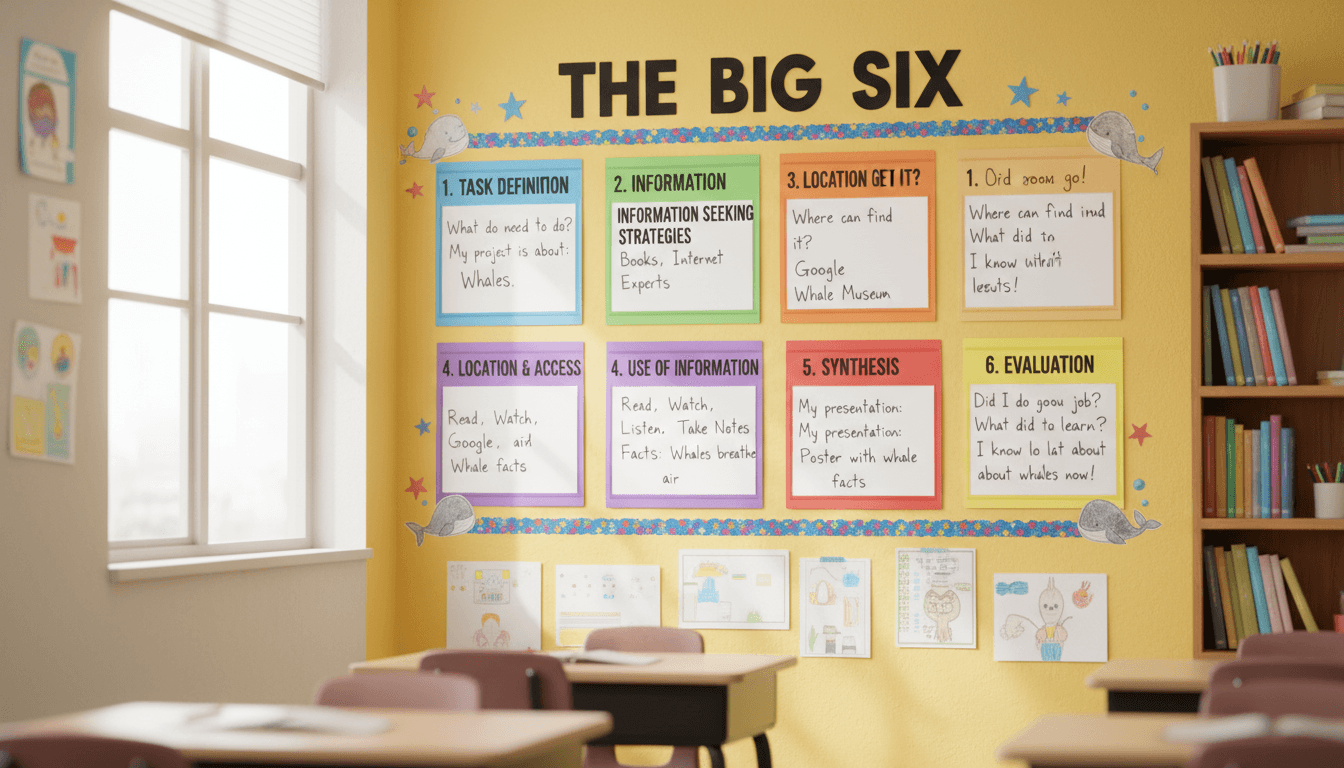
Most U.S. school librarians teach to one of two frameworks: Big6 for grades 3 and up, and Super3 for K-3. They are the same idea scaled to grade level. Big6 has six steps. Super3 collapses them into three. Together they cover every research project from kindergarten through middle school.
Super3 for K-3 families
Three words, three steps. Plan, Do, Review.
Plan: pick the topic, write down one question. Do: find the information and make something to share. Review: did it answer the question? A first grader picking the axolotl, drawing what they learned, and telling a partner one new fact has just completed Plan/Do/Review. Parents who use the three words at home back up what the librarian teaches in class.
Big6 step 1: Task Definition
Plain words: figure out exactly what you are trying to find out. Most research goes sideways here. Example: "A fourth grader was assigned a 'report on a state'. Step 1 turned that into 'What were the three biggest industries in Oregon in 1900, and how did they change by 2000?' Now the rest of the project has a target."
Big6 step 2: Information Seeking Strategies
Plain words: plan where you will look before you start looking. Example: "For the Oregon question, the student listed three sources before opening a browser: the school library database World Book Online, the Oregon Historical Society site, and one book from the library. Five minutes of planning saved an hour of random clicking."
Big6 step 3: Location and Access
Plain words: actually find the sources. Example: "The student searched World Book Online with 'Oregon industries 1900', clicked through to the Oregon Historical Society's economy page, and checked out one book on Pacific Northwest history from the school library. Three sources, twenty minutes."
Big6 step 4: Use of Information
Plain words: read or watch the source and take notes that answer the question. Example: "The student kept a two-column notes page: left column for the fact, right column for the source. Every fact had to have a source next to it. Citations at the end of the project took five minutes instead of two hours."
Big6 step 5: Synthesis
Plain words: put it all together into the final product. Example: "The Oregon report came together as a one-page infographic with three industry sections, each with a 1900 fact and a 2000 fact, and a small map showing where each industry was concentrated."
Big6 step 6: Evaluation
Plain words: did it answer the question, and what would you do differently. Example: "The student reviewed against the original question and realized one industry section was thin. They added a fourth source and rewrote that section. The teacher graded the final, but the student had already self-graded the draft."
The one parent move that helps the most
Spend ten minutes on step 1 before anything else. Ask the kid: "What exactly are you trying to find out?" Help them write one sharp question. After that, get out of the way. The frameworks do the rest of the work. Most research projects that go badly at home went bad because nobody slowed down at step 1.
How Daystage helps with information literacy explainer newsletters
Daystage lets you build the framework explainer template with one section per Big6 step and a Super3 sidebar for K-3 families. You write it once and refresh the examples each year. Parents save it and reference it when their kid hits the next research project, which is the whole point of sending it in the first place.
Get one newsletter idea every week.
Free. For teachers. No spam.
Frequently asked questions
What is the Big6 framework in plain language?
The Big6 is the most widely used information literacy framework in U.S. schools. It breaks research into six steps: define the task, plan how to find information, locate the information, use the information, put it together, and evaluate the result. Librarians teach the same six steps from grade 3 through high school. Parents who understand the steps can support research at home without doing it for the kid.
What is the Super3 framework and how is it different?
Super3 is the K-3 version of the Big6. It collapses the six steps into three that work for younger kids: Plan, Do, Review. A first grader picking an animal to research, drawing what they learned, and telling a partner one new fact has just completed Plan/Do/Review. Super3 in K-3 builds the habit. Big6 in grade 3 and up adds the rigor.
Why explain a research framework to parents at all?
Because the most common parent question at the third grade research project is 'how do I help my kid without doing it for them'. The Big6 answers that exact question. Each step has a specific parent move that supports without taking over. A short newsletter that walks through the six steps gives parents the tool they have been asking for.
Which step do families most often skip at home?
Step 1, define the task. Kids come home with a vague assignment, parents jump straight to googling, and the research drifts. Spending ten minutes on step 1, helping the kid figure out exactly what question they are trying to answer, makes every other step faster. Most failed research projects fail at step 1.
What tool keeps the information literacy explainer easy to send each year?
Daystage lets you build the framework explainer template with one section per Big6 step, a Super3 sidebar for K-3 families, and an example slot for each. You write it once and refresh the examples each year. Parents reference it for years after, especially when their kid moves from one grade to the next.

Adi Ackerman
Author
Adi Ackerman is a former classroom teacher and curriculum writer with 8 years in K-8 schools. She writes about school communication, parent engagement, and what actually works in real classrooms.
More for School Librarian
Ready to send your first newsletter?
3 newsletters free. No credit card. First one ready in under 5 minutes.
Get started free