
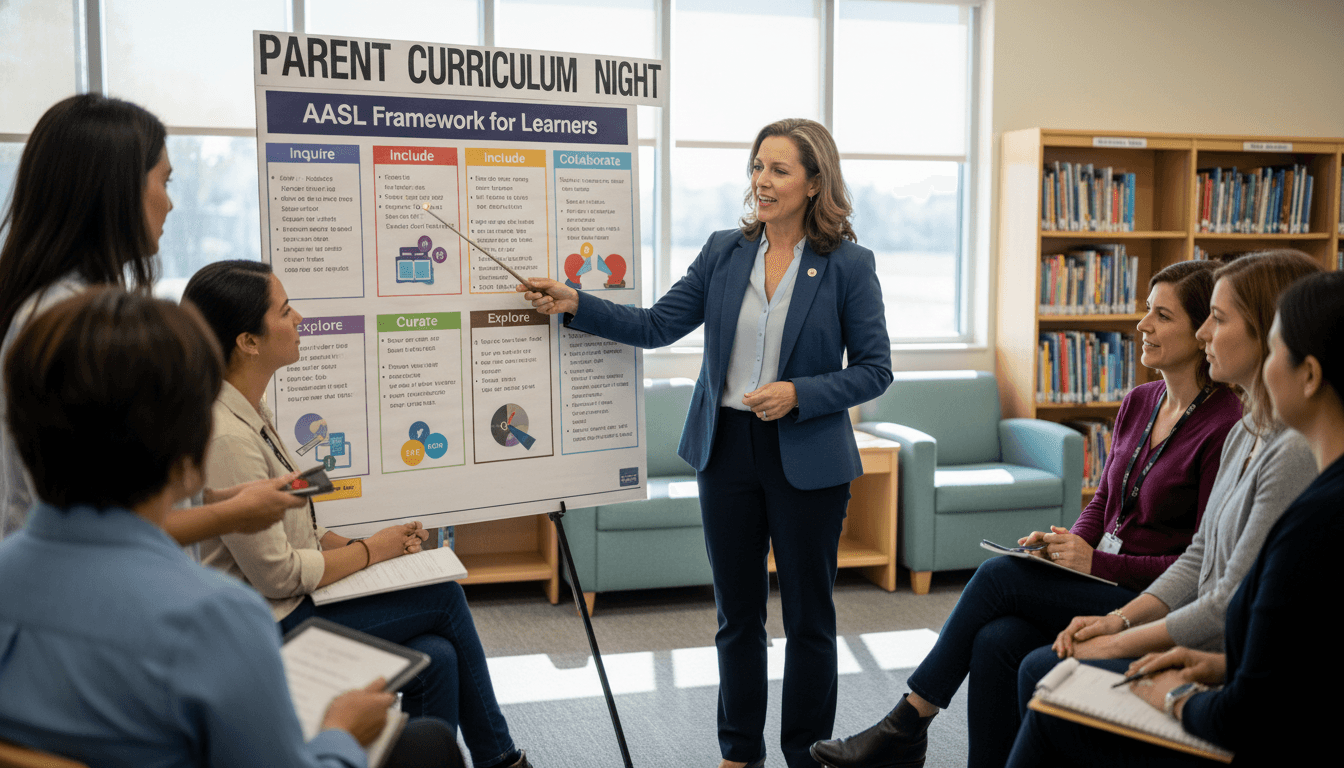
Library Newsletter Explaining the AASL Framework

Most parents do not know the school librarian teaches a curriculum. They know books get checked out and reading happens. The AASL framework is the missing piece, the part that turns the library from a collection into a program. A short explainer newsletter once a year does more for parent understanding of the library than twelve monthly book picks ever will.
What the AASL framework actually is
AASL stands for the American Association of School Librarians. Their National School Library Standards are the curriculum framework that school librarians follow, the same way math teachers follow Common Core. The framework is built around six shared foundations and four domains of learning. The six foundations are the easier place to start with parents.
Section 1: a one-paragraph opener
Tell parents why you are sending this. Example: "Most families do not know the librarian teaches a curriculum. We do, and the framework we teach to is the AASL National School Library Standards. Here are the six big ideas, with a real example of how each one shows up in your kid's library lessons this year."
Section 2: Inquire
Plain words: kids learn to ask good questions and look for answers. Example: "In our third grade animal habitat unit, students did not get a list of approved animals. They picked one they were curious about, wrote their own three research questions, and built a poster to answer them. One student picked the axolotl. Nobody had heard of it. By the end of the unit, half the grade had."
Section 3: Include
Plain words: kids learn that other perspectives exist and matter. Example: "In our fifth grade biography unit, students each chose a person whose story they did not know. We do not require diverse picks, but we make sure the collection has them. This year, choices included Bayard Rustin, Sylvia Mendez, and Temple Grandin."
Section 4: Collaborate
Plain words: kids learn to work with each other and with experts. Example: "Sixth graders worked in pairs on a source-evaluation project. They had to agree on which two sources were trustworthy and defend their reasoning to a third pair. We also brought in a local journalist on Zoom to talk about how she checks her own sources."
Section 5: Curate
Plain words: kids learn to gather, evaluate, and choose the right information. Example: "Fourth graders learned how to evaluate a website using a four-question checklist. By the end of the unit, they could tell you why .gov beats a random Wix site for medical information, and they could tell you when a .gov source is also biased."
Section 6: Explore
Plain words: kids learn to follow their own curiosity beyond the assignment. Example: "In every grade, we keep a 'follow-up shelf' with books connected to recent units. After the third grade habitat unit, the shelf filled with animal nonfiction. Five students checked out three or more books from it that they were not assigned."
Section 7: Engage
Plain words: kids learn to contribute their own work, ideas, and questions to a community. Example: "Every fifth grader writes one book review this year that gets posted in the library on the review wall. Younger students read those reviews and decide what to check out. That is the contribution loop, and it is built into how the library runs."
Section 8: why librarians teach beyond books
Close with one paragraph that names the bigger point. The framework is why the librarian is in the building. Reading is the entry point. Research, source evaluation, collaboration, and curation are the teaching. Books are the medium. The library is the classroom.
How Daystage helps with library framework explainer newsletters
Daystage lets you build a once-a-year framework explainer template with a section per shared foundation and an example slot for each. You write it once at the start of the year and refresh the examples each quarter as new units run. The email lands clean on every device, which matters because parents will actually read this one on their phone at the bus stop.
Get one newsletter idea every week.
Free. For teachers. No spam.
Frequently asked questions
What is the AASL framework in plain language?
The AASL National School Library Standards are the curriculum framework that school librarians use, just like math teachers use Common Core or science teachers use NGSS. It is built around six shared foundations (Inquire, Include, Collaborate, Curate, Explore, Engage) and four domains of learning (Think, Create, Share, Grow). It is what makes the library a teaching program, not just a collection.
Why would parents care about a curriculum framework?
Because most parents do not know librarians teach. They picture book checkout and reading nooks. A short newsletter that names the framework and shows a concrete example does more for parent perception of the library program than any one-off success story. It changes the answer to 'what does the librarian actually teach' from a shrug to a sentence.
Which parts of the AASL framework matter most to highlight for parents?
The six shared foundations, with one concrete example for each. Skip the four domains in a parent newsletter (Think/Create/Share/Grow); they overlap and confuse on a first read. The six foundations map cleanly to recognizable activities: asking questions, including different perspectives, working together, evaluating sources, exploring widely, and contributing.
How concrete should the examples be?
Very. 'Inquire' as a word means nothing to a parent. 'In November, third graders chose their own animal habitat research topic, generated their own questions, and built a one-page poster to answer them' means everything. Always pair the framework word with a real classroom example. Without the example, the framework reads as jargon.
What tool makes an explainer newsletter look professional without taking a day to design?
Daystage lets you build a framework explainer template with one section per shared foundation, an example slot, and a closing paragraph. You write it once for the school year and refresh the examples each quarter as new units run. Parents who read it once start asking better questions at conferences.

Adi Ackerman
Author
Adi Ackerman is a former classroom teacher and curriculum writer with 8 years in K-8 schools. She writes about school communication, parent engagement, and what actually works in real classrooms.
More for School Librarian
Ready to send your first newsletter?
3 newsletters free. No credit card. First one ready in under 5 minutes.
Get started free